Super-Rapid Protein Quantification Kit (BCA Assay): 5-Minute Quantification for High-Throughput Labs
When Protein Quantification Becomes the Bottleneck
In high-throughput labs—drug discovery screens, CRISPR library workflows, large-cohort biomarker studies—protein quantification isn't the experiment; it's the gatekeeper. Every hour spent waiting for a BCA assay to incubate at 37°C is an hour not spent generating data. Traditional BCA protocols require 30–60 minutes of incubation. That's 30–60 minutes of instrument time, bench time, and workflow latency, multiplied across hundreds of samples per week.
Abbkine's Super-Rapid Protein Quantification Kit (BCA Assay, KTD3010-EN) collapses that bottleneck to 5 minutes at room temperature.
High-Throughput Screening & Drug Discovery
In pharmaceutical screening, protein quantification must keep pace with automated liquid handlers and multi-plate workflows. The 5-minute incubation at room temperature integrates seamlessly with robotic platforms and plate-reader pipelines, enabling:
- Rapid normalization of cell lysates before compound treatment
- High-throughput target engagement assays requiring precise protein input
- Automated QC of recombinant protein batches
Cancer Biology & Translational Research
Large-cohort studies—tumor banks, patient-derived xenografts, organoid libraries—demand rapid, reproducible quantification across hundreds of samples. The super-rapid BCA kit's 1–2,000 µg/mL detection range accommodates the full spectrum from dilute organoid supernatants to concentrated tissue lysates[reference:39], while the 5-minute protocol keeps sample processing aligned with downstream Western blot or IP workflows.
The kit has been cited in research on NADH-reductive stress induced by dihydrolipoamide dehydrogenase activation contributing to cuproptosis, where protein concentration was determined using the super-rapid BCA kit (Abbkine, KTD3010) on a Tecan Infinite F50 microplate reader[reference:40]—demonstrating its compatibility with standard high-throughput instrumentation.
Neuroscience & Sample-Limited Research
When sample is scarce—rare CSF aliquots, microdissected brain regions, single-cell lysates—the 1–20 µL sample volume requirement[reference:41] preserves precious material while still delivering a quantifiable signal. The detection limit of 1 µg/mL[reference:42] ensures that even low-abundance samples yield reliable concentration data.
Microbiology & Fermentation Monitoring
Fermentation broths, bacterial lysates, and secreted protein supernatants require frequent quantification to track growth and expression. The 5-minute protocol enables real-time monitoring without halting the fermentation workflow.
How It Works
The protocol is deliberately simple:
- Preheat the microplate reader to 480 nm (30+ minutes warm-up)[reference:43]
- Prepare standards: dilute BSA Standard (10 mg/mL) to 2 mg/mL with PBS[reference:44]
- Add 20 µL standard or sample to a 96-well plate
- Add 200 µL Working Solution, mix well[reference:45]
- Incubate at room temperature for 5 minutes[reference:46]
- Read absorbance at 480 nm
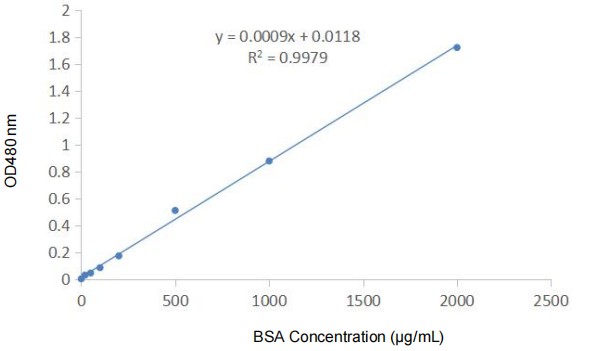
The linear working range spans 1–2,000 µg/mL, with a detection limit as low as 1 µg/mL[reference:47].
📊 Your Research Area?
High-Throughput Screening | Cancer Biology | Neuroscience | Microbiology | Drug Discovery
👉 Quantify protein in 5 minutes, not 60. View Product