SDS-PAGE Protein Sample Loading Buffer (5X): Why the Odor-Free Reducing Agent Replaces DTT and β-Mercaptoethanol
The Rotten-Egg Problem Every Lab Knows
If you've ever opened a tube of β-mercaptoethanol (2-ME) or weighed out DTT, you know the smell. β-Mercaptoethanol has a pungent, persistent odor that lingers on gloves, in the fume hood, and in the lab for hours. DTT is less volatile but still requires careful handling and fresh preparation. Both are the traditional reducing agents in SDS-PAGE loading buffers—and both come with stability and safety trade-offs.
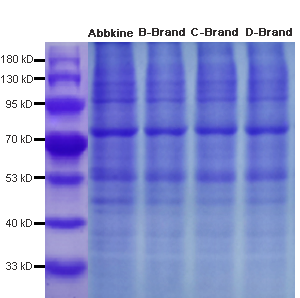
Abbkine's SDS-PAGE Protein Sample Loading Buffer (5X, KTD3003) solves this problem with a reformulated reducing agent that offers better stability, better reduction efficiency, and no unpleasant odor—replacing traditional DTT or 2-ME entirely[reference:28].
Why Abbkine KTD3003 Outperforms Traditional Laemmli Buffer
| Feature | Abbkine KTD3003 | Traditional Laemmli (with 2-ME/DTT) |
|---|---|---|
| Reducing Agent | Novel, odor-free, stable[reference:29] | β-Mercaptoethanol (pungent) or DTT (less stable) |
| Odor | None[reference:30] | Strong, persistent rotten-egg smell |
| Stability | Better stability of the reducing agent[reference:31] | 2-ME oxidizes rapidly; DTT requires fresh preparation |
| Reduction Efficiency | Better reduction effect[reference:32] | Variable; declines with storage |
| Format | 5× concentrated, ready-to-use[reference:33] | Often requires in-house mixing |
| pH | ~250 mM Tris-HCl, pH 6.8—optimal for SDS-protein binding and sample stability[reference:34] | Same target pH, but less consistent |
| Tracking Dye | Bromophenol blue[reference:35] | Bromophenol blue |
The Chemistry Behind the Improvement
The loading buffer is built around ~250 mM Tris-HCl at pH 6.8, which anchors the buffer at the optimal weak-acid pH for SDS–protein binding and sample stability before the run[reference:36]. The proprietary reducing agent cleaves disulfide bonds as effectively as—or more effectively than—traditional agents, but without the volatility and odor of β-mercaptoethanol[reference:37].
The 5× concentration allows flexible dilution according to sample volume, and the bromophenol blue tracking dye provides clear visualization of the dye front during electrophoresis[reference:38].
Validated for Real-World Western Blotting
This loading buffer is designed for routine reducing SDS-PAGE—the standard format for Western blotting, Coomassie staining, and downstream immunodetection. The improved reducing agent stability means the buffer remains effective over its shelf life, eliminating the "is my 2-ME still active?" uncertainty that plagues traditional Laemmli buffers.
Critical Handling Notes
- Ready-to-use — dilute 5× concentrate according to your sample volume
- Store according to the manufacturer's instructions to preserve reducing agent activity
- For reducing SDS-PAGE only — not intended for non-reducing conditions
The Bottom Line
For researchers who want to eliminate the odor of β-mercaptoethanol, the instability of DTT, and the uncertainty of in-house buffer preparation, KTD3003 delivers a stable, odor-free, ready-to-use 5× loading buffer that makes sample preparation faster and more pleasant—without compromising reduction efficiency.
👉 Kill the rotten-egg smell. View Product