Actin Polyclonal Antibody (ABP0056): The Loading Control That Survives the Jump from WB to IHC-P
The Most-Used Antibody in Biology Is Also the Most Often Chosen on Autopilot
Actin is the undisputed gold-standard loading control for nearly all molecular biology immunoassays—and for good reason. It is one of the most evolutionarily conserved and ubiquitously expressed cytoskeletal proteins in eukaryotic cells, serving as a structural anchor for cell shape, motility, and cytokinesis[reference:35].
But the reliability of Actin detection is non-negotiable, and many commercial Actin antibodies suffer from critical limitations: narrow species reactivity, cross-reactivity with other cytoskeletal proteins, poor performance across diverse assay formats, or weak signal for endogenous Actin[reference:36].
The problem is not that actin moves. The problem is that not every anti-actin reagent is built to survive the jump from a 1:500 Western blot to paraffin IHC-P without falling apart[reference:37].
C-Terminal Epitope Design: Conserved Across Isoforms, Divergent from Other Cytoskeletal Proteins
Abbkine's Actin Polyclonal Antibody (ABP0056) is generated using a synthetic peptide derived from the C-terminal region of human Actin (amino acid range 300–380) —a sequence that is highly conserved across the major cytoplasmic Actin isoforms (beta-actin and gamma-actin) and exhibits minimal homology with non-Actin cytoskeletal proteins such as tubulin and vimentin[reference:38][reference:39].
The antibody is further refined via affinity chromatography using the epitope-specific immunogen, depleting non-specific immunoglobulins from rabbit antiserum and enriching for high-affinity Actin-binding antibodies[reference:40].
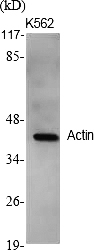
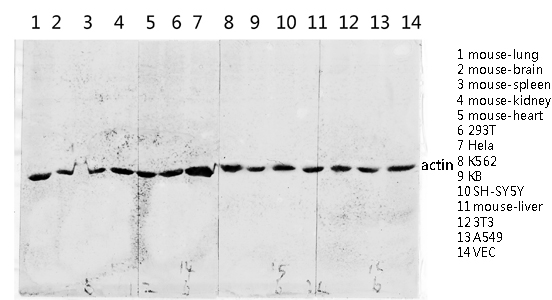
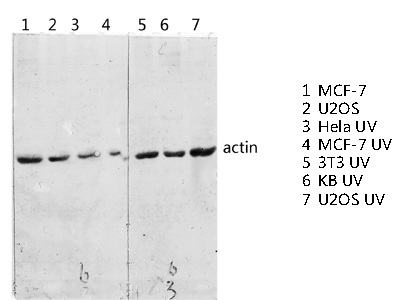
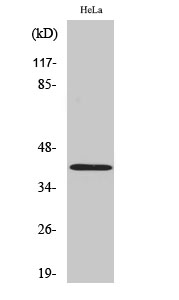
This dual optimization ensures ABP0056 exclusively detects endogenous Actin at its expected molecular weight of 45 kDa, with no observable off-target bands or background signal in complex cell lysates or tissue sections[reference:41].
Broad Cross-Species Reactivity: Human, Mouse, Rat—and Fish
| Parameter | ABP0056 |
|---|---|
| Target | Actin / β-Actin (ACTB) |
| Host / Isotype | Rabbit · IgG · Polyclonal |
| Reactivity | Human, Mouse, Rat, Fish |
| Immunogen | C-terminal region, human Actin (aa 300–380) |
| Observed Molecular Weight | 45 kDa |
| Concentration | 1 mg/mL |
| Validated Applications | WB, IHC-P, IF, ELISA |
| Price (100 μL, 1 mg/mL) | $229 |
The inclusion of fish reactivity is a differentiating feature: developmental biologists investigating cytoskeletal dynamics in zebrafish can use the same reagent that serves their mammalian experiments, eliminating the need to source and validate species-specific Actin antibodies[reference:42].
Validated Dilutions Across Four Applications
| Application | Suggested Dilution |
|---|---|
| Western Blot | 1:500–1:2000 |
| IHC-P | 1:100–1:300 |
| Immunofluorescence | 1:50–1:200 |
| ELISA | 1:10,000 |
Head-to-Head: Actin Antibody Comparison
| Feature | ABP0056 | Generic Actin Antibodies |
|---|---|---|
| Epitope | C-terminal (aa 300–380) | Often N-terminal (variable) or conserved motifs shared with tubulin/vimentin |
| Cross-Reactivity | Minimal (C-terminal divergence) | Variable |
| Species Reactivity | Human, Mouse, Rat, Fish | Often limited to 2–3 species |
| Applications | WB, IHC-P, IF, ELISA | Often WB only |
| Affinity Purification | Epitope-specific | Variable |
The Bottom Line
For core facilities and publication-focused labs that need a single Actin reagent to work across Western blots, paraffin-embedded IHC, immunofluorescence, and ELISA—without re-validating a new antibody for each format—ABP0056 delivers the epitope-informed specificity and cross-species breadth that makes a loading control something you can actually trust.
📎 Reference: Actin Polyclonal Antibody (ABP0056)