Protein Quantification Kit (BCA Assay): Why the 20–2,000 µg/mL Range Makes It the Workhorse of Protein Analysis
BCA: The Gold Standard for Protein Quantification
Protein quantification is the invisible foundation of every downstream experiment—Western blot, IP, enzyme assay, mass spec. Get the concentration wrong, and every normalization, every loading control, every statistical comparison inherits that error. The BCA (bicinchoninic acid) assay has become the workhorse of protein quantification because it combines robust chemistry with a broad dynamic range and compatibility with detergents—unlike the Bradford assay, which struggles with SDS and Triton X-100.
Why Abbkine KTD3001 Leads the Field
| Feature | Abbkine KTD3001 (BCA) | Bradford (KTD3002) | UV A280 |
|---|---|---|---|
| Detection Range | 20–2,000 µg/mL[reference:11] | 50–1,000 µg/mL | Variable |
| Minimum Detection | 0.4 µg protein[reference:12] | ~1 µg | ~10 µg |
| Sample Volume | 1–20 µL[reference:13] | 1–20 µL | 100+ µL |
| Detergent Compatibility | High (SDS, Triton, Tween tolerated) | Poor (SDS <0.1%, Triton <0.1%)[reference:14] | Variable |
| Reducing Agent Compatibility | Moderate (DTT interferes) | Better | Excellent |
| Standard Curve | Linear | Non-linear (best fit)[reference:15] | Linear |
| Sensitivity | 20 µg/mL[reference:16] | 25 µg/mL | Low |
The Broad Range Advantage
The BCA method is suitable for detecting protein concentrations across a 20–2,000 µg/mL range, with a minimum detected protein amount of 0.4 µg and a sample volume of just 1–20 µL[reference:17]. This single-kit range covers the vast majority of biological samples—from dilute cell culture supernatants (low µg/mL) to concentrated tissue homogenates (high µg/mL)—without requiring multiple dilutions or a second assay method.
Why the Linear Standard Curve Matters
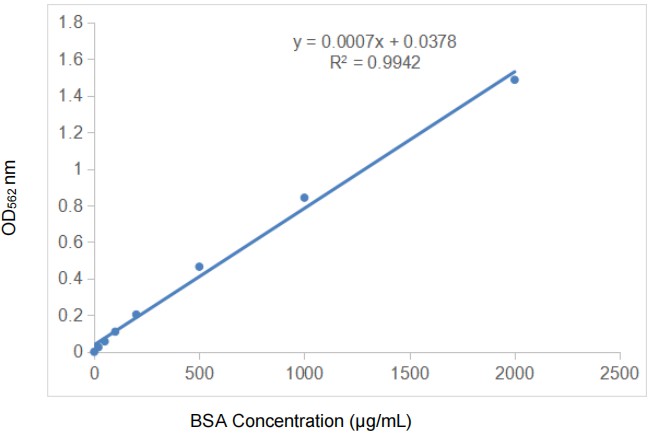
Unlike the Bradford assay, whose standard curve must be fitted as a non-linear function(标曲只能拟合为曲线形态,不支持做成直线)[reference:18], the BCA assay produces a linear standard curve across its working range. A linear curve means:
- Simpler calculations — no curve-fitting software required
- More reliable interpolation — a single equation accurately predicts concentration across the entire range
- Better reproducibility — less sensitivity to minor pipetting errors at the curve's inflection points
Detergent Compatibility: The Deciding Factor
Most protein samples are extracted in buffers containing detergents. The Bradford assay requires SDS <0.1% and Triton X-100 <0.1%—a constraint that forces many labs to dialyze or dilute their samples before quantification[reference:19]. The BCA assay tolerates substantially higher detergent concentrations, making it the pragmatic choice for lysates prepared in RIPA buffer or other detergent-rich formulations.
The One Caveat: Reducing Agents
The BCA assay is affected by chelating agents and higher concentrations of reducing agents(BCA法受螯合剂和略高浓度的还原剂的影响)[reference:20]. If your sample contains DTT or β-mercaptoethanol above the tolerated threshold, consider the Bradford assay or a compatible BCA formulation.
The Bottom Line
For researchers who need a single assay that covers dilute and concentrated samples alike, tolerates common detergents, and delivers a linear standard curve, KTD3001 (BCA) is the workhorse that keeps protein quantification off your list of bottlenecks.
👉 Quantify protein across the full biological range. View Product