




The Serum Your Secondary Antibody Has Been Waiting For—And Why 16 Publications Now Insist on Donkey
Every immunohistochemistry protocol ever written contains a step so brief, so unassuming, that it is performed almost without conscious attention. You pipette 5% BSA in PBS onto your tissue section, incubate for thirty minutes at room temperature, flick off the excess, and proceed to your primary antibody incubation confident that the hydrophobic patches on your Fc receptors are now occupied by inert albumin molecules that will not capture your detection reagents. Then you look at the image. The extracellular matrix is stained. The cytoplasm carries a haze that cannot be reconciled with your target protein's known subcellular localization. The negative control—the one you ran because protocol checklists demand it, not because you expected it to show anything—displays signal nearly as intense as your experimental slide. The problem was never the BSA concentration or the incubation time. The problem was the assumption that BSA was the right blocker for this tissue, this antibody, this detection system.
Normal donkey serum occupies a distinct and underappreciated position in this landscape because its blocking logic is fundamentally different from that of any chemically defined protein blocker. Unlike BSA, casein, or non-fat dry milk, which present a homogeneous surface of a single or a few protein species to the tissue, whole normal donkey serum presents the entire repertoire of serum proteins—albumin, globulins, complement factors, protease inhibitors, and the normal polyclonal IgG pool—each of which saturates a different class of non-specific binding site. Hydrophobic patches on denatured tissue proteins are coated by albumin. Charged residues on extracellular matrix glycosaminoglycans are masked by globulins. And, crucially, the endogenous Fc receptors present on tissue-resident immune cells and damaged cell membranes are occupied by the IgG fraction of the serum, preventing those receptors from capturing the Fc domain of your detection antibody. This last function is biochemically irreplaceable: BSA cannot block Fc receptors because BSA has no Fc domain. The result is that when your secondary antibody is raised in donkey—as the overwhelming majority of highly cross-adsorbed secondary antibodies for multiplex imaging now are—only normal donkey serum provides the homologous IgG that saturates the Fc-binding sites that would otherwise generate the characteristic "membrane-edge background" or "fibroblast-shaped artifacts" that experienced IHC microscopists recognize and dread.
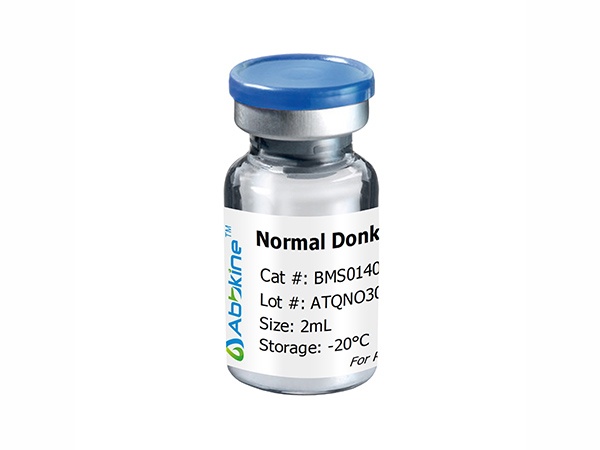
Abbkine's Normal Donkey Serum (BMS0140) refines this blocking logic through processing specifications that reward the kind of close reading most serum datasheets do not invite. The serum is collected exclusively from non-immunized normal adult donkeys, a sourcing decision that carries immunological weight. Serum from immunized or environmentally challenged animals carries elevated titers of polyclonal antibodies against common environmental and laboratory antigens that cross-react with blocking reagents, detection antibodies, and target proteins in unpredictable ways. Non-immunized sourcing eliminates this variable at its origin. Proprietary techniques minimize hemolysis during the blood collection and serum extraction processes—a detail that matters because free hemoglobin released from lysed red blood cells possesses potent pseudoperoxidase activity that catalyzes the conversion of DAB substrate in HRP-based detection systems, producing insoluble brown precipitate indistinguishable from genuine antigen localization. The serum then undergoes lipid extraction to improve optical clarity, a specification that becomes operationally decisive in fluorescence-based detection modalities where residual lipid micelles scatter excitation light and produce the punctate autofluorescence that survives all subsequent washes and mounting medium applications. Finally, the extracted serum is dialyzed against 10 mM sodium phosphate, 0.15 M sodium chloride, pH 7.2, a buffer composition that precisely matches phosphate-buffered saline and eliminates the osmotic shock that can distort delicate tissue architecture when a high-protein serum solution is applied. The resulting product is supplied as a ready-to-use liquid solution rather than a lyophilized powder requiring reconstitution, sterile filtration, and concentration verification—a presentation choice that removes the rehydration variability that has contributed to more failed blocking experiments than most laboratory managers realize.
The technical specifications of BMS0140 are stated quantitatively rather than aspirationally, and the numbers separate this product from the generic normal sera with which it competes. IgG content is measured at 7.8 mg/mL—approximately 40% lower than fetal bovine serum—which means less competing immunoglobulin in the blocking solution and lower non-specific background. Endotoxin is specified at less than 1 EU/mL, a threshold that ensures the blocking reagent does not activate NF-κB signaling in cell-based immunofluorescence experiments and generate the false-positive nuclear staining that confounds transcription factor localization studies. Hemoglobin is held below 0.5 mg/dL, with absorbance at 520 nm measuring 0.02, effectively eliminating autofluorescence in the 488 nm and 555 nm channels most heavily used in confocal multiplex imaging. Osmolality is maintained at 295 mOsm/kg, matching PBS and preventing the cell shrinkage and membrane blebbing that can occur when hypersomolar blocking solutions are applied to live or lightly fixed cells. The bioburden specification of 0 CFU per 10 mL, combined with stability testing that demonstrates 30-day sterility at 4°C after opening, means the serum can be incorporated into standard operating procedures without weekly re-filtration steps.
Publication validation is not a footnote for this product. At the time of writing, BMS0140 has accumulated 16 citations in peer-reviewed literature, a number that places it among the most extensively validated normal serum products in the Abbkine catalog. A study published in Immunity (IF 26.3) deployed the serum while characterizing the disruption of the Na⁺/K⁺-ATPase-purinergic P2X7 receptor complex in microglia and its role in stress-induced anxiety—a neuroscience context requiring blocking conditions that do not introduce immunoglobulin contaminants capable of cross-reacting with neural tissue antigens. A second publication in Autophagy (IF 14.3) used BMS0140 during the investigation of HMGB1 downregulation in retinal pigment epithelial cells and its protective role against diabetic retinopathy through the autophagy-lysosome pathway—an application where tissue autofluorescence in the retinal pigment epithelium is already high, and any additional background introduced by the blocking reagent would swamp the specific signal. A third study in Science Advances (IF 12.5) examined lamellar Schwann cells in the Pacinian corpuscle and their role in potentiating vibration perception, a project demanding immunohistochemical clarity in mechanically sensitive tissue structures where non-specific antibody trapping in the corpuscle lamellae is a known artifact. Additional publications span journals including PLoS One, Applied Genetics and Molecular Biotechnology, Journal of Shanghai Jiao Tong University, and the International Journal of Molecular Medicine, covering experimental models from vestibular dysfunction to cancer biology. The aggregate signal from 16 independent laboratories, publishing in journals with impact factors ranging from specialized to 26.3, is more informative about real-world blocking performance than any manufacturer's internal QC dataset.
The dual functionality of normal donkey serum—as both blocking reagent and negative control—distinguishes it from chemically defined alternatives in a manner that becomes visible only when an experiment fails. Normal serum from the same host species as the secondary antibody, diluted to the same total protein concentration, provides the most biochemically appropriate negative control for any immunoassay. Unlike buffer-only controls that reveal only the background from secondary antibody binding to tissue, a normal serum control at matched immunoglobulin concentration reveals the background from non-specific primary antibody Fc region binding, hydrophobic interaction, and charge-based adsorption—which is the background that actually competes with specific antigen-antibody signal. For laboratories using donkey anti-rabbit, donkey anti-mouse, or donkey anti-goat secondary antibodies, the availability of a validated normal donkey serum that serves both blocking and negative control functions eliminates the need to source, validate, and optimize separate reagents for these two analytically distinct purposes.
The broader immunological context makes the case for proper blocking reagent selection increasingly urgent as multiplexed and super-resolution imaging technologies proliferate. Tyramide signal amplification (TSA)-based multiplexed immunohistochemistry deposits covalent fluorophore-tyramide conjugates at the site of HRP activity, permanently labeling the tissue with fluorophores that cannot be chemically removed without compromising epitope integrity. Any non-specific HRP binding during the amplification step—including HRP captured by endogenous Fc receptors that were inadequately blocked—produces permanent signal that cannot be computationally deconvolved. In cyclic immunofluorescence methods such as CyCIF, CODEX, and 4i, where the same tissue section undergoes 10–40 sequential rounds of primary antibody incubation, secondary antibody detection, imaging, and antibody stripping, the cumulative probability of blocking failure across cycles approaches certainty unless the blocking reagent performs consistently across every round. Normal donkey serum blocking at 5–20% (v/v) in PBS provides the dense, multi-component protein coverage that iterative detection methods demand, and the IgG fraction specifically addresses the Fc receptor binding that accumulates across cycles as repeated antibody incubations expose tissue to progressively higher cumulative immunoglobulin loads.
Formulation and storage specifications reward a practical reading. The product is supplied as a liquid solution in 10 mM sodium phosphate, 0.15 M sodium chloride with 0.05% sodium azide as preservative, pH 7.2, available in 2 mL and 10 mL package sizes with bulk sizes available upon request. Shipping is on gel packs with blue ice. Storage is at 2–8°C for short-term use, or aliquot and store at -20°C or below for long-term storage, with the explicit instruction to avoid repeated freezing and thawing—freeze-thaw cycling of whole serum promotes the formation of cryoprecipitate, aggregated immunoglobulins and lipoprotein complexes that precipitate upon thawing and, once formed, do not fully resolubilize. The recommended starting dilutions of 1:10–1:20 for IHC on paraffin sections and IF/ICC, and 1:100 for ELISA, reflect the empirically validated range that the immunochemistry literature has converged upon over decades of optimization. The product is for research use only and is not intended for use in human or clinical diagnosis.
For the core facility technologist who processes hundreds of tissue sections and cells per month and cannot afford a single failed blocking step, the immunology laboratory whose multiplexed tissue imaging experiment depends on the cumulative integrity of 40 sequential blocking and staining rounds, the neuroscientist whose confocal micrographs must distinguish genuine synaptic protein localization from Fc receptor-mediated background, the cancer biologist whose TSA-amplified multiplex panels demand near-zero non-specific HRP deposition, and the investigator who simply wants the negative control slide to produce a truly negative image, a properly processed normal donkey serum is the most biochemically appropriate blocker available. The serum that has been quietly ensuring immunohistochemistry reproducibility in laboratories publishing in Immunity, Autophagy, and Science Advances is available in 2 mL and 10 mL vials.
Explore specifications, access the protocol FAQ, and place your order here: https://www.abbkine.com/product/normal-donkey-serum-bms0140/





