| Product name | Normal Donkey Serum |
| Host | Donkey |
| Applications | BL, ELISA, ICC, IF, IHC |
| Applications notes | Optimal working dilutions should be determined experimentally by the investigator. Suggested starting dilutions are as follows: IHC-p (1:10-20), IF/ICC (1:10-20) and ELISA (1:100). |
| Preparation method | Normal donkey serum is processed from blood collected from non-immunized normal adult donkeys. Hemolysis is minimized by employing proprietary techniques during the blood collection and serum extraction processes. |
| Preparation method | Lipid extracted and dialyzed against 10 mM sodium phosphate, 0.15 M sodium chloride, pH 7.2 |
| Purity | Whole serum |
| Formulation | Liquid solution |
| Storage buffer | 10 mM sodium phosphate, 0.15 M sodium chloride with 0.05% sodium azide as preservative, pH 7.2 |
| Storage instructions | Store at 2-8°C or aliquot and store at or below -20°C for long-term storage. Avoid repeated freezing and thawing. |
| Shipping | Gel pack with blue ice. |
| Precautions | The product listed herein is for research use only and is not intended for use in human or clinical diagnosis. Suggested applications of our products are not recommendations to use our products in violation of any patent or as a license. We cannot be responsible for patent infringements or other violations that may occur with the use of this product. |
| Background | Normal donkey serums, which are from non-immuned donkey hosts, are lipid extracted to improve clarity, dialyzed against phosphate buffered saline (PBS) containing sodium azide. Normal serum diluted to 5%-20% (v/v) in PBS is strongly recommended as a blocking reagent to reduce background from non-specific binding, or control for most immunoassay applications. Best results are obtained with diluted normal serum from the same host as the labeled antibody, as a separate incubation step before addition of the primary antibody. |
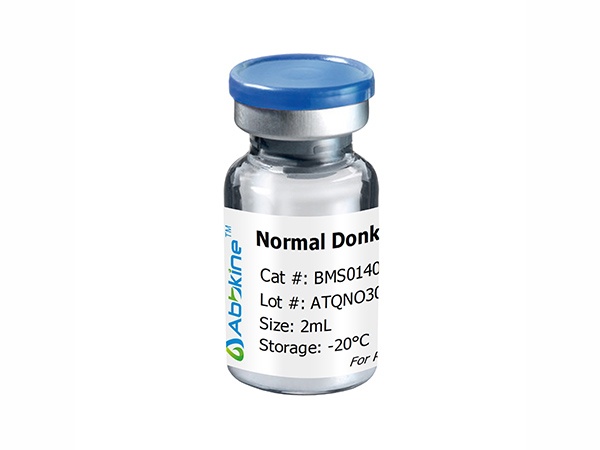
Fig. Normal donkey serum is processed from blood collected from non-immunized normal adult donkeys. Normal serum diluted to 5%-20% (v/v) in PBS is strongly recommended as a blocking reagent to reduce background from non-specific binding, or control for most immunoassay applications. 2ml, 10ml package sizes are available, whicle bulk size available upon request.
Author:S Huang, W Dong, X Lin, K Xu, K Li, S Xiong, Z Wang, ... Publication name:PLoS One IF:26.3
Author:L Feng, L Liang, S Zhang, J Yang, Y Yue, X Zhang Publication name:Applied genetics and molecular biotechnology IF:14.3
Author:Chen, Yuh-Tarng, et al. Publication name:Science Advances IF:12.5
Author:H Ding, X Liu, X Li, M Wen, Y Li, ... Publication name:Phytopathology® IF:5.8
Author:Z Zhang, Q Yu, X Zhang, X Wang, Y Su, W He, J Li, ... Publication name:Brain Research Bulletin IF:5.1
Author:He, Ruonan, et al. Publication name:Inflammopharmacology IF:5
Author:F Busse, JH Booth, NM Kronenberg, Y Sun, ... Publication name:Comparative Biochemistry and Physiology D-Genomics & Proteomics IF:3.2
Author:H Zheng, X Sun, J Chen, L Deng, Y Li, X Wang, Y Su, ... Publication name:JoVE (Journal of Visualized Experiments) IF:2.8
Author:H Zheng, X Sun, Q Yu, X Wang, Y Su, X Jing, ... Publication name:JOURNAL OF IMMUNOLOGY IF:2.7
Author:P Fang, G Sun, J Wang Publication name:Stem Cell Research IF:2.3
Author:YB Zhao, SH Yang, J Shen, K Deng, ... Publication name:Journal of Experimental & Clinical Cancer Research IF:2.2
Author:Yiqing, L. I. U., et al. Publication name:Journal of Shanghai Jiao Tong University IF:
Author:刘祎晴, et al. Publication name:上海交通大学学报 IF:
You must be logged in to post a review.











Reviews
There are no reviews yet.