




The Signal You Lose Before the Film Developer Even Warms Up — And the $59 Substrate That 20 Publications Already Trust
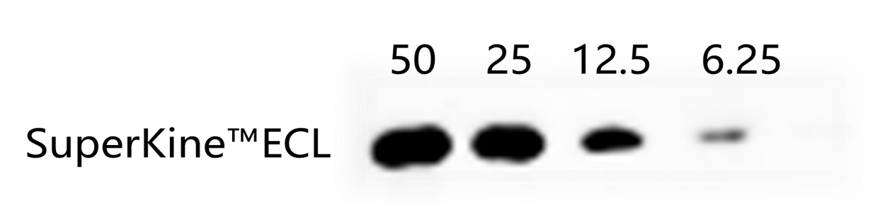
Every western blot protocol ever written contains a step so brief, so unassuming, that it is performed in the dark without the operator ever seeing whether it succeeded. You mix equal volumes of two clear solutions in a 15-mL conical tube, pour the mixture over a PVDF membrane, incubate for sixty seconds, drain the excess, wrap the blot in plastic, and press it against X-ray film or slide it into a digital imager. The light that reaches the detector in the next three minutes determines whether your experiment produced a figure for a publication or a troubleshooting session for a lab meeting. But the chemistry generating that light is not a passive reporter. It is a kinetic race. In a standard ECL reaction, HRP catalyzes the oxidation of luminol, consuming hydrogen peroxide to generate a transient excited-state intermediate that emits a photon at 428 nm as it relaxes to the ground state. The problem is not the chemistry. The problem is that the hydrogen peroxide concentration necessary to sustain the reaction simultaneously inactivates the HRP, shortening the enzyme's half-life to approximately 30 seconds under conventional substrate conditions. What this means at the bench is that the brightest signal your blot will ever produce occurs in the first thirty seconds after you add the substrate—before you have even drained the excess, before you have wrapped the blot, and certainly before the film or CCD detector begins its exposure. You are not capturing the signal. You are capturing what remains after the signal has already begun to die. A 2025 Abbkine technical article dissected the mechanism in molecular detail: direct addition of high-concentration hydrogen peroxide causes rapid HRP inactivation, and the key innovation of the BMU101 kit lies in its sustained-release mechanism, which employs a glucose oxidase-glucose system to continuously generate H₂O₂, maintaining a concentration within a critical 50–100 μM window—enough to drive luminol oxidation without causing irreversible oxygenation damage to the HRP heme structure. Experimental data confirmed that this sustained-release system extends the effective luminescence time from two minutes to 45 minutes. Forty-five minutes. For the researcher who has been racing against a 120-second signal decay window, that number is not an incremental improvement. It is a qualitative change in what is experimentally possible.
Abbkine's SuperKine™ West Pico PLUS Chemiluminescent Substrate (BMU101-EN) builds its performance on this sustained-release architecture, but the molecular engineering extends further into the detection chemistry than a single mechanism can describe. The kit's high sensitivity is not achieved by simply increasing the luminol concentration—a strategy that would elevate background alongside signal—but through an enhancer molecule network that functions as an electron relay station. The enhancers, typically phenolic derivatives such as p-iodophenol or p-phenylphenol, are oxidized by HRP Compound I to form stable phenoxy radicals with an oxidation potential approximately 0.3 V lower than that of luminol radicals. Each enhancer radical rapidly transfers electrons to surrounding luminol molecules and is itself restored to a reduced state, enabling a single HRP enzyme molecule to catalyze roughly 100 enhancer oxidation cycles per second, with each enhancer radical transferring electrons to 20–30 luminol molecules before quenching. The cascading amplification increases total luminescence efficiency from the 0.1% typical of standard ECL to over 5%. The enhancer molecules are further engineered with hydrophobic C12–C14 alkyl tails that spontaneously form micelle structures in aqueous solution, encapsulating luminol molecules within the micelle interior. When the luminescent product 3-aminophthalate collides with the micelle wall, partial energy transfer shifts the emission wavelength to 445 nm, better matching the quantum efficiency peak of CCD cameras. The enhancer concentration has been optimized through orthogonal experimental design at 1.8 mM, the value at which luminescence intensity reaches its maximum while background signal remains at baseline. These are not the specifications of a generic ECL reagent. They are the specifications of a detection chemistry that was engineered rather than simply formulated.
The practical consequence of this engineering is detection sensitivity that the product page specifies at the picogram level. The substrate enables detection of antigens at 30–50 pg or lower, a range that places it in direct competition with premium ECL products costing two to four times as much. For a graduate student trying to detect a low-abundance phosphorylated signaling protein in primary neuron lysates—where the target may represent less than 0.001% of total protein and the entire experiment may yield only 20 µg of material—the difference between a substrate that detects at the nanogram level and one that detects at the picogram level is the difference between data and a blank film. The substrate achieves this sensitivity without requiring specialized imaging equipment: it is compatible with both traditional X-ray film and digital CCD imaging systems, with signal stability enabling multiple exposures from a single blot without the signal decay that forces users of conventional ECL reagents to capture their image in a single attempt and hope the exposure time was correct.
Ease of use is a specification that matters most to the researcher who runs four western blots per week, not to the marketing department that writes the brochure. BMU101-EN consists of two components—ECL HRP Substrate Reagent A and Reagent B—that are mixed at a 1:1 ratio to prepare the working solution. The user suggests 0.1–0.2 mL of working solution per square centimeter of blot membrane, incubates the blot for 1–5 minutes, drains the excess reagent, covers the blot with clear plastic wrap, and exposes to X-ray film or places in a digital imager. The protocol is effectively identical to that of every other ECL substrate on the market, which means there is no re-optimization required when switching from a more expensive product. This drop-in compatibility is a deliberate design feature, not a coincidence. The product page states explicitly that the substrate can directly replace other expensive ECL products without the need to re-optimize experimental conditions. For a laboratory manager who has just been informed that the ECL substrate the lab has used for five years is increasing in price by 30%, the availability of a functionally identical replacement at a lower cost is not a purchasing decision; it is a budget rescue.
The publication record for BMU101-EN is the validation that no manufacturer's certificate of analysis can replicate. At the time of writing, the product has accumulated 20 citations in peer-reviewed literature, a number that places it among the most extensively validated chemiluminescent substrates in the Abbkine catalog. A study published in Nature Communications deployed the substrate while identifying the role of arginine methylation of METTL14 in promoting RNA N⁶-methyladenosine modification and endoderm differentiation of mouse embryonic stem cells—a context demanding the detection of low-abundance epigenetic regulatory proteins whose signals would be lost to background in a less sensitive detection system. Additional publications span the research spectrum, and the product page reports 6,833 views, a traffic volume reflecting sustained interest from the research community. Each of the 20 publications represents an independent laboratory that prepared its own blots, used its own antibodies, operated its own imaging equipment, and submitted its own figures for peer review with BMU101-EN listed in the methods section. The aggregate signal from 20 independent laboratories is more informative about real-world performance than any single internal validation dataset.
Storage and stability specifications reward a practical reading because they determine whether the substrate in the refrigerator today performs identically to the same substrate used six months from now. BMU101-EN is stable for one year at 4–8°C from the date of shipment, with exposure to sunlight or intense light potentially harming the working solution while short-term exposure to typical laboratory lighting is harmless. Shipping occurs on gel packs with blue ice. The 100 mL size consists of 50 mL Reagent A and 50 mL Reagent B, yielding 100 mL of working solution—enough for approximately 500–1000 square centimeters of blot membrane, depending on the user's application volume. The 500 mL size is also available for core facilities and high-throughput laboratories. Different batch numbers and reagents from different manufacturers should not be mixed, a standard caution that reflects the sensitivity of the luminol-enhancer-HRP reaction system to minor variations in component concentration.
Economic accessibility is the specification that distinguishes BMU101-EN from the premium ECL products whose performance it matches. The product is priced at 250—less than the cost of a single premium primary antibody. For laboratories in countries where research budgets are constrained by currency exchange rates, import duties, and limited grant funding, the difference between 200 for an ECL substrate is the difference between running the confirmatory replicates a reviewer requested and omitting them because the substrate budget was exhausted. The product page describes the kit as the perfect combination of excellent quality and friendly price, and the numbers support that characterization without requiring hyperbole.
The broader technological context makes the case for selecting an ECL substrate with sustained-release chemistry increasingly difficult to ignore as quantitative western blotting standards tighten. Chemiluminescent detection remains the most widely used method for western blot quantification—more sensitive than colorimetric detection, more accessible than fluorescence, and compatible with the PVDF and nitrocellulose membranes that researchers have used for decades. But as journals and funding agencies increasingly require quantitative western blot data with demonstrable linear dynamic range, the signal decay kinetics of the detection substrate become an analytical variable rather than a technical footnote. A substrate whose signal decays by 50% within two minutes forces the user to capture the image at a single time point, which may fall outside the linear range of the detection system for either the highest- or lowest-abundance bands on the membrane. A substrate whose signal remains stable for 45 minutes—as BMU101-EN's sustained-release chemistry enables—allows the user to capture multiple exposures, verify that band intensities fall within the linear range, and select the exposure that provides accurate quantification across all bands of interest. The difference is not merely convenience. It is the difference between semi-quantitative western blotting and quantitative western blotting, and reviewers increasingly know the difference.
For the graduate student whose low-abundance target protein has resisted detection through three different primary antibodies and four different transfer conditions, the postdoctoral fellow who processes 30 blots per month and watches the ECL substrate budget line hemorrhage funds, the core facility manager who must standardize on a single substrate across diverse user projects without compromising detection sensitivity, the principal investigator who submits grant renewal data that must survive reviewer scrutiny of every band on every blot, and the researcher in any laboratory anywhere who has watched a chemiluminescent signal fade to background while the CCD camera was still initializing, BMU101-EN provides picogram-level detection sensitivity, a sustained-release peroxide generation system that extends signal duration to 45 minutes, 1:1 drop-in compatibility with existing ECL protocols, 20 peer-reviewed publication citations, one-year stability at 4–8°C, and a $59 price for 100 mL. The signal you have been losing before the film developer even warms up can now be captured, quantified, and published.
Explore full specifications, view representative data, and place your order here: https://www.abbkine.com/product/superkine-west-pico-plus-chemiluminescent-substrate-bmu101-en/





