




Anti-GAPDH Rabbit Polyclonal Antibody (ABL1021): The Polyclonal That Sees What the Monoclonal Misses
The Monoclonal Limitation No One Talks About
Monoclonal antibodies deliver exquisite specificity—one epitope, one binding site, one signal. That precision is their strength and their limitation[reference:54]. A monoclonal raised against a single peptide sequence will fail to recognize its target the moment that epitope is post-translationally modified, partially degraded, or cross-linked into a protein complex that sterically blocks antibody access[reference:55].
GAPDH is heavily modified in cells: it is S-nitrosylated, acetylated at multiple lysine residues, phosphorylated, oxidized, and O-GlcNAcylated[reference:56]. Each of these modifications can ablate the binding of a monoclonal antibody raised against an unmodified peptide[reference:57].
The Polyclonal Advantage: Signal Redundancy
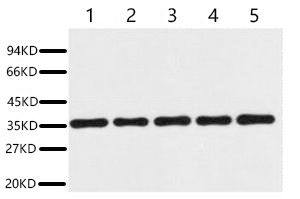
Abbkine's Anti-GAPDH Rabbit Polyclonal Antibody (ABL1021) enters this landscape with a different detection philosophy: instead of targeting a single peptide sequence, it presents a polyclonal repertoire raised against the full-length recombinant GAPDH protein[reference:58]. The result is a pool of antibodies that recognize multiple epitopes distributed across the entire 37-kDa polypeptide[reference:59].
If one epitope is masked by a residual post-translational modification, point mutation, or splice variant, the remaining antibodies in the polyclonal pool still bind and generate signal[reference:60]. That signal redundancy is not a sign of imprecision—it is the feature that keeps the loading control working under conditions a monoclonal cannot anticipate[reference:61].
Affinity-Purified: Not Just Rabbit IgG
ABL1021 was raised in rabbit against recombinant GAPDH protein and then affinity-purified from the resulting antiserum by affinity-chromatography using specific immunogen[reference:62]. The word "affinity-purified" is critical—it separates a reagent that is mostly rabbit IgG from one that has been enriched for GAPDH-specific antibodies[reference:63].
Trusted in High-Impact Research
| Metric | Value |
|---|---|
| Citations | 18+[reference:64] |
| Notable Publication | Journal of Medicinal Chemistry (IF 7.3)[reference:65] |
Head-to-Head: Polyclonal vs. Monoclonal GAPDH
| Feature | ABL1021 (Polyclonal) | ABL1020 (Monoclonal) |
|---|---|---|
| Epitopes Targeted | Multiple[reference:66] | Single[reference:67] |
| PTM Tolerance | High[reference:68] | Low[reference:69] |
| Species Reactivity | Human, Rabbit, Rat, Mouse, Monkey, Sheep, Xenopus, Chicken[reference:70] | 11 species[reference:71] |
| Applications | IHC-P, WB[reference:72] | Immunoassay[reference:73] |
The Bottom Line
When a researcher runs a western blot and sees a band that should be there but is not, the protein did not disappear. The epitope did[reference:74]. ABL1021 ensures that doesn't happen to you.
📎 Reference: Anti-GAPDH Rabbit Polyclonal Antibody (ABL1021)





