




The Glutathione Blind Spot That Is Quietly Destroying Your Oxidative Stress Data
Every oxidative stress researcher has a story. It usually begins on a Friday afternoon, in front of a plate reader, staring at numbers that refuse to make physiological sense. Your experimental group received a pro-oxidant challenge that should have depleted intracellular glutathione by at least 50%—yet the colorimetric assay reports a barely perceptible 8% decline. The GSH/GSSG ratio, that most sacred of redox biomarkers, looks essentially unchanged. You know this cannot be right. You know glutathione is the cell’s primary non-enzymatic antioxidant, the thiol tripeptide that neutralizes hydrogen peroxide and lipid peroxides through glutathione peroxidase, conjugates xenobiotics via glutathione S-transferase, and maintains the reduced environment that permits protein folding and enzyme function. You know that in rat models of acetaminophen hepatotoxicity, traumatic brain injury, hyperoxia-induced lung injury, and neurodegeneration, GSH depletion is not subtle—it is catastrophic, and it happens early. And yet your assay says otherwise.
The problem is not your hypothesis. The problem is your detection chemistry. Glutathione is a small haptenic molecule (307 Da), not a protein. It exists predominantly in its reduced monomeric form (GSH) but undergoes rapid auto-oxidation to glutathione disulfide (GSSG) the moment your tissue homogenate or plasma sample hits atmospheric oxygen. Without an alkylating agent to immediately trap thiol groups as they exist in vivo, your measured GSH value reflects an artifact of sample processing, not biology. Enzymatic recycling methods using DTNB (Ellman’s reagent) suffer from interference by protein thiols, cysteine, and other low-molecular-weight sulfhydryls, generating overestimates that obscure genuine depletion. HPLC achieves the requisite specificity but demands derivatization steps, expensive fluorescent detectors, and sample volumes that preclude longitudinal sampling in small rodents. These are not minor technical irritants. They are systematic sources of error that have generated an unknowable volume of irreproducible oxidative stress literature.
Abbkine KTE100838: The Sandwich ELISA Engineered for the Molecule That Does Not Behave Like a Protein
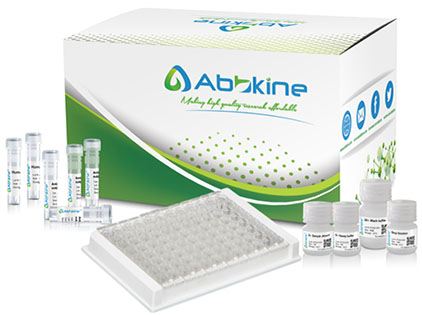
Abbkine’s Rat Glutathione (GSH) ELISA Kit (KTE100838) confronts the hapten detection problem with a two-site sandwich ELISA format specifically optimized for a tripeptide analyte. A capture antibody with high affinity for the reduced GSH epitope (γ-L-glutamyl-L-cysteinylglycine) is pre-coated onto the microplate. Standards and samples are pipetted into the wells, where any GSH present is bound by the immobilized antibody. After washing away unbound material—including GSSG, cysteine, and other low-molecular-weight thiols—an HRP-conjugated detection antibody is added, followed by a chromogen substrate that develops color in direct proportion to the amount of GSH captured in the initial binding step.
This is not a competitive assay with its mathematically inverted standard curves and signal compression at both extremes. This is a true sandwich—the geometry that immunochemists prefer when they want linearity, low background, and reproducibility that holds across independent runs. The detection limit reaches 5.0 ng/L, and the calibration range spans 50–800 ng/L. These units deserve a moment of reflection. Many legacy colorimetric GSH kits report sensitivity in the micromolar range, while KTE100838 operates in the nanogram-per-liter domain—a sensitivity differential measured in orders of magnitude rather than percentage improvements. The antibody pair has been validated to minimize cross-reactivity with GSSG, γ-glutamylcysteine, cysteinylglycine, and other structurally related thiols. This specificity is not a luxury; it is a prerequisite for generating GSH measurements that correspond to the actual reduced glutathione pool rather than a composite signal contaminated by the oxidized disulfide form and dietary cysteine.
Sample compatibility spans serum, plasma, cell culture supernatants, and other biological fluids, enabling longitudinal GSH monitoring across diverse rat experimental paradigms without matrix-specific re-optimization.
The Vial in Your Hand Versus the HPLC in the Core Facility: Why Throughput Has Become a Scientific Variable
The comparative landscape for glutathione quantification has long been dominated by HPLC-based methods, and for good reason. Reversed-phase HPLC with fluorescence or electrochemical detection can separate GSH from GSSG, cysteine, and other thiols with exquisite resolution, providing unambiguous quantification of the reduced-to-oxidized glutathione ratio that serves as the canonical indicator of cellular redox status. But HPLC-based workflows impose constraints that grow more burdensome with every passing year. Instrumentation costs routinely exceed $50,000. Sample derivatization protocols demand hours of technician time and introduce batch-to-batch variability that compounds across multi-day studies. Gradient run times of fifteen to thirty minutes per sample translate to fewer than fifty samples analyzed per day per instrument—a throughput ceiling that collides painfully with the reality of a toxicology study involving six dose groups, eight time points, and six animals per group. For the researcher who has spent weeks generating samples only to watch them queue up at the core facility HPLC while oxidative degradation silently continues, the bottleneck is not theoretical.
ELISA-based quantification, by contrast, requires only a standard microplate reader capable of measuring absorbance at 450 nm—hardware that exists in virtually every modern life science laboratory. The KTE100838 protocol delivers a complete standard curve and up to forty samples in duplicate in under three hours, using equipment you already own and a workflow your technicians already understand. This throughput advantage becomes decisive when experimental designs demand higher n-numbers to achieve statistical power, when pilot studies must be repeated with modified dosing regimens, or when the compound library screen demands GSH readouts from hundreds of wells.
Practical Protocol Wisdom: Because GSH Is Not Stable, and Your Pipetting Technique Matters
The instructions packed with KTE100838 reflect the hard-won experience of troubleshooting ELISA performance across diverse biological matrices. The mandate is clear: allow all reagents to warm to room temperature for at least 30 minutes before opening—temperature gradients across the plate generate binding kinetics gradients that manifest as edge effects and well-to-well coefficient of variation that no amount of post-hoc statistical adjustment can salvage. Pre-rinse pipette tips with reagent, use fresh tips for every sample, standard, and reagent transfer—GSH is a small molecule that adsorbs to plastic surfaces, and carryover contamination from a high-concentration standard well to a low-concentration sample well is a single lapse of attention away. Unused wells must be kept desiccated at 4°C in the sealed bag provided; the pre-coated capture antibody is a protein, and humidity-driven hydrolysis of the coating layer is a degradation pathway that operates silently but inexorably. Mix thoroughly—the protocol recommends a low-frequency oscillator or gentle hand shaking every 10 minutes to ensure homogeneous reagent distribution and prevent the formation of concentration gradients within wells. And crucially: assay all standards and samples in duplicate or triplicate.
The unopened kit is stable at 2–8°C and ships on gel pack with blue ice. The product is designated for research use only, not for diagnostic applications—a standard disclaimer that nonetheless reflects its positioning within the preclinical research ecosystem where rat models occupy a central role in oxidative stress biology.
Where GSH Fits in the Redox Puzzle—and What Else Abbkine Brings to the Bench
A single GSH measurement is a snapshot. The GSH/GSSG ratio is the movie. GSSG accumulates when glutathione peroxidase reduces hydrogen peroxide and the resulting glutathione disulfide is not efficiently recycled by glutathione reductase—a ratio shift that precedes overt cellular damage and serves as the earliest biochemical indicator of oxidative stress in rat hepatocytes, neurons, and vascular endothelium. KTE100838 provides the reduced GSH half of this equation with precision. For the full picture, Abbkine offers complementary kits including Rat Glutathione Reductase (GR) and Glutathione Peroxidase (GSH-Px) ELISA kits that complete the enzymatic arm of the glutathione system. This modular ecosystem enables oxidative stress profiling across multiple arms of the redox network from a single experimental cohort, with consistent assay formats, compatible reagents, and shared protocol logic that reduces training burden and technical variability.
Abbkine Scientific Co., Ltd—headquartered in Wuhan, China—has built its reputation on the EliKine series of ELISA kits, which deliver high-quality antibody pairs and protein standards optimized for sensitivity, specificity, and lot-to-lot reproducibility. For the researcher who has experienced the sinking moment when a replacement kit lot generates standard curves that do not overlay with previous experiments, this commitment to quality control is not marketing language. It is the entire point of using a validated commercial kit instead of building a bespoke assay from scratch.
Product Details:
- Product Name: Rat Glutathione (GSH) ELISA Kit
- Brand: Abbkine
- Catalog Number: KTE100838
- Method: Quantitative Sandwich ELISA
- Detection Range: 50 ng/L – 800 ng/L
- Sensitivity: 5.0 ng/L
- Sample Types: Serum, Plasma, Cell Culture Supernatants, Other Biological Fluids
- Detection Method: Colorimetric (HRP/TMB)
- Storage: Unopened kit at 2–8°C; ships on blue ice
Product Link: https://www.abbkine.com/product/rat-glutathione-gsh-elisa-kit-kte100838/





