




The Currency You Cannot Afford to Ignore: Direct Acetyl-CoA Quantification That Leaves the Mass Spectrometer Behind
In the summer of 1951, Feodor Lynen isolated a compound from yeast that, upon degradation, yielded pantothenic acid, cysteamine, adenosine-3′,5′-diphosphate, and a thioester-linked acetyl group. He had captured acetyl coenzyme A. Two years later, he would share the Nobel Prize with Hans Krebs. Over the seven decades that followed, acetyl-CoA accumulated a resume no other two-carbon unit can rival: it fuels the tricarboxylic acid cycle, provides the building blocks for fatty acids and cholesterol, donates acetyl groups to histones for chromatin remodeling, and sits at the convergence point where glucose, lipid, and amino acid catabolism merge into a single metabolic highway. In mammalian cells, acetyl-CoA is the global carbon currency—mediating transactions between glycolysis, the TCA cycle, amino acid metabolism, gluconeogenesis, and fatty acid synthesis. When a cancer cell doubles its membrane lipids in preparation for division, acetyl-CoA pays the bill. When a hepatocyte packages triglycerides for export, acetyl-CoA is the substrate. When a memory T cell reprograms its epigenome to sustain long-term survival, acetyl-CoA supplies the acetyl groups. The molecule is not simply involved in these processes. It is the shared limiting resource that governs their output.
The measurement challenge has, for decades, been disproportionate to the biological importance. Acetyl-CoA is intrinsically unstable—the thioester bond that makes it such an excellent acyl donor also renders it susceptible to rapid hydrolysis at physiological pH. Pools can shift within seconds during sample processing. The classical analytical methods that offer precision—liquid chromatography coupled to tandem mass spectrometry—require dedicated metabolomics facilities, highly trained operators, isotopically labeled internal standards, and per-sample costs that quickly erode even generous reagent budgets. An important challenge in studying lipid metabolism has been the accurate measurement of acetyl-CoA, particularly given its compartmentalization within cells—mitochondrial, cytosolic, and nuclear pools that can move independently of one another. On the other end of the accessibility spectrum, commercially available enzymatic kits have historically traded specificity for convenience. A 2023 study comparing colorimetric, fluorometric, and LC-MS-based acetyl-CoA assays published in PMC revealed that context-specific assay selection remains difficult because systematic comparisons between techniques had not been reported, leaving researchers to choose methods without clear performance benchmarks. The defining analytical burden has been the fragile thioester linkage—in acetyl-CoA, the sulfur-carbon bond is significantly more reactive than conventional oxyester bonds, and any detection method that does not respect that fragility will generate data that tracks extraction artifacts, not biology.
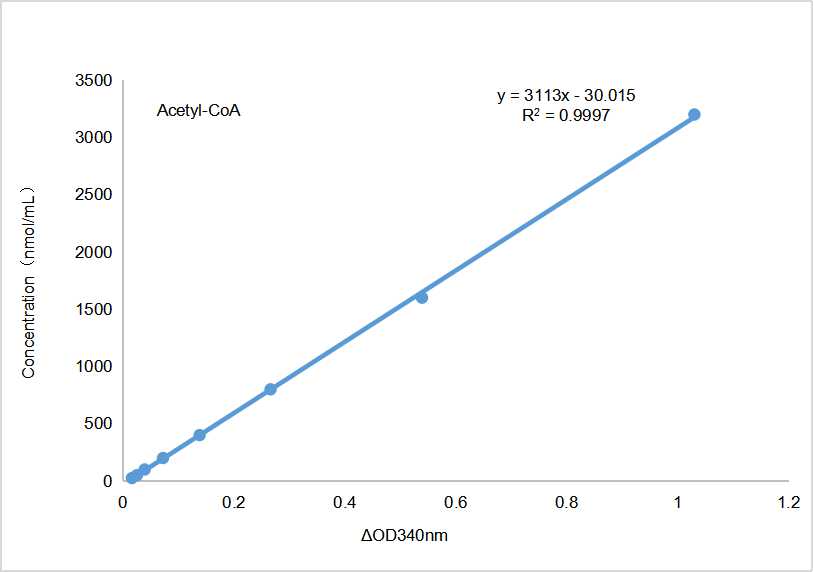
Abbkine‘s CheKine™ Micro Acetyl Coenzyme A (Acetyl-CoA) Assay Kit (KTB1260) recognizes that fragility and builds the measurement around it. The chemistry is an enzymatic cascade in which two well-characterized reactions are coupled to generate an NADH signal whose accumulation rate is directly proportional to the acetyl-CoA concentration in the original sample. Malate dehydrogenase first catalyzes the conversion of malic acid and NAD⁺ into oxaloacetate and NADH. Citrate synthase then condenses that oxaloacetate with the acetyl-CoA from the sample to produce citric acid and regenerate free coenzyme A. This is not an opportunistic antibody-based detection borrowed from an ELISA platform. It is a substrate-specific enzymatic relay built around the very chemistry that cells themselves use to recognize and metabolize acetyl-CoA. The only thing the kit measures is the rate of NADH generation at 340 nm—a wavelength every UV-capable microplate reader supports, requiring no exotic filters, no fluorescence lifetime detectors, and no mass spectrometer. The signal is colorimetric, direct, and stoichiometrically anchored to the acetyl-CoA content of the well.
The operational implications of that design unfold in ways that cumulative bench experience makes visible. A 96-well plate can be loaded with samples, positive controls, NADH standards for the calibration curve, and negative controls in a single sitting. The absorbance decrease is monitored kinetically, which means the linearity of the reaction is verified within each well—no endpoint color that saturates unpredictably, no post-hoc realization that your most interesting sample exceeded the dynamic range and delivered a number that belongs in fiction. The kit components—Extraction Buffer, Reagent I through IV, and an NADH standard—ship on gel packs with blue ice and store stably at -20°C protected from light for six months from receipt. No separate cofactor solutions to source. No substrate cocktails requiring fresh preparation within two hours. No reagents that oxidize within a working week. The protocol explicitly instructs users to keep all samples and reagents on ice during preparation to avoid denaturation and deactivation, and emphasizes that fresh samples yield optimal results—if the assay cannot be performed immediately, completing the sample preparation step before freezing preserves analyte integrity. These are not arbitrary warnings. They are the biochemical courtesies that a thioester-containing analyte demands.
Sample compatibility spans the practical range of biological matrices that metabolism researchers encounter daily: animal tissues, plant tissues, and cultured cells—both adherent and suspension lines. The broad sample spectrum matters because acetyl-CoA is evolutionarily conserved and central to energy metabolism across kingdoms; a kit that restricts itself to mammalian tissue culture immediately excludes plant biologists studying mitochondrial respiration under stress and microbiologists profiling fungal lipid accumulation. The label on the box reflects that breadth.
The publication record, though still in its early stages, tells the story of a tool that has already earned trust in demanding experimental contexts. Two publications currently cite KTB1260, and both merit attention. One study published in Plant Growth Regulation (2025) examined the mechanism of GABA response to aluminum stress in Acacia species, employing the assay under experimental conditions where extraction reliability across treatment groups is non-negotiable. The second, forthcoming work deployed the kit in the context of cross-kingdom metabolic profiling—precisely the kind of application that validates the kit’s stated compatibility across sample types. These are not citations that merely list the product number in a methods section. They are independent laboratories that extracted acetyl-CoA from biological tissue, ran the assay, and found the resulting values credible enough to defend under peer review.
The practical note that deserves the most emphasis is also the one most frequently ignored by first-time users: speed of sample processing is the dominant variable in acetyl-CoA measurement, and no reagent chemistry can rescue data from tissue that spent five minutes on a room-temperature bench before extraction. Acetyl-CoA levels fluctuate rapidly in response to metabolic state. The protocol’s recommendation to use fresh samples, to work on ice, and to snap-freeze material immediately when the assay will be delayed is not padding. It is the difference between measuring a metabolite and measuring its hydrolysis product.
Research areas that stand to gain the most from direct acetyl-CoA quantification span the full contemporary landscape of metabolism-dependent biology. Cancer researchers studying de novo lipogenesis can move beyond measuring fatty acid synthase expression and actually quantify the substrate that feeds the pathway. Neuroscience labs investigating the link between mitochondrial function and histone acetylation in neuronal gene regulation can ask whether acetyl-CoA pools change in correlation with chromatin modification states rather than assuming the connection from enzyme abundance alone. Immunology groups tracking T-cell activation and metabolic reprogramming can directly measure the carbon currency driving differentiation rather than relying exclusively on extracellular flux analysis. Nutrition science, aging research, and metabolic disease pharmacology all share the same unmet need: a method that reports acetyl-CoA content accurately without requiring a dedicated mass spectrometry core.
The assay’s detection principle, which couples malate dehydrogenase and citrate synthase to generate a proportional NADH signal at 340 nm, is not a new invention. It is a biochemistry textbook reaction that has been optimized for microplate format. What has changed is the packaging—pre-formulated reagents that eliminate the need for individual enzyme procurement, a protocol that does not assume the user has spent a decade purifying mitochondrial enzymes, and a format that transforms a previously esoteric metabolite measurement into a routine assay that any lab with a standard UV plate reader can perform. The gap between the biological importance of acetyl-CoA and the accessibility of its measurement has been narrowing. KTB1260 narrows it further.
For researchers who have spent years building metabolic narratives around acetyl-CoA using surrogate markers—citrate levels, fatty acid synthase expression, histone acetylation western blots—the availability of a direct, microplate-based quantitation changes the type of hypothesis they can test and the type of conclusion they can draw. Measuring the actual concentration of the central carbon currency in a biological sample is not a luxury. It is, increasingly, the standard that reviewers and funding agencies expect when a manuscript claims that a metabolic intervention altered acetyl-CoA-dependent processes. The currency that runs the cell’s economy is now measurable without a metabolomics facility. That is the statement KTB1260 makes.
Explore specifications, access the protocol, and place your order here: https://www.abbkine.com/product/chekine-micro-acetyl-coenzyme-a-acetyl-coa-assay-kit-ktb1260/





