




A Gatekeeper Worth Measuring: Targeting the Enzyme That Governs Fatty Acid Synthesis, from Inhibitor Screens to Frozen Sperm
There is a particular kind of experimental frustration that afflicts lipid biologists more than most. You have a compound that looks promising—perhaps an ACC inhibitor that reduced tumor volume in a xenograft, or a herbicide candidate that browned the leaves of a resistant grass biotype exactly as predicted. You have mass spectrometry data showing malonyl-CoA depletion. You have gene expression panels confirming that lipogenic enzymes downstream of ACC are downregulated. What you do not have, and what the reviewer keeps demanding in pointed emails, is a direct ACC activity measurement from the treated tissue. Not a western blot for ACC protein. Not a qPCR result for ACACA transcript. Not a surrogate endpoint inferred from triglyceride accumulation. A number that tells you, unequivocally, how much enzymatic work the target was actually performing when the treatment landed. That number has been, for most laboratories and most of the history of ACC enzymology, inconvenient to obtain. The gold-standard ¹⁴C-bicarbonate incorporation assay requires radioisotope licensing, scintillation counting infrastructure, and a waste disposal protocol that takes environmental health and safety a month to approve. The alternative—a coupled spectrophotometric method tracking NADH oxidation—suffers from the universal problem of any NADH-linked assay in crude lysates: every other dehydrogenase in the sample contributes to the background, and your ACC signal is whatever remains after you subtract that noise.
Abbkine's CheKine™ Micro Acetyl CoA Carboxylase (ACC) Activity Assay Kit (KTB1261) breaks with both traditions by choosing a different analytical endpoint entirely. Rather than chasing radiolabeled carbon or monitoring nucleotide cofactor redox states, the kit measures the one reaction product that every ACC-catalyzed turnover generates stoichiometrically regardless of which isoform is active: inorganic phosphate.
The detection chemistry is a phosphate determination with a lineage that extends back through decades of analytical biochemistry. ACC in the sample catalyzes the ATP-dependent carboxylation of acetyl-CoA and NaHCO₃ to produce malonyl-CoA and inorganic phosphate. That liberated phosphate is then quantified by the ammonium molybdate method—a colorimetric reaction in which phosphate ions react with ammonium molybdate under acidic conditions to form a phosphomolybdate complex with a characteristic absorption that can be read on any standard microplate spectrophotometer. The absorbance increase is directly proportional to ACC activity in the well. There are no coupled enzymatic cascades introducing off-target signal. There is no radioactive waste. There is no requirement for a UV-capable plate reader; visible-wavelength detection suffices. The chemistry measures the enzyme through its own catalytic product rather than through a reporter reaction that happens to occur in the same cuvette, and that distinction matters when working with unpurified tissue homogenates that contain hundreds of competing enzymatic activities.
The six-reagent kit ships on gel packs with blue ice and stores at -20°C protected from light for six months from receipt. Components include Extraction Buffer, Reagent I through VI, and a Standard. Fresh samples are necessary for reliable results, and the protocol advises that if the assay cannot be performed immediately, completing the sample preparation step before freezing preserves enzyme activity. Samples can be stored at -80°C for up to one month after preparation. These are not arbitrary cautions—ACC, like most biotin-dependent carboxylases, undergoes cold-induced conformational changes that progressively inactivate the enzyme, and the protocol's explicit acknowledgment of that biochemical reality signals that the kit was designed by people who have purified ACC rather than by people who have merely marketed it.
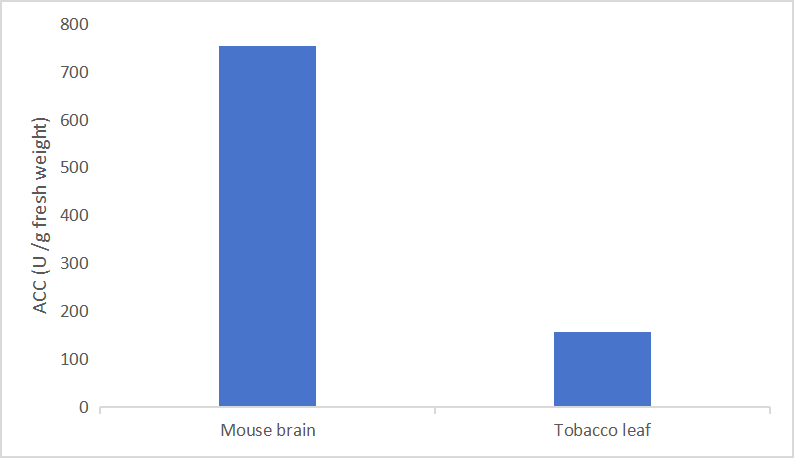
Sample compatibility is genuinely broad. The kit accepts animal and plant tissues, bacteria, cultured cells, serum, and plasma. The inclusion of plant tissue and bacterial samples is not a trivial expansion of the compatibility list; it opens the kit to herbicide discovery programs that need to screen ACC-inhibiting chemistries against resistant grass biotypes, and to plant lipid biologists studying oil accumulation in seeds where ACC activity is the primary determinant of carbon flux into fatty acid synthesis. The product background emphasizes that ACC catalyzes the carboxylation of acetyl-CoA to malonyl-CoA and functions as the key regulatory enzyme in the synthesis of fatty acids and many secondary metabolites—its activity determines, in part, both the rate of fatty acid synthesis and the level of oil content in biological tissues.
The kit has been validated through published, peer-reviewed application. A 2025 study in Frontiers in Veterinary Science employed KTB1261 to demonstrate that cryopreservation significantly reduces ACC activity in goat sperm, linking the enzymatic deficit to impaired very long-chain fatty acid biosynthesis and ultimately to the loss of sperm motility that plagues frozen-thawed semen. The authors measured ACC activity directly in fresh versus frozen-thawed sperm samples, integrated those data with metabolomic profiling and electron microscopy of mitochondrial ultrastructure, and used the combined evidence to identify capric acid supplementation as a potential cryoprotectant strategy. That a veterinary reproduction laboratory—operating far from the lipid metabolism core facilities and oncology pharmacology units that typically drive ACC research—could successfully deploy the kit and generate publication-quality data speaks to its practical accessibility.
Several usage notes deserve prominent mention. The protocol recommends performing several dilutions of the sample to ensure readings fall within the standard value range—a standard practice for enzymatic activity assays that the instructions state clearly rather than burying in a troubleshooting appendix. The ammonium molybdate phosphate detection method has been independently validated in multiple ACC assay systems, including a 2025 report confirming that malachite-green-based phosphate detection generates a Z'-factor of approximately 0.7 in high-throughput ACC inhibitor screening, a statistical performance metric that classifies the assay as an excellent screening system. KTB1261 applies the same phosphate detection logic—ACC produces phosphate, phosphate drives the colorimetric signal—in a pre-formulated, ready-to-use reagent format that eliminates the need to source and titrate individual phosphate detection components.
The broader metabolic context makes the case for routine ACC activity measurement increasingly urgent. ACC occupies a uniquely commanding position in lipid metabolism: it catalyzes the first committed and rate-limiting step of de novo fatty acid synthesis, and its product, malonyl-CoA, simultaneously serves as the carbon donor for fatty acid chain elongation and as a potent allosteric inhibitor of carnitine palmitoyltransferase 1, the enzyme that controls mitochondrial fatty acid import for β-oxidation. When ACC is active, fatty acid synthesis proceeds and fatty acid oxidation is suppressed. When ACC is inhibited—pharmacologically by compounds like ND-646 and firsocostat, or physiologically by AMPK-mediated phosphorylation at Ser79—the entire metabolic program reverses. This dual-control mechanism has made ACC a high-priority drug target for non-alcoholic steatohepatitis, obesity, type 2 diabetes, and multiple cancer types including non-small-cell lung cancer. An ACC inhibitor that successfully engages its target should produce a measurable decrease in ACC enzymatic activity in the tissue of interest. If that decrease cannot be demonstrated directly, the mechanism-of-action argument remains dependent on downstream markers that are themselves regulated by pathways entirely independent of ACC.
For the cancer biologist screening ACC inhibitors against tumor cell lines, the herbicide chemist profiling resistance mutations in grass weeds, the plant scientist engineering oilseed crops, or the reproductive physiologist investigating cryopreservation-induced metabolic damage, direct ACC activity measurement transforms a correlative metabolic observation into a mechanistic one. Knowing that malonyl-CoA levels decreased after treatment is correlation. Knowing that ACC catalytic activity dropped by 65% while ACL and FASN activities remained unchanged is mechanism. Knowing that a specific ACC inhibitor reduced enzyme activity with an IC₅₀ that matches the cellular growth inhibition EC₅₀ is target engagement. These are the distinctions that separate a descriptive metabolomics paper from a mechanistic enzymology story, and they are the distinctions that KTB1261 was engineered to enable.
The enzyme that governs the entry point of carbon into fatty acid synthesis is now measurable without a radioactivity license, without a mass spectrometer, and without the coupled-enzyme background subtraction that has historically made ACC activity data difficult to defend during peer review. Quantify the gatekeeper. Not the traffic downstream of it.
Explore the full specifications and place your order here: https://www.abbkine.com/product/chekine-micro-acetyl-coa-carboxylase-acc-activity-assay-kit-ktb1261/





