




The Comet Assay That Has Been Quietly Destroying Your Genotoxicity Data Since the Day You Trusted a Single-Well Protocol
Here is a scene that unfolds in toxicology laboratories with the regularity of a quarterly safety inspection. You irradiate your lymphocytes, embed them in agarose, perform alkaline unwinding, run the electrophoresis, stain with SYBR Green, and image under a fluorescence microscope. Tail moment: 12.4 ± 8.7. Olive tail moment: 9.1 ± 7.3. The coefficient of variation exceeds 70%. Your triplicate wells disagree by margins that erase the statistical significance of a six-dose-group genotoxicity study. The problem is not your electrophoresis voltage, your lysis duration, or your imaging software. The problem is a physical reality that single-well comet slide manufacturers refuse to acknowledge: edge effects distort electric field uniformity at the agarose-glass interface, and the resulting non-uniform DNA migration generates tail moment variability that no amount of post-hoc image analysis can correct.
The comet assay—single-cell gel electrophoresis (SCGE), the most widely used method for detecting DNA strand breaks, alkali-labile sites, and incomplete excision repair at the level of individual eukaryotic cells—suffers from a reproducibility crisis that is largely architectural rather than biochemical. When the electric field encounters the boundary between agarose gel and glass slide, field lines bend, current density varies across the gel surface, and fragmented DNA migrates at different velocities depending on where on the slide a given cell happens to sit. Cells near the edge of the agarose produce exaggerated tail moments. Cells in the center produce compressed ones. The resulting data distribution is artifactual, and no amount of increasing sample size can correct a systematic error built into the physical geometry of the assay platform.
KTA3040: The 3-Well Architecture That Finally Separates Sample Replication from Slide Geometry
Abbkine's Comet Assay Kit (3-Well Slides)—Catalog No. KTA3040—is not a rebranded generic SCGE protocol. It is a design-first re-engineering of the comet assay platform that addresses the physical origins of irreproducible tail moment measurements. Each slide contains three discrete wells, each engineered with a raised rim that constrains agarose within a defined boundary and ensures uniform electric field distribution across the entire gel surface. The consequence is immediate and measurable: intra-slide coefficient of variation drops below the levels achievable with single-well formats, and the triplicate measurements that statistical reviewers demand are built into the physical architecture of every slide.
The kit components are complete and pre-optimized: Comet Slides (3-Well), 10× Lysis Solution, EDTA (500 mM), Low Melting Point Agarose, Propidium Iodide (50×), and 40 mM Tris-HCl (pH 7.5). There is no requirement to source agarose from one vendor, lysis buffer from another, and electrophoresis-grade Tris from a third—a fragmentation that introduces buffer incompatibilities and lot-to-lot variability that compound across multi-day genotoxicity studies. The manufacturer explicitly warns against mixing reagents or materials from other kit lots or vendors, and that warning reflects the biochemical reality that alkaline comet assay performance depends on precise lysis buffer ionic strength, EDTA chelation capacity, and Tris neutralization buffer pH—parameters that drift when assembled from disparate sources.
The single agarose formulation eliminates a specific workflow burden that has frustrated comet assay users for decades. Traditional protocols demand sequential layering of normal melting point agarose as a base coat, followed by low melting point agarose for cell embedding, followed by a top layer to seal the preparation—a three-layer construction that consumes technician time and introduces adhesive failure points at each gel-gel interface. KTA3040 uses a single low melting point agarose formulation that adheres directly to the specially treated slide surface. The result: samples do not detach during the aggressive lysis and alkaline unwinding steps that strip poorly adhered gels from untreated glass. "Compared to multilayer agaroses, the sample is not easy to fall off"—a specification that translates directly into fewer lost samples and fewer experiments abandoned mid-protocol.
The detection reagent is propidium iodide, the classic intercalating DNA dye (excitation ~535 nm, emission ~617 nm), supplied as a 50× concentrate. Under alkaline electrophoresis conditions, fragmented DNA migrates toward the anode: intact genomic DNA remains within the nuclear boundary, forming a circular or slightly tailed pattern, while fragmented DNA produces the characteristic comet-like morphology with a dense head and a diffuse tail whose length and intensity are proportional to the extent of DNA damage. The PI staining protocol is compatible with standard epifluorescence microscopes equipped with TRITC or PE filter sets—hardware that exists in virtually every cell biology laboratory—and does not require the SYBR Gold, SYBR Green, or ethidium bromide alternatives that introduce additional fluorescent channel conflicts in multiplexed imaging workflows.
Alkaline vs. Neutral: The Protocol Decision That Defines What DNA Damage You Actually Detect
The alkaline comet assay—the protocol implemented by KTA3040—operates at pH greater than 13, denaturing double-stranded DNA and converting alkali-labile sites (apurinic/apyrimidinic sites, base modifications) into detectable strand breaks. Under these conditions, the assay reports single-strand breaks, double-strand breaks, alkali-labile sites, and intermediates of base and nucleotide excision repair simultaneously. The neutral comet assay, by contrast, operates at pH 7–8, retains double-stranded DNA structure, and detects only double-strand breaks. The distinction is not academic. If a genotoxicity study aims to detect oxidative base damage, alkylation lesions, or incomplete repair intermediates—precisely the damage spectrum produced by ionizing radiation, heavy metals, and alkylating chemotherapeutics—the neutral assay will produce false-negative results. The alkaline comet assay is the appropriate detection modality for comprehensive DNA damage screening, and KTA3040's alkaline protocol is validated for this purpose.
The biochemical principle is elegantly simple and devastatingly sensitive. Cells are mixed with molten agarose at 37°C and applied to the 3-well slide. After gelation at 4°C, the embedded cells are immersed in lysis solution, which strips membranes, removes histones, and releases naked DNA into the agarose matrix. Alkaline unwinding solution (pH > 13) relaxes supercoiled DNA and denatures double strands. During electrophoresis, undamaged high-molecular-weight DNA migrates slowly and remains within the nucleoid boundary; fragmented DNA, having lost its superhelical constraint, migrates freely toward the anode, forming the comet tail. After neutralization with Tris-HCl, PI staining quantitatively labels all DNA, and the ratio of tail fluorescence to total fluorescence provides a direct measure of DNA damage at the single-cell level.
Publication-Grade Reproducibility: Your Genotoxicity Data Is Only as Strong as the KTA3040 Slide Geometry That Generated It
The comet assay was first described in 1984 and has since accumulated over four decades of methodological refinement. The alkaline variant specifically—measuring single-strand breaks, double-strand breaks, and alkali-labile sites in individual eukaryotic cells—has become the most common method for DNA damage assessment in toxicology, radiation biology, and drug safety screening, with comprehensive methodological guides published in peer-reviewed journals and standard operating procedures established by the International Comet Assay Workshop . In this mature methodological landscape, the remaining sources of inter-laboratory variability are not biochemical—they are physical, and they center on the slide platform.
KTA3030 has been cited in 9 peer-reviewed publications at the time of writing, spanning journals whose impact factors range from 15.7 to 4.0. These are not promotional placements. They represent independent laboratories that validated the kit's performance across diverse genotoxicity models and chose to stake their publications on the resulting comet images. The product page lists publications in the International Journal of Biological Sciences (IF 15.7), Nature Communications (IF 12.8), and additional journals spanning toxicology and cancer biology. The diversity of applications is instructive: the kit appears in plant DNA repair studies investigating AtMCM10's role in homologous recombination via liquid-liquid phase separation, in radiation biology research examining glioblastoma response to radiotherapy, and in toxicology screening across chemical genotoxicity assessment workflows.
Every citation represents a laboratory that ran KTA3040 through its own validation pipeline—testing it against its own cell types, with its own genotoxic challenges, under its own electrophoresis conditions—and found the performance sufficient for peer-reviewed publication. For the researcher evaluating comet assay kits across vendors, a documented citation record in high-impact journals provides the most reliable evidence of community-tested performance.
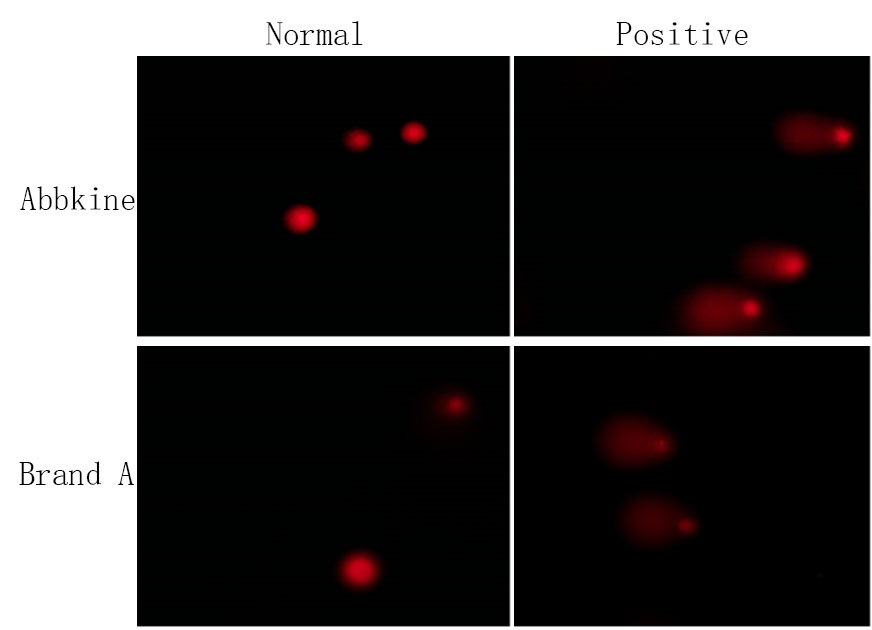
Manufacturer-provided comparison data demonstrate that the kit produces fluorescence brightness and image clarity exceeding those of competitor products. In a head-to-head comparison using the kit to detect DNA damage in Jurkat normal cells and a DNA-damage-induced positive control group, Abbkine's Comet Assay Kit delivered superior brightness and sharpness relative to a competing brand, a performance differential attributed to optimized PI staining reagent formulation and reduced background from the single-layer agarose architecture.
Practical Protocol Decisions That Distinguish Publication-Grade Comet Images from the Data Your Committee Will Question
The instructions packed with KTA3040 reflect a manufacturer's understanding of what actually goes wrong at the bench, and the level of detail exceeds the generic protocol descriptions typical of budget comet kits.
Storage is clearly specified: the complete kit is stored at 4°C for up to 6 months, protected from light, and ships on gel pack with blue ice. The light protection requirement is non-negotiable—PI is a fluorescent dye subject to photobleaching, and ambient laboratory lighting degrades both the stock concentrate and stained slides, compressing the dynamic range between undamaged and heavily damaged cells. The PI stock solution is supplied as a 50× concentrate that must be diluted immediately before use and protected from light during staining and imaging.
Lysis and alkaline unwinding duration are protocol parameters that materially affect assay sensitivity. The kit's lysis solution contains detergents and high-salt components that strip cellular membranes and remove histones. Under-lysis leaves residual protein bound to DNA, restricting migration and producing falsely short comet tails. Over-lysis can strip DNA from the gel matrix entirely, producing ghost comets with absent heads. The recommended lysis duration at 4°C is optimized for mammalian cell lines and primary lymphocytes; tissues may require extended lysis with agitation.
Electrophoresis conditions demand attention to both voltage and buffer temperature. The alkaline electrophoresis buffer contains NaOH and EDTA at concentrations that maintain pH above 13. Electrophoresis generates resistive heating, and buffer temperature above 15°C accelerates DNA diffusion, blurring comet tail boundaries and confounding image analysis. The kit protocol recommends pre-chilling the electrophoresis buffer to 4°C and monitoring buffer temperature throughout the run. A starting current of 300 mA (approximately 1 V/cm gel surface) is typical for mammalian cells; optimization may be required for non-mammalian species with different genome sizes and chromatin packaging densities.
The product is designated for research use only and is not intended for human or clinical diagnostic applications. This is a standard disclaimer that reflects the kit's positioning in the preclinical research ecosystem where comet assays serve as screening tools for genotoxicity, DNA repair kinetics, and chemotherapeutic drug development rather than regulated diagnostic procedures.
The Broader DNA Damage Detection Ecosystem
KTA3040 exists within a DNA damage detection landscape that includes the alkaline comet assay as its foundational technology, alongside complementary approaches such as γ-H2AX immunostaining for double-strand break foci, TUNEL for apoptotic DNA fragmentation, and the micronucleus assay for chromosomal damage. The comet assay's unique advantage—single-cell resolution of DNA strand breaks without requiring antibodies, transgenic reporters, or flow cytometry—positions it as the first-line screening tool in genotoxicity assessment pipelines. KTA3040's 3-well slide architecture respects this role by enabling simultaneous processing of positive control, negative control, and experimental sample on a single physical platform, eliminating the inter-slide variability that compromises single-well formats.
Product Details:
- Product Name: Comet Assay Kit (3-Well Slides)
- Brand: Abbkine
- Catalog Number: KTA3040
- Method: Single Cell Gel Electrophoresis (SCGE) Assay, Alkaline (pH > 13)
- Kit Components: Comet Slides (3-Well); 10× Lysis Solution; EDTA (500 mM); Agarose (Low Melting Point); Propidium Iodide (PI) (50×); 40 mM Tris-HCl (pH 7.5)
- Detection: Propidium Iodide staining (Ex/Em: ~535 nm / ~617 nm); fluorescence microscopy
- Slide Design: 3-well glass slides with raised rim for uniform electric field distribution; single agarose layer application
- Applications: Detection of single-strand DNA breaks, double-strand DNA breaks, alkali-labile sites, and DNA repair intermediates; genotoxicity screening; radiation biology; chemotherapeutic drug development; environmental toxicology; DNA repair kinetics studies
- Features & Benefits: Complete reagents with unique comet slides; simple operation without multi-layer agarose curing; sample adhesion reliability
- Storage: 4°C for 6 months, protected from light
- Shipping: Gel pack with blue ice
- Citations: 9 peer-reviewed publications
Product Link: https://www.abbkine.com/product/comet-assay-kit-3-well-slides-kta3040/





