




The 2-Minute Gatekeeper: Why the Bradford Assay Is Still the Everyday Workhorse — and How Abbkine's KTD3002 Makes It Bulletproof
Nothing kills a good Western blot, IP, or enzyme prep faster than a bad protein number at the very beginning. You can have the cleanest antibody in the world and the fanciest OrbiTrap queue lined up, but if your lysate concentration is off by 30%, every normalization, every band intensity, and every "fold-change" becomes a rounding error in disguise. That's why the Bradford assay remains the true daily workhorse of protein quantification — fast, dye-binding, no heating step, no alkali, no copper chemistry to get upset by EDTA. The Protein Quantification Kit (Bradford Assay) — KTD3002 from Abbkine packages this classic into a ready-to-use, Coomassie G-250–based system with calibrated BSA standards and a clearly defined interference envelope, so your "quick protein check" actually stays quick, and more importantly, reliable.
The Chemistry in Plain English: A Dye That Changes Color When It Hugs Your Protein
The Bradford assay revolves around Coomassie Brilliant Blue G-250 dissolved in an acidic medium (usually phosphoric or hydrochloric acid with ethanol/methanol). In its free state, the dye exists in a reddish-brown protonated form absorbing near ~465–488 nm. When it binds to protein — primarily through cationic (Arg) residues and hydrophobic patches — the complex shifts to a stable blue form whose absorbance peaks sharply at 595 nm.
The beautiful part for day-to-day bench work? Equilibrium is reached in about 2 minutes, and the protein–dye complex stays stable at room temperature for ~1 hour. No hot water baths, no 30-minute incubations, no waiting for color to "develop." You pipette, mix, wait one coffee sip, and read.
Why "Bradford" Beats "BCA" in the Everyday Lane (and Vice Versa)
If KTD3001 (BCA) is your choice for alkali-stable, detergent-tolerant, low-pH-sensitive precision work, KTD3002 (Bradford) is the champion of speed, simplicity, and compatibility with reducing agents:
Parameter Bradford (KTD3002) BCA (KTD3001)
Time-to-read ~2 min after mixing (RT) 30 min @ 37°C or 2 h RT (or heated)
Chemistry Dye-binding (acidic, G-250) Cu²⁺ reduction + bicinchoninic acid (alkaline)
Reducer tolerance ✅ Up to ~1 mM β-mercaptoethanol, ~5 mM DTT ❌ Strongly inhibited by DTT/β-ME at higher levels
Detergent caveat ⚠️ Must limit SDS < 0.1%, Triton X-100 < 0.1%, Tween 20/60/80 < 0.06% Better with mild nonionics; worse with SDS above threshold
pH sensitivity Needs acidic environment — sample pH shift can matter Loves alkaline pH; more tolerant of some salts
Protein-to-protein variance Slightly higher variance (Arg-rich vs. Arg-poor) Generally flatter response across diverse proteins
Translation: If your lysis buffer is RIPA with 1% SDS or you're swimming in Triton/Tween above the cutoffs, you don't just "run Bradford anyway" — you either dilute the lysate into the dye so those detergents fall below threshold, or you switch to BCA. But if your buffer is mildly nonionic and you keep detergents in check, Bradford's 2-minute read becomes your productivity hack of the week.
What's Inside KTD3002 (and Why the "Kit" Format Matters Here)
This isn't "buy G-250 powder and spend Friday afternoon adjusting phosphoric acid." The kit is set up so the chemistry is already solved:
• Coomassie Assay Reagent (Bradford Reagent) — pre-formulated acidic G-250 working solution, ready to use
• BSA Standard (Albumin Standard) — to build a proper standard curve on the same plate as your samples
Available in scalable sizes (500 T / 2000 T / 5000 T), so whether you're checking 6 lysates or qualifying 96 fractions, you're not overbuying or under-running. Storage is 2–8°C unopened, shipped blue ice, research use only (not for clinical diagnosis).
The 5-Minute Workflow (Literally)
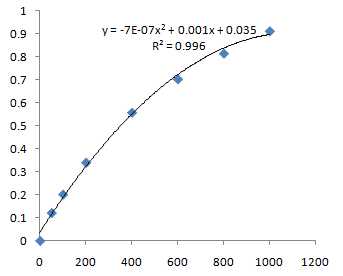
- Prepare the BSA standard curve across the linear range — typically 50–1000 µg/mL for Bradford — by diluting the provided BSA standard in your actual buffer blank (not pure water) whenever possible.
- Add sample (or standard) to a tube/well, then add Bradford Reagent (typical ratios are easy — e.g., 5–10 µL sample + 200 µL reagent in a 96-well plate, or 1 mL scale in a cuvette — follow the kit's stated volumes).
- Wait ~2 min (room temperature). The blue color is stable for about an hour, so you don't have to race the clock, but don't leave it overnight either.
- Read Absorbance at 595 nm on your microplate reader or spectrophotometer.
- Plot standard curve → fit (linear or 4-PL) → interpolate unknowns → back-calculate for any dilutions.
That's it. No heater, no copper precipitation, no "why is my working reagent cloudy today?"
The One Rule That Saves You: Watch the Detergents
This is where most "Bradford gave me garbage" stories come from — not the dye, but the surfactant load:
• SDS must be < 0.1% (w/v) in the final assay mixture
• Triton X-100 < 0.1%
• Tween 20 / 60 / 80 < 0.06%
Practical fix: If your stock lysis buffer is 1% Triton X-100, don't panic — just dilute your lysate 1:10 or 1:20 into the Bradford Reagent so the final Triton hitting the dye is well under 0.1%. Run your BSA standards in that same diluted buffer matrix and your curve will thank you.
Also: the kit explicitly tolerates β-mercaptoethanol up to ~1 mM and DTT up to ~5 mM in the sample — handy when your lysis buffer carries mild reductants that would kneecap a BCA.
Where KTD3002 Earns Its Keep (Use Cases)
• Daily lysate normalization before SDS-PAGE / Western — the classic: equal µg, not equal µL.
• Fraction tracking during protein purification — column eluate, Ni-NTA fractions, salt cuts — fast 595 nm reads between fractions.
• Cell surface/biotinylation & membrane preps where you're in milder detergent ranges and want speed over extreme sensitivity.
• Fermentation / culture supernatant checks (if protein is present at detectable levels and media components won't interfere).
• High-throughput screening prep — 96-well format means you can quantify 60+ samples in one plate while your gel is casting.
Bradford vs. BCA: The Lab-Practical Cheat Sheet
• Choose Bradford (KTD3002) when: you want fast, your detergents are under control (or easily diluted), and you have mild reductants in play.
• Choose BCA (KTD3001) when: you're dealing with higher SDS, higher salt/alkali conditions, or you want the flatter protein-to-protein response and thermal signal boost for low-input preps.
In a sane lab workflow, you don't pick one dogmatically — you keep both on the shelf and deploy whichever matches the lysis buffer you actually used.
The Bottom Line
Your data is only as honest as your protein quantification. The Protein Quantification Kit (Bradford Assay) — KTD3002 from Abbkine takes the classic Coomassie G-250 method and strips away the prep headaches: pre-formulated reagent, matched BSA standard, defined linear range (50–1000 µg/mL, sensitivity ~25 µg/mL), and a clear interference envelope so you know exactly where it'll thrive and where it needs a dilution. Two minutes from mix to read, rock-solid for daily throughput, and cheap enough to run everywhere without guilt — this is the gatekeeper your Westerns and purifications deserve.
Product Reference: KTD3002 – Protein Quantification Kit (Bradford Assay)
Learn more and order: https://www.abbkine.com/product/protein-quantification-kit-bradford-assay-ktd3002/





