




Kill the Rotten-Egg Smell at the Source: Why Abbkine's 5X SDS-PAGE Loading Buffer (KTD3003) Is the Laemmli Upgrade Your Bench Deserves
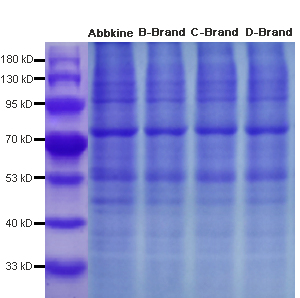
There are few experiences in the life sciences more universally relatable — or more universally loathed — than cracking open a tube of traditional loading buffer and getting hit by that sharp, sulfurous wall of β-mercaptoethanol (2-ME) vapor. It burns your nose, lingers on your gloves for hours, and serves as a daily reminder that one of the most mission-critical reagents in your workflow is still stuck in a prehistoric formulation. The SDS-PAGE Protein Sample Loading Buffer (5X) — KTD3003 from Abbkine is here to retire that problem. This isn't just another "5X Laemmli buffer" you measure out in a fume hood while holding your breath. It's a pre-formulated, ready-to-use, 5× concentrated loading buffer built around a novel, odorless reducing agent that outperforms and outlasts the old-school 2-ME/DTT duo — giving you sharp bands, reproducible denaturation, and a lab atmosphere that doesn't smell like a boiled rotten egg.
The Loading Buffer: Small Volume, Massive Influence
Every SDS-PAGE gel — and by extension every Western blot behind it — rises or falls on what happens before you even touch the pipette to the well. The loading buffer's job is deceptively multi-functional: it must denature proteins into linear polypeptides, coat them uniformly with negative charge via SDS, break inter-chain disulfide bridges so subunits run as true monomers, increase sample density so your lysate sinks cleanly into the well, and give you a visible tracker dye to pace the run. Skip or weaken any one of those jobs, and you pay for it with smeared lanes, uneven front lines, floating sample, or ghost bands that waste an entire day. KTD3003 is engineered so that every one of those jobs fires on all cylinders — and stays fired — without the chemical hostility.
The Secret Weapon: A Next-Gen Reducing Agent That Replaces 2-ME & DTT
Here's the real story behind this product's design, and why it matters more than you might think.
Traditional Laemmli loading buffers rely on β-mercaptoethanol (5% v/v) or DTT (0.5–1 M) as the disulfide-bond reducer. Both work — but both come with baggage:
• 2-ME is volatile, foul-smelling, classified as hazardous, and oxidizes progressively once the tube is opened, which gradually weakens its reducing punch.
• DTT is more expensive, still smells unpleasant, and its free thiols can interfere with downstream considerations if you aren't careful with excess carryover.
KTD3003 solves this with a proprietary, stability-optimized, essentially odorless reducing agent that replaces both traditional options while delivering superior and more consistent reductive performance. The result is a buffer that:
• Doesn't announce its presence the moment you open the tube — no more clearing the bench or turning on the fume hood fan for "buffer prep."
• Holds its reducing power longer under storage, so your last lane looks like your first lane even across a long experimental run.
• Keeps the chemistry aggressive where it counts — disulfide bonds in multi-subunit proteins get cleanly broken, preventing aggregation and ensuring accurate apparent molecular weight.
What's Inside: The 5X Laemmli Architecture, Refined
While the exact formulation is proprietary, KTD3003 follows the classic, proven 5× Laemmli skeleton that the entire field runs on — just executed with better ingredients:
Component Role in Your Lane
~250 mM Tris-HCl, pH 6.8 Anchors the buffer at the optimal weak-acid pH for SDS–protein binding and sample stability before the run
~10% (w/v) SDS The anionic detergent that denatures, linearizes, and negatively charges your proteome so migration depends only on size
~50% (v/v) glycerol Drives sample density so it sinks into the bottom of the well instead of diffusing upward into the running buffer
Bromophenol Blue (~0.05% w/v) The iconic blue tracking dye — rides the ion front just ahead of the smallest resolved proteins, letting you gauge run progress at a glance
Proprietary odorless reducing agent Slices inter- and intramolecular disulfide bonds so multi-subunit complexes (antibodies, dimers, kinases) resolve as true monomers
You treat it exactly the way you expect: 1 part 5X buffer + 4 parts protein sample → mix → heat (commonly 95–100 °C for 5–10 min) → chill briefly → load.
The 3-Minute Prep (Because It's Already 5X and Ready-to-Use)
One of the quiet luxuries of KTD3003 is that there's almost nothing to "make." It ships as a 10 mL 5× ready-to-use liquid.
Typical workflow:
- Grab your cleared protein lysate (already quantified — because you ran a BCA from KTD3001, right?).
- Mix 4 µL lysate + 1 µL KTD3003 in a PCR tube (or 20 µL + 5 µL, or whatever scales to your well volume).
- Heat 95–100 °C for 5–10 min. Spin briefly to collect condensate.
- Load directly onto your gel. Watch that blue streak sink perfectly into the well bottom.
No weighing SDS powder. No adjusting pH at the bench. No "add 2-ME now and hurry." The 5× concentrate is pre-balanced so you just dilute-and-boil.
Where KTD3003 Saves You (and Where It Shines Brightest)
Scenario Why the Odorless 5X Buffer Wins
Daily expression checks (His-tag / GST / GFP fusions) Fast prep, no smell, consistent reducing power = lanes you can trust on the first try
Precious clinical or animal samples (limited tissue, can't afford a ruined prep) Stable reducing chemistry means even tiny-volume preps get fully denatured/disulfide-broken
Multi-gel marathons (12+ samples, multiple conditions) Open the tube, dispense, close — no fume hood drama, no degrading reducer mid-run
Shared core spaces / teaching labs Eliminates the "who left the 2-ME open again" problem; much friendlier for students and non-toxicology-trained users
Downstream Western Blot quality Fully denatured, evenly loaded, low-variability samples = sharper target bands & cleaner normalization
Storage, Handling & The One Rule That Protects Your Data
• Store at -20°C (spontaneous shipment date, stable 12 months) ; ship blue ice.
• Because it's a reducing system, limit unnecessary thaw/refreeze cycles — aliquoting into smaller tubes (e.g., 10–20 × 500 µL working tubes) is the belt-and-suspenders move for labs running gels daily.
• Always denature hot (≥95 °C) for standard samples — partial denaturation is the silent killer behind "why is my band smeared upward?"
• Yes — it's For Research Use Only, NOT for diagnostics — use it where it belongs: pushing discovery forward.
The Bottom Line
Your gel is only as honest as the 30 seconds before you load it. The SDS-PAGE Protein Sample Loading Buffer (5X) — KTD3003 from Abbkine takes the most chemically abrasive step in electrophoresis and modernizes it: ready-to-use 5× format, rock-solid Laemmli architecture, and a next-gen odorless reducing agent that replaces the ancient 2-ME/DTT headache with cleaner air and more consistent band morphology. No drama. No sulfur sting. Just load, run, and move on with your science.
Product Reference: KTD3003 – SDS-PAGE Protein Sample Loading Buffer (5X)
Learn more & order: https://www.abbkine.com/product/sds-page-protein-sample-loading-buffer-5x-ktd3003/





