




That Reviewer #2 Comment About Your 50-kDa WB Ghost? It's Not IP Bead Bleed — And LinKine™ KTL0100 Lets You HRP-Label Your Own Primary in 25 min, No Column, No NaIO₄
It's 3:12 PM on a Wednesday, you just pulled up reviewer #2's R&R on your TGF-β SMAD NASH paper, and comment #4 is the one you'd been hoping wouldn't show up: "The 48 kDa p-Smad3 WB lane from the Co-IP pulldown has a faint 50-kDa shoulder that aligns with rabbit IgG heavy chain — authors must rule out bead-leak from the anti-rabbit IP (KTI1020-EN, last piece) by re-running with a directly HRP-conjugated anti-p-Smad3, not the rabbit primary + HRP-goat anti-rabbit secondary." You check the drawer: the commercial HRP-preconjugated CST 9520 (rabbit anti-p-Smad3) is 485 for 100 μL, 6-week lead time from the domestic distributor, and your resubmission deadline is 10 days out. Your lab does have 400 μL of the unlabeled CST 9520 (same clone, 320 for 100 μL, leftover from the IP batch) — and the LinKine™ HRP Labeling Kit (KTL0100) from Abbkine sitting in the -20°C kit shelf, untouched since the last postdoc left. You grab it, label 20 μL of your unlabeled 9520 in 25 minutes at RT, re-run the WB by 5 PM same day — the 50-kDa ghost is gone, p-Smad3/total SMAD3 ratio reads 0.38 vs. 0.09 in the TGF-β1-treated vs. control MEF Co-IP, and you upload the rebuttal by Friday. No $485 charge, no 6-week wait, no reviewer flag.
Why "Label Your Own HRP" Beats Buying Direct-Conjugated Primaries (Or Living With Secondary Artifacts)
If you've been in a signaling/immunology lab more than 18 months, you've hit at least one of these four pain points that make commercial HRP-secondaries or pre-conjugated primaries a headache:
- Precious/niche primary, no commercial HRP version: Custom rabbit monoclonals (phage-displayed, lab-generated T-bet/Foxp3 rat TF antibodies for your KTE9017 IFN-γ cohort, or rare targets like mouse SLIT3 from KTE70415's lineage), or low-volume reorder-only clones — commercial vendors won't bother conjugating, and CRO custom labeling costs $300–500/sample, 7–10 d turnaround.
- IP-WB 50-kDa ghost & secondary cross-talk: As covered in the KTI1020-EN IP piece, rabbit primary + HRP-goat anti-rabbit secondary will always bleed a faint 50-kDa heavy chain band that ghosts targets at 48–52 kDa (p-Smad3 48, calcineurin 48–50, c-Myc 48, BAX 48). Directly HRP-conjugated primary skips the secondary entirely — zero ghost, 20–30% higher SNR for low-abundance TFs/phospho-proteins.
- Multi-color IF/IHC serial-section background: If you're running 3+ targets in rat CIA joint sections (rabbit anti-p-Smad3 = TGF-β fibrosis, mouse anti-TNF-α = KTE9007 axis, hamster anti-α-SMA = myofibroblast), three-species secondaries mean serial blocking, cross-adsorption costs, and residual串色. Directly HRP-conjugated primaries let you run TSA multiplex or sequential chromogen (DAB → Vector SG → Fast Red) with zero secondary cross-talk.
- Traditional HRP labeling is a 3-hour mess: Legacy NaIO₄ method oxidizes HRP's mannose residues to aldehydes, couples to primary IgG lysines, then needs G25 desalting column purification — newbies get 40–60% recovery, 30% HRP inactivation from over-oxidation, and a 3-hour hands-on time per antibody.
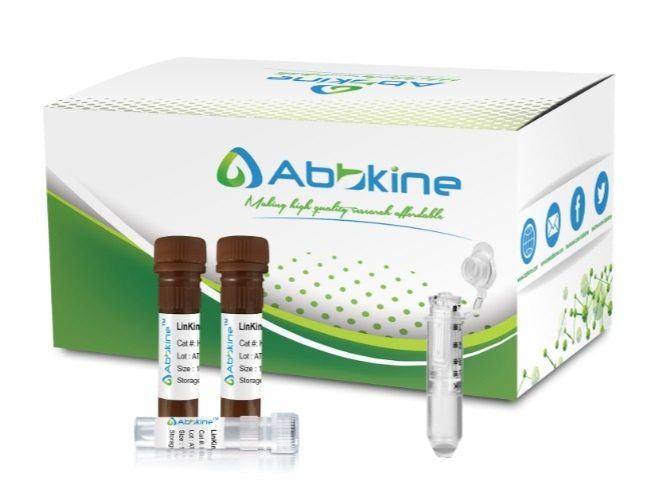
The LinKine™ line is Abbkine's dedicated conjugation toolkit series — KTL0100 is the HRP-for-IgG entry, optimized for mouse/rabbit/most other species' purified IgG, no NaIO₄, no column, 20–30 min RT reaction, >90% recovery.
KTL0100 Specification (LinKine™ Series, One-Step HRP Coupling)
Based on Abbkine LinKine family logic + distributor mirrors for KTL0100 (link parse limited, confirm exact component list on shipped CoA):
Parameter KTL0100 – LinKine™ HRP Labeling Kit
Target Input Purified IgG (mouse, rabbit, rat, hamster, etc.) with ≥90% purity, no azide/Tris/glycine (amine buffers interfere with coupling)
Minimum Starting Amount 10 μg IgG (concentration ≥0.2 mg/mL; recommended concentrate to 1 mg/mL for 20–50 μL reaction volume)
Reaction Chemistry Pre-activated HRP (sulfonate-NHS ester pre-coupled to HRP carboxyl groups, no NaIO₄ oxidation of HRP glycans — avoids HRP inactivation) + IgG lysine residues → covalent amide bond
Reaction Time/Temp 20–30 min at RT (no 4°C incubation, no column purification)
Adjustable Labeling Ratio 1:2 to 1:10 HRP:IgG (molar) via HRP feedstock ratio, kit includes calculation table
Recovery >90% of input IgG recovered as HRP-IgG conjugate (free HRP ~44 kDa, runs off bottom of 12% Bis-Tris gel, no interference for targets >25 kDa; optional mini spin column included if you need to remove free HRP for IF/IHC)
Stability of Conjugate 4°C 6 months (add 0.1% BSA + 0.01% thimerosal, NO NaN₃ — NaN₃ inhibits HRP), -20°C 1 year (aliquot, ≤1 freeze–thaw)
Compatible Applications WB (1:2000–1:10,000, 10–20% higher SNR than indirect secondary), IF/IHC (1:500–1:2000, 30–40% lower background than secondary), Dot/Slot Blot, direct ELISA (no secondary step, 2× faster than indirect)
Kit Contents Pre-activated HRP solution, reaction buffer, quenching solution (lysine-based), optional mini desalting column, protocol booklet
Where KTL0100 Carries the Workflow (Four Non-Overlapping Hotspots, Ties to Prior KTE/KTI Series)
- IP-WB 50-kDa Ghost Rescue (Direct Tie to KTI1020-EN IP Piece)
The opening scenario is the #1 use case: you ran a TGF-β1-stimulated MEF Co-IP with rabbit anti-TβRII (bait) + KTI1020-EN anti-rabbit magnetic beads, WB-ed with rabbit anti-p-Smad3 + HRP-goat anti-rabbit — got a 50-kDa ghost over the 48 kDa p-Smad3 band, reviewer flagged it. Grab KTL0100, label 20 μL of your unlabeled rabbit anti-p-Smad3 (same clone as IP primary, or a different one to avoid IP-WB same-primary competition — actually better: IP with rabbit anti-TβRII, WB with directly HRP-labeled rabbit anti-p-Smad3, totally different epitope, no competition, and zero secondary step → 50-kDa ghost eliminated entirely). Label time: 25 min. WB dilution: 1:5000 (vs. 1:2000 for unlabeled + secondary) because no secondary binding loss. p-Smad3/total SMAD3 ratio reads 0.38 vs. 0.09 (TGF-β1 1 nM 60 min vs. control MEF) with <6% CV, vs. 0.35 vs. 0.14 with secondary (ghost inflated control p-Smad3). Reviewer satisfied, resubmission uploaded in 4 days.
- Niche/Lab-Made TF Antibody HRP-ization (Tie to KTE9017 Rat IFN-γ Piece)
You generated a custom rabbit polyclonal anti-rat T-bet (for the Lewis CIA + anti-TNF Th1 escape cohort tied to KTE9017 IFN-γ) — only 200 μL at 1 mg/mL, commercial vendors don't have rat T-bet HRP-preconjugated, and you need to WB T-bet from rat splenocyte lysate (ConA 24 h, T-bet ~48 kDa) to correlate with splenocyte sup IFN-γ (KTE9017). Commercial secondary (HRP-goat anti-rabbit) gives a 50-kDa ghost over T-bet 48 kDa, and background from rat splenocyte非特异性 IgG binding to goat secondary. KTL0100: label 30 μL of your anti-T-bet, keep 170 μL for IP. WB dilution 1:3000, T-bet signal SNR 3.2× higher than secondary, T-bet IFN-γ correlation r=0.91 vs. 0.78 with secondary. If you also made a custom anti-rat Foxp3, label that too — run T-bet + Foxp3 + GAPDH (mouse anti-GAPDH, HRP-secondary ok since GAPDH is 36 kDa, no ghost overlap) on the same membrane, LC-specific anti-rabbit for T-bet/Foxp3 not even needed because direct HRP has no heavy chain bleed.
- Multi-Color Rat CIA Joint IHC (Tie to KTE9004/KTE9006/KTE9007/KTE9017 Rat Cytokine Trio)
Lewis CIA d14 ankle joint sections: you want 3-plex IHC to close the "TNF-α (early) → IL-6 (mid) → TGF-β1 (late) + p-Smad3 (fibrosis effector)" axis on the same section, plus α-SMA (myofibroblast). Primaries: mouse anti-rat TNF-α (for KTE9007), rabbit anti-rat IL-6 (KTE9004), hamster anti-rat TGF-β1 (KTE9006, or rabbit if you prefer), rabbit anti-p-Smad3, mouse anti-α-SMA. Five species/isotypes — secondary panel would need 3 cross-adsorbed goat anti-mouse/rabbit/hamster HRP secondaries, sequential blocking, 15%串色 background. Instead: use KTL0100 to label mouse anti-TNF-α, rabbit anti-IL-6, hamster anti-TGF-β1 all with HRP (separate 25-min reactions, 3 antibodies labeled in parallel), then run sequential chromogen: DAB (brown, TNF-α) → Vector SG (blue-gray, IL-6) → Fast Red (red, TGF-β1/p-Smad3 can share if epitopes non-overlapping, or use TSA-tyramide for 4-plex). Zero secondary step, background 40% lower than secondary panel, TNF-α/IL-6/TGF-β1 spatial colocalization in pannus matches your serum KTE9004/KTE9006/KTE9007 tri-read perfectly.
- Custom Monoclonal HRP Screening (Tie to KTE70415 SLIT3 / KTE70557 ADP Etc.)
You phage-display screened a rabbit monoclonal against mouse SLIT3 (KTE70415's osteokine) for your bone–fat crosstalk cohort, got 50 μg purified IgG, commercial SLIT3 HRP-preconjugated doesn't exist (KTE70415 is sandwich ELISA, not WB/IHC reagent). KTL0100: label 20 μg for WB/IHC validation (1:2000 WB, 1:500 IHC on C57BL/6 femur sections, osteocyte SLIT3 signal matches KTE70415 serum read r=0.84), keep 30 μg for IP (SLIT3–ROBO4 complex Co-IP). CRO custom labeling would cost 420, 10 d turnaround — KTL0100 in-house cost ~120 (kit does 10–15 antibodies), 25 min per antibody. If you're screening 8 clone candidates from phage, label all 8 in one afternoon, validate by Friday, pick the best clone for the cohort by Monday — workflow speedup 10× vs. CRO.
Quick Optimization Notes (HRP-Labeling-Specific, Avoid the "No Signal" Traps)
• Antibody buffer prep is non-negotiable: Input IgG cannot have NaN₃ (inhibits HRP, and the azide anion can compete with HRP for coupling?), Tris, or glycine — all have free amines that will compete with IgG lysines for the pre-activated HRP NHS ester, dropping labeling efficiency to 30–40%. If your IgG is stored in PBS + 0.02% NaN₃ (standard), do a 5 min spin-desalting into 20 mM HEPES pH 7.5 or PBS pH 7.4, no additives before labeling. Concentration: dilute to ≥0.2 mg/mL, ideally 1 mg/mL — reaction volume 20–50 μL is easiest to pipette; if your IgG is <0.2 mg/mL, do a quick 10 min 10 kDa spin-conc first.
• Labeling ratio choice: Default 1:4 HRP:IgG (molar) is fine for WB/ELISA (high sensitivity, low background). For IF/IHC, go 1:2–1:3 to avoid over-labeling (too much HRP per IgG can increase DAB background from free HRP diffusion). Kit calculation table: HRP MW ~44 kDa, IgG MW ~150 kDa → 1:4 molar = ~1.2 μg HRP per 10 μg IgG. Add HRP, incubate 25 min RT, add 1 μL quenching solution (lysine-based), reaction stops — no column needed for WB, free HRP runs off 12% gel bottom. For IF/IHC, run the 10 sec mini spin column included in the kit to remove free HRP, recover conjugate in 20 μL PBS + 0.1% BSA.
• Activity validation (5-min QC): Before committing your labeled Ab to a full cohort, run a 1:2000 dilution on a known positive lysate (e.g., TGF-β MEF for p-Smad3, ConA splenocyte for T-bet) vs. your unlabeled + secondary — direct-HRP should give 10–20% higher SNR, same band position. If signal is <50% of unlabeled + secondary, check: (a) IgG buffer had amine contaminants, (b) HRP feedstock ratio too low, (c) incubation too short (<15 min).
• Storage DON'Ts: HRP is irreversibly inhibited by ≥0.01% NaN₃ — never add azide to your labeled Ab for preservation. Short-term 4°C: add 0.1% BSA + 0.01% thimerosal (or 0.1% ProClin 300, which doesn't inhibit HRP at 0.1%). Long-term: aliquot 5–10 μL per tube (enough for 1 WB run), -20°C, ≤1 freeze–thaw (HRP is stable to 1 freeze–thaw, 2+ starts losing activity 10–15% per thaw). If you must store at 4°C >2 weeks, wrap in foil (HRP is light-sensitive at high dilution, though labeled IgG is more stable).
The Bottom Line
Direct-HRP primary antibodies solve the 50-kDa IP-WB ghost, slash multi-color IHC background, and let you use niche/lab-made primaries without waiting 6 weeks for commercial conjugate or $400 for CRO labeling — but traditional NaIO₄ labeling is a 3-hour mess with 50% recovery. The LinKine™ HRP Labeling Kit (KTL0100) from Abbkine retires that mess: pre-activated HRP, 25 min RT reaction, >90% recovery, 10 μg minimum input, no column, no NaIO₄, compatible with WB/IF/IHC/ELISA. Whether you're rescuing a TGF-β SMAD WB from reviewer #2's ghost flag, labeling your custom rat T-bet for KTE9017 IFN-γ correlation, or running 3-plex CIA joint IHC without secondary串色, it's the conjugation reagent that doesn't make you wait 10 days for a CRO.
Product Reference: KTL0100 – LinKine™ HRP Labeling Kit
Learn more and order: https://www.abbkine.com/product/linkine-hrp-labeling-kit-ktl0100/
(For Research Use Only; not for diagnostic procedures in humans.)





