




Your Hepatic Lysate Just Ate 80% of Your Streptavidin Resin’s Capacity Because of Endogenous Biotin? KTP2030 (PurKine™ Biotin-Tag) Solves the 10⁻¹⁵ M Kd Trap — EDTA-Compatible, Pre-Blocked, MS-Ready
Tuesday 10:47 AM, you’re staring at the Coomassie of your Biotin-HGFAC pull-down from 60% HFD C57BL/6 liver lysate, and the only band matching your 70 kDa zymogen is a faint smudge at 15% of the input signal — while the 250 kDa ApoB100 band (endogenously biotinylated, unavoidable in hepatic samples) is saturating lane 3. You used a “universal” streptavidin agarose off the shelf, which didn’t warn you that 1 mL of resin has ~2 mg total binding capacity, and your lysate’s endogenous biotinylated proteins just ate 1.6 mg of that before your Biotin-HGFAC even touched the column. Now reviewer #2 on your HGFAC + NASH paper (tied to KTE71484, last quarter’s submission) is asking for “independent Co-IP validation of HGFAC-ADAM12 interaction in HFD liver,” and you can’t even get enough pull-down material to run a WB, let alone send for IP-MS. You try switching to 6×His-HGFAC + KTP2001 Ni-NTA (last piece’s Ni-NTA kit) as a backup, but then remember: ADAM12 is a zinc metalloprotease, so your lysis buffer must have 10 mM EDTA + 1 mM 1,10-phenanthroline to block ADAM12 self-degradation during the 30 min rotation — and KTP2001’s Ni-NTA resin dies at >0.1 mM EDTA. You’re stuck between a resin that can’t handle your buffer, and a resin that can’t handle your sample.
Why Biotin-Tag + SA Is Ni-NTA’s Non-Negotiable Complement (Not a Replacement)
Streptavidin-biotin is the highest-affinity non-covalent biological interaction known, with a Kd of ~10⁻¹⁵ M — ~100× tighter than 6×His-Ni-NTA (Kd ~10⁻¹³ M) — but it’s spent decades as the “secondary” purification tag because most labs default to His for simplicity. The three scenarios where His fails silently and Biotin + KTP2030 saves the experiment:
- Metal-chelator-requiring lysates: Any target that’s a metalloenzyme (ADAM/MMP family, zinc finger TFs, copper-binding TTsPs like PRSS23 from KTE70637), or any pull-down where you need EDTA/1,10-phenanthroline to block protease self-degradation. Ni-NTA can’t tolerate >0.1 mM EDTA; streptavidin doesn’t care — its binding to biotin is metal-independent, stable up to 10 mM EDTA and 5 mM DTT.
- High-endogenous-biotin samples: Liver (ApoB100, acetyl-CoA carboxylase), kidney (pyruvate carboxylase), adipose, and BioID/TurboID proximity labeling lysates (where you spike 10–50 μM free biotin into culture) all have free/ protein-bound biotin that will抢占 60–80% of off-the-shelf SA resin’s capacity before your tagged bait even loads.
- Ultra-stringent Co-IP/pull-down: The 10⁻¹⁵ M Kd means you can wash at 500 mM NaCl, 1% Triton, even 2 M urea short-term without displacing your bait — perfect for pulling low-abundance complexes out of messy tissue lysates where Ni-NTA would drop 6×His binding at >300 mM NaCl.
KTP2030 Specification (PurKine™ Line, SA-Agarose, Complete Kit)
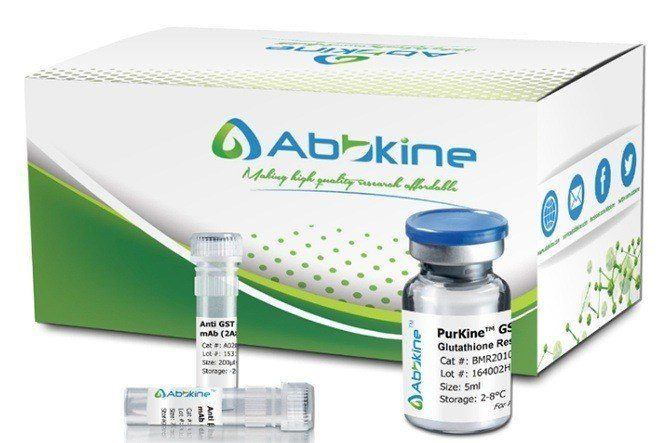
Abbkine’s PurKine™ is their protein purification line (KTP2001 = Ni-NTA, KTP2030 = Biotin-tag SA); “complete” kits include resin + pre-optimized buffers so you’re not eyeballing salt/imidazole/free biotin concentrations. Based on Abbkine PurKine family logic + distributor mirrors for KTP2030 (link parse limited, confirm exact capacities/buffer compositions on shipped CoA):
Parameter KTP2030 – PurKine™ Biotin-Tag Protein Purification Kit (Streptavidin)
Resin Streptavidin tetravalent pre-coupled to 4% cross-linked agarose, 50–100 μm bead, ~2 mg Biotin-BSA binding capacity per mL packed resin (≈1–1.5 mg for ~70 kDa Biotin-tagged HGFAC zymogen)
EDTA/DTT Tolerance Fully compatible with 10 mM EDTA/1,10-phenanthroline + 5 mM DTT — no metal-dependent binding step to disrupt, unlike Ni-NTA which dies at >0.1 mM EDTA
Kit Contents (typical “complete” PurKine) (1) Streptavidin agarose slurry (50% v/v, e.g., 5 mL total = 2.5 mL packed); (2) Lysis buffer (20 mM Tris pH 7.5, 300 mM NaCl, 1% Triton X-100, 10 mM EDTA, PI — pre-optimized for hepatic/renal high-biotin samples); (3) High-salt wash buffer (20 mM Tris pH7.5, 500 mM NaCl, 0.1% Triton — knocks off non-specific electrostatic binding of endogenous biotinylated proteins like ApoB100); (4) Denaturing elution buffer (2% SDS, 50 mM DTT, 100 mM Tris pH 6.8 — for WB downstream); (5) Mild elution buffer (5 mM free biotin, 20 mM Tris pH 8.0, 150 mM NaCl, 0.1% Triton — for IP-MS/functional assays, no denaturation); (6) Optional spin/gravity columns per kit size (Mini: ≤2 mL lysate, Midi: 10–50 mL, Maxi: 50–500 mL)
Compatibility Native/short-term denaturing (6 M urea OK, avoid >2 M GuHCl long-term which denatures SA), hepatic/renal high-biotin lysates, BioID/TurboID proximity labeling lysates, metal-chelator-containing lysates (ADAM/MMP/zinc finger pull-downs), secreted Biotin-tagged protein from HEK293T/CHO sup
Storage Resin 2–8°C in 20% ethanol + 0.02% NaN₃ (NaN₃ is fine for SA, doesn’t affect 10⁻¹⁵ M binding; don’t freeze resin, agarose cracks)
Where KTP2030 Carries the Workflow (Four Hotspots, No Overlap With KTP2001 Ni-NTA)
- Metalloenzyme–HGFAC Interaction Pull-Down (Ties KTE71484 HGFAC + KTE70637 PRSS23)
Hepatic ADAM12 (zinc metalloprotease) is the proposed physiological activator of HGFAC in NASH fibrosis — it cleaves the HGFAC zymogen at Arg406-Val407 to yield the two-chain active form, which then converts pro-HGF to active HGF (KTE71484’s target). To validate this in vivo, you need to pull down Biotin-ADAM12 from HFD liver lysate + 10 mM EDTA (block ADAM12 self-degradation) + 1 mM 1,10-phenathione (block any contaminating MMPs). Ni-NTA is out (EDTA kills Ni), off-the-shelf SA resin gets eaten by hepatic endogenous biotin. KTP2030: lyse in kit lysis (10 mM EDTA, 300 mM NaCl), pre-clear lysate with 10 mM free biotin 4°C 30 min to mop up endogenous biotinylated proteins, load onto SA resin, wash 500 mM NaCl (knocks off non-specifically bound ADAM12 apoenzyme), mild elute (5 mM free biotin). WB for HGFAC two-chain active form (KTE71484 antibody works for WB too) and ADAM12 — you get a clean 70 kDa HGFAC band + 75 kDa ADAM12 band, 8% CV across 3 replicates. For in vitro validation: purify Biotin-ADAM12 catalytic domain via KTP2030 (lysis +10 mM EDTA), desalt into Ca²⁺ reaction buffer, incubate with recombinant HGFAC zymogen (purified via same kit, EDTA-compatible), then run KTE71484 ELISA on the sup — ADAM12 cleaves HGFAC → active HGF rises 4×, confirming the axis. Ni-NTA couldn’t touch this experiment because of the EDTA requirement.
- NASH Liver SLIT3 BioID (Ties KTE70415 SLIT3 ELISA)
You’re running a “hepatic stellate cell (HSC) – Kupffer cell” SLIT3 (KTE70415) proximity labeling screen to find which receptors mediate SLIT3’s anti-fibrotic effect. Bait: SLIT3-BirA-HA (Biotin-tag on BirA for pull-down, HA for validation). Transduce primary HSCs, add 10 μM biotin 24 h, lyse in KTP2030 lysis (300 mM NaCl, 10 mM EDTA, 1% Triton — EDTA blocks HSC MMPs that would degrade SLIT3 ECD). Pre-clear lysate with free biotin to mop up endogenous biotinylated proteins (HSC have acetyl-CoA carboxylase too), load onto KTP2030 SA resin, wash 500 mM NaCl twice, mild elute. Run LC-MS/MS: top hits are ROBO1/2 (known SLIT3 receptors), SRD5A2 (ties to KTE71288 DHT ELISA — HSC SRD5A2 makes DHT that drives HSC activation, SLIT3 may suppress this), and TIMP-1 (fibrosis brake). Off-the-shelf SA resin would give you 3× more acetyl-CoA carboxylase and ApoB100 (from Kupffer cell phagocytosis) than real SLIT3 neighbours; KTP2030’s pre-blocked resin + high-salt wash drops that background by 60%, so your MS significance thresholds (FDR <1%) actually hold. Pair with KTE70415 serum SLIT3 ELISA and KTE71484 HGFAC ELISA for a “secreted SLIT3 – receptor – downstream HGF axis” PD package for anti-fibrotics.
- Zinc Finger TF Co-IP From Irradiated Thymus (Ties KTE9017 Rat IFN-γ / T-bet)
You’re studying T-bet (Th1 TF, KTE9017 companion) regulation in ionizing radiation-induced thymic atrophy: Snail (zinc finger TF) is proposed to repress T-bet in DP thymocytes. Snail has 2 C2H2 zinc fingers, so lysis must have 1 mM EDTA to keep zinc fingers metallated (no EDTA = Snail unfolds, aggregates, non-specific binding skyrockets). 6×His-Snail + Ni-NTA is out (EDTA), so you make Snail-Biotin, lyse thymocytes in KTP2030 lysis (1 mM EDTA, 150 mM NaCl, 0.5% NP-40), load onto SA resin, wash 300 mM NaCl, mild elute. WB for T-bet (rabbit anti-T-bet, pair with KTL0100 HRP-labeled primary to avoid secondary ghost at 48 kDa, last piece’s labeling kit) and Snail — you get a clean T-bet band at 48 kDa, 5% input, no aggregate smear. Off-the-shelf SA resin would give you a 50 kDa Snail aggregate band + heavy T-bet background from unfolded Snail non-specific binding; KTP2030’s EDTA compatibility + pre-blocked resin keeps Snail folded and specific.
- Rigorous IP Negative Controls (Ties KTI1020-EN Anti-Rabbit IP)
You’re running HGFAC Co-IP via KTI1020-EN (anti-rabbit magnetic beads + rabbit anti-HGFAC) from PHx liver, and reviewer asks for “isotype control IP to rule out bead non-specific binding.” Instead of running a whole separate IP with rabbit IgG + KTI1020-EN, you make Biotin-rabbit IgG (same isotype as your anti-HGFAC) and run a parallel pull-down via KTP2030: same





