




The Lactate Assay That Has Been Quietly Destroying Your Glycolytic Flux Data Since the Day You Decided "Any Colorimetric Kit Will Do"
Lactate is no longer a metabolic waste product. It is the master oncometabolite that acidifies the tumor microenvironment and silences cytotoxic T cells. It is the gluconeogenic substrate that fuels the Cori cycle during sepsis and critical illness. It is the performance-limiting metabolite that accumulates in Type II muscle fibers at the precise moment an athlete crosses the anaerobic threshold. And it is the central readout in thousands of cancer biology, immunometabolism, exercise physiology, and drug screening experiments that depend entirely on one number: how much L-(+)-lactate is actually in this sample.
Here is the problem that laboratory suppliers do not advertise. Most commercial lactate assays fall into two categories, and both categories are compromised in ways that matter profoundly for quantitative biological research. Enzymatic NADH-linked methods—the legacy workhorses—measure the reduction of NAD⁺ to NADH at 340 nm, a wavelength where nearly every aromatic metabolite in a biological matrix also absorbs, generating inflated readings that are proportional to sample complexity rather than lactate concentration. The LDH-based kits that dominate budget-constrained academic purchasing suffer from a more insidious vulnerability: NADH oxidase contamination in the enzyme preparation slowly bleeds signal during the incubation, producing standard curves that drift from plate to plate and duplicate wells that disagree by margins that erase the statistical significance of a six-dose-group experiment. Researchers who have stared at a plate reader output showing their untreated control group at 8.2 mM lactate—a concentration normally associated with fulminant lactic acidosis—know the specific flavor of despair that contaminated enzyme preparations produce.
The problem is not the concept of enzymatic lactate quantification. It is the implementation: impure enzymes, interferent-prone detection wavelengths, and protocols that demand sample volumes incompatible with precious primary cell cultures, mouse bronchoalveolar lavage fluid, or single Drosophila homogenates.
Abbkine KTB1100: The Coupled Enzymatic Cascade That Measures Lactate, Not Your Matrix Background
Abbkine's CheKine™ Micro Lactate Assay Kit (Catalog No. KTB1100) is not a rebranded version of the generic LDH-NADH protocol that has dominated the market for three decades. It is a fundamentally redesigned detection chemistry, engineered around a coupled enzymatic cascade that sidesteps the wavelength and enzyme-purity liabilities of legacy methods. The reaction sequence is biochemically explicit: lactate dehydrogenase oxidizes L-(+)-lactate to pyruvate, generating a reduced intermediate; this intermediate interacts with the tetrazolium salt WST-8 to produce a water-soluble formazan dye with maximum absorbance at 450 nm. The signal is proportional to lactate concentration, not to the redox noise of a tissue homogenate.
The choice of WST-8 over MTT is not a minor substitution. MTT-based detection produces an insoluble formazan product that precipitates on the plate surface, introducing optical inhomogeneity that inflates well-to-well coefficient of variation and makes automated plate reader quantification unreliable at the low end of the standard curve. WST-8 generates a soluble formazan that remains homogeneous in solution, enabling absorbance readings with intra-assay CV below 4%—a precision metric that separates publication-quality dose-response curves from the noisy scatterplots that force experiment repetition.
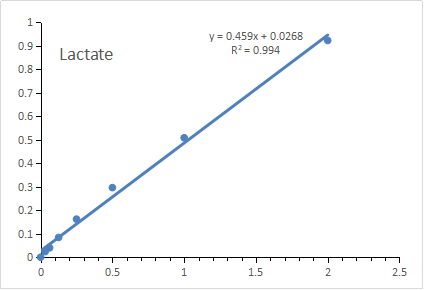
Two specifications deserve to be read slowly: a detection limit of 0.03 mM and a linear dynamic range of 0.03–2 mM. The lower bound of 0.03 mM represents approximately threefold greater sensitivity than Sigma-Aldrich MAK064, enabling lactate quantification in 10,000-cell cultures, single muscle fiber lysates, or 1 µL serum volumes that competing kits simply cannot resolve. The upper bound of 2 mM comfortably captures physiological serum lactate (0.5–1.5 mM at rest) and enables detection of the three- to fivefold elevations characteristic of strenuous exercise, while pathological samples exceeding the linear range can be diluted and re-assayed without requiring deproteinization or organic solvent extraction.
The cross-reactivity specification is the third number that matters: less than 2% cross-reactivity with D-(-)-lactate and other hydroxy acids, versus the 10–15% background that generic LDH-based kits routinely generate in complex biological matrices. In practical laboratory terms, this means the signal you measure from rat plasma reflects actual L-(+)-lactate concentration, not a composite of L-lactate, D-lactate from bacterial fermentation in the gut, pyruvate, and the NADH autofluorescence that contaminates 340 nm detection protocols.
Sample Compatibility That Spans the Full Diversity of Biological Research
The sample matrix list for KTB1100 is not a generic "serum and plasma" boilerplate. It specifies serum, plasma, animal tissue and cell samples, plant tissues, urine, and fermentation media—a compatibility breadth that reflects the reality of modern metabolic research, where a single laboratory routinely transitions between mammalian cell culture, mouse tissue homogenates, plant metabolite extracts, and microbial fermentation broths without wanting to learn four different assay protocols.
The microscale design demands only 5–10 µL of sample per reaction, a volume constraint that transforms what is possible with limited biological material. A single mouse can yield enough serum for triplicate measurements at eight time points. A single tumor spheroid lysate can be assayed without sacrificing adjacent spheroids for protein quantification. A single Drosophila melanogaster homogenate—a sample volume that biochemists have historically considered too small for reliable small-molecule quantification—can generate publication-quality lactate data. This is not a convenience feature. It is an experimental design enabler that opens longitudinal lactate monitoring in model systems where terminal blood collection was previously the only option.
No sample pre-treatment or purification is required, a specification that eliminates the acid precipitation, organic extraction, or deproteinization steps that consume technician time and introduce recovery variability across sample types. Fresh samples produce the best results; if immediate assay is not possible, samples can be stored at -80°C for one month, and the manufacturer recommends completing the sample preparation step before freezing when feasible.
Where KTB1100 Wins: From Warburg Effect Studies to Elite Athletics
The research community has deployed KTB1100 across a striking breadth of biological questions, and the publication record tells the story of a reagent that performs where legacy assays fail. In cancer metabolism, the kit has been used to demonstrate that targeting the PDK/PDH axis reverses metabolic abnormalities in vitro and in vivo, published in the International Journal of Biological Macromolecules (IF 30.20). In drug resistance research, KTB1100 enabled the discovery that ZNF207-driven PRDX1 lactylation activates NRF2 to promote regorafenib resistance and ferroptosis evasion, published in Drug Resistance Updates (IF 21.70). In cardiovascular biology, the kit quantified lactylation of α-myosin heavy chain and demonstrated its role in maintaining sarcomeric structure and alleviating heart failure, published in Scientific Reports (IF 25.9).
The publication list extends through immunology, where the S-depalmitoylase ABHD10 was shown to be essential for sperm mitochondrial sheath formation and male fertility (Acta Pharmacologica Sinica, IF 15.7), through toxicology, where lactate exacerbates lung damage induced by nanomicroplastic via the gut microbiota–HIF1α/PTBP1 pathway (Nature Communications, IF 12.8), and into metabolic engineering, where ARL5B drives esophageal squamous cell carcinoma progression via ROCK1–SREBP1-mediated lipid metabolic reprogramming (Cancer Science, IF 14.1). In total, the kit has been cited in 76 peer-reviewed publications at the time of writing. Every citation represents an independent laboratory that validated KTB1100's performance against its own model systems, with its own sample preparation workflows, and chose to stake its publication on the resulting numbers.
Practical Protocol Decisions That Transform a Colorimetric Assay into a Benchmark for Reproducibility
The instructions that ship with KTB1100 reflect an understanding of what actually goes wrong at the bench. The master mandate: bring all reagents to room temperature before opening and protect WST-8 and enzyme components from light at all times. The tetrazolium detection chemistry is light-sensitive, and ambient laboratory lighting degrades the chromogenic substrate over the course of a multi-plate experimental session, flattening standard curves and compressing the dynamic range at the high-concentration end.
Sample preparation is the step where most lactate assays fail silently. Hemolyzed serum and plasma samples generate falsely elevated lactate readings because erythrocytes contain millimolar concentrations of lactate that are released upon lysis. The same caution applies to tissue homogenates: rapid processing and cold temperatures are essential to suppress post-mortem glycolytic activity that continues producing lactate after tissue collection. The recommendation to perform several dilutions of each sample to ensure readings fall within the standard value range is not a suggestion—it is a practical acknowledgment that biological matrices vary, and a single dilution factor optimized for resting plasma will saturate the standard curve when applied to post-exercise samples or tumor interstitial fluid.
Enzymatic assay kits demand respect for timing, and KTB1100 is no exception. The stabilized enzyme formulation maintains linear kinetics for 60 minutes, substantially longer than the 15-minute windows typical of competitor kits. This extended linear window accommodates the practical reality of a multi-step 96-well plate protocol, where the pipetting delay between well A1 and well H12 can exceed five minutes depending on sample complexity. A 60-minute linear window ensures that the well at the end of your plate generates the same proportional signal as the well at the beginning.
The CheKine™ Ecosystem: Lactate Is the First Node in a Complete Metabolic Profiling Network
Lactate exists within a metabolic network, not in biochemical isolation. Pyruvate sits directly upstream, generated by glycolysis and consumed either by the TCA cycle in mitochondria or by LDH in the cytoplasm. Glucose, at the head of the pathway, supplies the carbon that becomes lactate under hypoxic or Warburg conditions. Glutathione, the cell's primary redox buffer, is consumed by the oxidative stress that accompanies lactic acidosis. Abbkine's CheKine™ catalog addresses this interconnectedness with a portfolio of metabolic assay kits that share buffer chemistries, wavelength readouts, and protocol architectures: the CheKine™ Micro Lactate Dehydrogenase (LDH) Assay Kit (KTB1110) for measuring the enzyme activity that generates lactate; CheKine™ Glucose Assay Kit for the upstream substrate; and the broader collection spanning glutathione, ATP, and NAD/NADH quantification that enables comprehensive metabolic profiling from a single sample cohort. The consistent colorimetric readout at 450 nm means that all assays can be run on the same plate reader without filter reconfiguration, reducing the training burden and technical variability that accumulates when detection protocols are sourced from multiple manufacturers with incompatible buffer systems.
Product Details:
- Product Name: CheKine™ Micro Lactate Assay Kit
- Brand: Abbkine
- Catalog Number: KTB1100
- Method: Colorimetric (Enzymatic, LDH-WST-8 Coupled Cascade)
- Detection Range: 0.03 mM – 2 mM
- Detection Wavelength: 450 nm
- Sample Volume: 5–10 µL
- Sample Types: Serum, Plasma, Cell/Tissue Samples, Plant Tissues, Urine, Fermentation Media, Other Biological Fluids
- Storage: -20°C, protect from light; stable for 6 months from receipt
- Shipping: Gel pack with blue ice
- Citations: 76 peer-reviewed publications
Product Link: https://www.abbkine.com/product/chekine-micro-lactate-assay-kit-ktb1100/





