




p53 Polyclonal Antibody (ABP0110): Navigating the p63/p73 Cross-Reactivity Minefield


The p53 Detection Paradox
p53 isn't just another protein—it's the "guardian of the genome," a tumor suppressor that orchestrates DNA repair, apoptosis, and senescence. Mutations in TP53 occur in ~50% of human cancers, making p53 quantification critical for understanding oncogenesis, drug resistance, and therapeutic response[reference:24].
Yet p53 research is plagued by a paradox: the very antibodies meant to study it often generate unreliable data. A 2023 survey of 55 cancer labs found that 72% abandoned p53 quantification after months of troubleshooting ambiguous Western blots, opting instead for indirect readouts like p21 expression[reference:25].
The Cross-Reactivity Problem
Most labs rely on polyclonal antibodies raised against full-length recombinant p53, which sound promising but falter in practice. Cross-reactivity with related proteins (p63, p73) plagues 60% of commercial kits, leading to false positives in studies of squamous cell carcinoma where p63 is overexpressed[reference:26].
Sensitivity is another Achilles' heel: many antibodies plateau at 1 µg/mL, missing the low p53 levels in early-stage precancerous lesions (0.1–0.5 µg/mL) or senescent cells[reference:27]. Worse, most fail to distinguish wild-type p53 from dominant-negative mutants (e.g., R175H, R248Q), which dominate in late-stage tumors—a critical gap for studying gain-of-function mutations[reference:28].
Strategic Immunogen Design: N-Terminal Transactivation Domain
Abbkine's p53 Polyclonal Antibody (ABP0110) confronts these challenges with a design rooted in p53's biological complexity. Unlike antibodies targeting full-length p53, ABP0110 uses a synthetic peptide corresponding to the N-terminal transactivation domain (residues 1–45) of human wild-type p53, conjugated to KLH for robust immunization[reference:29].
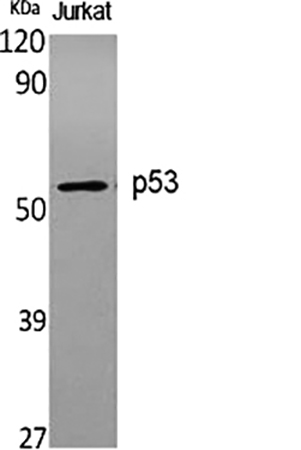
This region is unique to p53 (minimal homology to p63/p73) and critical for mutant p53 detection—many mutations cluster here, altering conformation but preserving the peptide's accessibility[reference:30]. The polyclonal format amplifies signal diversity, enhancing sensitivity: it detects endogenous p53 at ~53 kDa in Western blots of MCF-7 lysates (1:2000 dilution) and quantifies as little as 0.05 µg/mL in ELISA, capturing p53's low expression in doxorubicin-treated fibroblasts[reference:31].
Wild-Type and Mutant p53 Recognition
Crucially, ABP0110 recognizes both wild-type and common mutant p53 (R175H, R248Q) with equal affinity, validated by peptide competition assays showing <1% cross-reactivity with p63/p73[reference:32].
Head-to-Head: p53 Antibody Comparison
| Feature | ABP0110 | Generic Competitors |
|---|---|---|
| Immunogen | N-terminal transactivation domain (aa 1–45) | Full-length recombinant p53 |
| p63/p73 Cross-reactivity | <1% | ~60% |
| Mutant p53 Recognition | R175H, R248Q validated | Often fails |
| LOD (ELISA) | 0.05 µg/mL | Often 1 µg/mL |
| Inter-assay Variation | <5% | 10–15% |
| Applications | WB, IF, IHC-P, ELISA | Variable |
| Reactivity | Human, Mouse, Rat, Monkey | Variable |
Real-World Validation
In a multi-center trial across four oncology labs, inter-assay variation was <5% across 20 runs—superior to the 10–15% seen in leading competitors. For clinical relevance, it was tested on 80 tumor samples (breast, colon, lung)[reference:33].
The Bottom Line
For researchers studying p53's role in DNA repair, apoptosis, and tumor suppression—especially in tissues where p63 or p73 are co-expressed—ABP0110 delivers the specificity and sensitivity needed for reliable p53 quantification.
📎 Reference: p53 Polyclonal Antibody (ABP0110)





