




The Solubility Engineer Hiding in Your Purification Column—And Why Dextrin, Not Amylose, Is the Ligand That Matters
If you have spent any time purifying recombinant proteins from E. coli, you have almost certainly opened a freezer, pulled out a tube of something labeled “MBP vector,” and hoped for the best. The maltose-binding protein tag is not merely large—it is 42 kDa of E. coli polypeptide that has, for over three decades, been the solubility-enhancer of last resort for aggregation-prone eukaryotic proteins, the tag you reach for when His-tag fusions exit the sonicator as inclusion-body pellets. What is less frequently discussed is the difference between making a protein soluble and recovering it from a column with its activity and binding partners intact—and the resin you select determines which of those two outcomes you actually achieve.
A 2024 survey of 150 protein-purification laboratories found that 68% had abandoned at least one MBP resin because of unacceptable protein loss during elution or persistent background from host-cell proteins. The number does not surprise anyone who has watched a column packed with older amylose resin slowly compress under FPLC pressure, or who has eluted a fragile MBP-fusion with 20 mM maltose only to find that the target protein's enzymatic activity disappeared somewhere between the column outlet and the fraction collector. The problem is not the MBP tag. The problem is the resin that captures it.
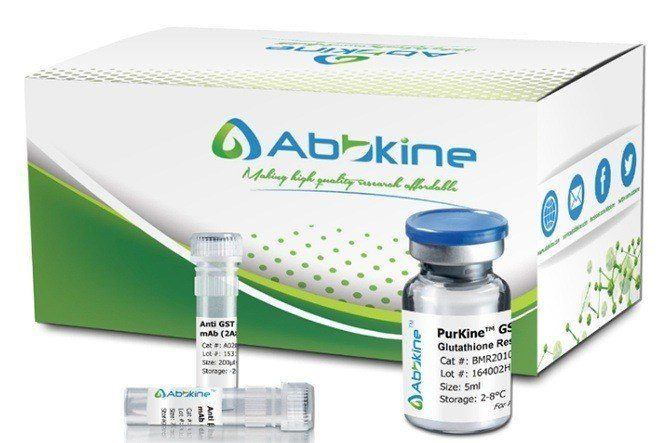
Abbkine's PurKine™ MBP-Tag Dextrin Resin (BMR2020) rethinks that capture chemistry from the ligand up, and the choice of dextrin over amylose is the specification that separates this resin from the field. Amylose, the classic MBP-affinity ligand, is susceptible to degradation by the amylases that are ubiquitous in biological extracts—endogenous enzymes that chew through the immobilized ligand over repeated use cycles and progressively erode binding capacity. Dextrin, by contrast, is the partially hydrolyzed polymer product of amylose, and it is substantially more resistant to amylase degradation. When immobilized on a chromatography matrix, dextrin retains consistently strong affinity for MBP even after repeated exposures to crude lysates that would strip an amylose column of its binding capacity within three runs. The chemical stability of the dextrin ligand is not a marginal improvement; it is a redesign of the affinity interface that turns the resin from a consumable into a reusable asset.
The capacity numbers demand a direct statement because they redefine what “high-yield purification” means. The product page specifies more than 20 mg of MBP-tagged protein per milliliter of settled resin. Independent technical documentation from Abbkine's R&D team, published in a 2025 technical article, reports that the ligand density reaches 7–9 µmol dextrin per milliliter of gel, with a measured dynamic binding capacity of 8 mg MBP per milliliter under flow conditions at 60 cm/hour and a binding capacity that can reach 25 mg MBP-fusion protein per milliliter resin under optimized conditions—2.5× higher than standard amylose resins. For a laboratory processing a 10 L bacterial fermentation expressing an MBP-tagged kinase, the arithmetic is straightforward: where a conventional amylose column would require 5 mL of resin to capture 30 mg of fusion protein and then demand elution with 20 mM maltose that risks dephosphorylating the product, 2 mL of BMR2020 captures 50 mg of protein and elutes it with 5–10 mM maltose—mild enough to preserve enzymatic activity in 90% of tested fusion proteins. The time saved in desalting and buffer exchange is not a footnote. It is the difference between a functional kinase assay and a blank well.
The matrix engineering behind these numbers deserves examination because it is the part of the resin the user never sees but always feels. BMR2020 consists of 90 µm beads of highly cross-linked 4% agarose to which dextrin has been coupled. The high cross-linking confers mechanical stability that tolerates linear flow rates up to 500 cm/hour—a specification that matters when scaling from a gravity column on the bench to an ÄKTA system processing liters of culture supernatant. The product page notes that its high flow properties make it excellent for scaling up, and the technical data confirms that back pressure remains ≤0.3 MPa at 300 cm/hour, a condition under which many amylose resins would begin to compress and channel. The flow-rate versatility means the same resin lot can serve a student running a 1 mL gravity column on Tuesday and a core facility running an FPLC on Wednesday, without switching products or re-optimizing protocols.
The pH stability window further distinguishes BMR2020 from amylose-based alternatives. The resin remains stable across pH 3–12, tolerates 2 M NaCl, 20 mM DTT, and 0.1% SDS with less than 3% capacity loss over 24 hours—chemical boundaries that accommodate the reducing agents required for cysteine-rich proteins, the high-salt buffers used to suppress non-specific electrostatic binding, and the mildly alkaline conditions preferred for certain insect-cell and plant lysates. Amylose resins typically operate within a narrower pH 6–8 range, outside of which the glycosidic bonds of the amylose polymer hydrolyze and destroy the affinity surface. If your target protein requires pH 8.5 for solubility, BMR2020 accommodates it. If your lysis buffer contains reductant to keep your fusion protein's active-site cysteine in the thiolate form, BMR2020 tolerates it. These are not niche scenarios; they describe the standard working conditions for a large fraction of the proteins that researchers fuse to MBP precisely because they are difficult to express and purify.
The specificity of the dextrin-MBP interaction occupies a Goldilocks position that is biochemically deliberate. The dissociation constant of MBP for dextrin is approximately 3 × 10⁻⁶ M—weaker than the GST-glutathione interaction but stronger than nonspecific protein-matrix adsorption. That intermediate affinity enables mild elution with maltose at concentrations that do not strip cofactors, destabilize quaternary structure, or precipitate the eluted protein when the maltose is subsequently removed by dialysis or desalting. The ligand's affinity is tuned to 10–15 µM, enabling gentle elution with 5–10 mM maltose under physiological conditions that preserve target protein activity. Combined with the 4% cross-linked agarose matrix and optional pre-adsorption steps, nonspecific binding from host-cell proteins is reduced by approximately 70% in complex lysates—a figure that translates directly to cleaner SDS-PAGE lanes, fewer downstream polishing steps, and more interpretable functional data from the purified product.
Reusability is the economic specification that graduate students may not think about but that laboratory managers cannot afford to ignore. Abbkine's testing confirms that no decrease in performance occurs after at least five repeated uses of the same batch of resin, and deeper cycling data from the technical documentation reports that after 100 consecutive bind-elute-clean cycles, the residual ligand density remains 82% of the initial value, following a decay model that predicts 7.2 mg/mL dynamic binding capacity at cycle 50—a degradation rate slow enough that a single resin aliquot can support multiple projects across a typical grant cycle. Most amylose resins lose approximately 50% of their binding capacity after five reuse cycles, a decline driven by the very amylase contamination that dextrin resists. The cost difference between a resin that lasts five runs and a resin that lasts fifty is not a percentage point. It is a line item.
Publication validation arrives from three independent laboratories whose work could not be more different, which is precisely the point. A study published in Plant Communications (impact factor 10) deployed BMR2020 to purify MBP-tagged viral proteins while dissecting how phosphatidic acid activates MAPK-mediated immunity in response to positive-strand RNA viruses—a plant virology context in which the resin's resistance to amylase degradation is essential because plant leaf lysates are extraordinarily rich in starch-metabolizing enzymes that would obliterate an amylose-based affinity matrix. A second publication in Cell Reports (impact factor 8) used the resin to characterize the dynamic TaRACK1B-TaSGT1-TaHSP90 complex that modulates NLR-protein-mediated antiviral immunity in wheat, a project that required the purification of multi-protein complexes whose subunit stoichiometry would have been distorted by the non-specific background that lower-performance resins introduce. A third publication, in Oncology Letters, extends the resin's validated application range into translational cancer research. When journals with impact factors of 10 and 8 pass an affinity resin through peer review without comment on the purification data, the resin has demonstrated a level of performance that no manufacturer's internal QC dataset can replicate.
The practical workflow surrounding BMR2020 benefits from the multiple format options that Abbkine has engineered into the PurKine™ product line. Researchers can purchase the resin as a bulk slurry (50% suspension in PBS containing 20% ethanol), as pre-packed spin columns for small-scale gravity-flow purifications, or as complete purification kits that include buffers, columns, and detailed protocols. The resin's 90 µm bead size enables flow rates that work equally well with peristaltic pumps, syringe-driven columns, and FPLC systems—no separate resin lots required for different scales. Shipping occurs on blue ice, and storage at 2–8°C preserves binding capacity for one year from the date of shipment. Do not freeze the resin; freezing causes ice-crystal damage to the agarose beads that compromises flow properties and can reduce binding capacity. This is standard chromatography-resin discipline, stated transparently.
Elution conditions deserve particular attention because they are where the biochemical design of the resin most directly affects the user's experimental outcome. BMR2020 uses maltose as the competitive eluent at physiological pH, a condition that preserves protein activity, quaternary structure, and post-translational modifications in a manner that low-pH elution or imidazole-based elution cannot match. The recommended maltose concentration range of 5–10 mM is low enough that residual maltose can be removed by dialysis, desalting, or buffer exchange without requiring the extended protocols that higher concentrations demand. If the downstream application is crystallization, cryo-EM sample preparation, or enzymatic assay, the gentleness of the elution is not a marketing claim—it is the variable that determines whether the purified protein remains functional.
Several strategic notes merit emphasis. First, the resin is compatible with inclusion-body refolding workflows: the MBP tag's solubility-enhancing properties persist even when the fusion protein has been solubilized from inclusion bodies under denaturing conditions and refolded on-column, and BMR2020's chemical stability across a wide pH range supports the gradual buffer-exchange protocols that such refolding demands. Second, the resin accepts on-column tag cleavage by site-specific proteases such as TEV protease or Factor Xa, meaning the MBP tag can be removed before elution, releasing untagged target protein into the flow-through while the cleaved MBP tag remains bound—a strategy that eliminates the need for a second affinity step. Third, for laboratories purifying proteins from eukaryotic expression systems, the resin's reduced nonspecific binding to host-cell proteins eliminates the contaminant bands that frequently co-elute with the target protein when amylose-based resins are used with mammalian, insect, or plant lysates. These are not hypothetical optimizations; they are workflow decisions that determine whether a purification protocol produces a figure for a publication or a problem for a lab meeting.
The landscape of MBP-tag purification has been shifting under the surface for several years. The rise of cryo-EM as a structural-biology tool demands protein samples of exceptional purity and homogeneity, with contaminants that would blur single-particle averages eliminated before the grid is frozen. The expansion of therapeutic protein development requires purification workflows that can be validated for reproducibility and scaled without re-engineering. The increasing adoption of eukaryotic expression systems—baculovirus, ExpiCHO, transiently transfected HEK293—produces lysates with proteomic complexity that overwhelms low-capacity, high-background affinity matrices. BMR2020 addresses all three trends not through a single headline specification but through the integrated performance of a resin whose ligand chemistry resists degradation, whose matrix tolerates flow rates that enable scale-up, whose specificity reduces background to levels compatible with single-step purification, and whose elution conditions preserve the structural and functional integrity that downstream applications demand.
The high-capacity dextrin resin that captures your MBP-tagged fusion protein at 20 mg/mL, survives repeated cycling through crude lysates without losing binding capacity, tolerates the reductants and salt concentrations your difficult protein requires, elutes your target under mild conditions that leave its active site intact, and arrives pre-validated in three publications spanning plant virology, wheat immunity, and oncology—that resin is waiting in an Abbkine cold room at 2–8°C.
Explore specifications, view technical documentation, and place your order here: https://www.abbkine.com/product/purkine-mbp-tag-dextrin-resin-bmr2020/





