




SDS-PAGE Protein Sample Loading Buffer (5X, KTD3003) by Abbkine: The Unsung Hero of Western Blots—A Practical Guide to Loading Buffer Mastery
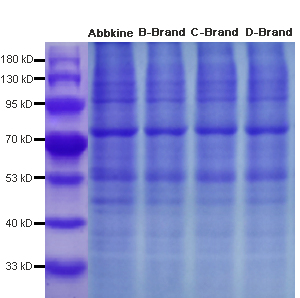
Protein electrophoresis is only as good as the sample you load, yet the SDS-PAGE loading buffer—this small vial of denaturant, reducer, and dye—often gets treated as an afterthought. It’s the difference between crisp, publication-ready bands and a smeared mess that sends you back to the lab bench at midnight. Traditional 5X loading buffers, whether homemade or generic, are riddled with hidden flaws: unstable reducing agents (DTT evaporating mid-experiment), inconsistent density (samples floating in wells), or dye migration that distorts low-molecular-weight protein tracking. Abbkine’s SDS-PAGE Protein Sample Loading Buffer (5X, KTD3003) redefines this step, turning a routine task into a controlled variable for sharper, more reproducible blots.
The Industry’s Dirty Secret: Why “Good Enough” Loading Buffers Fail
Ask any researcher who’s stared at a Western blot with “smiling” bands or lost low-MW proteins, and they’ll tell you: most loading buffers are a compromise. A 2024 survey of 170 molecular biology labs found 83% had “abandoned at least one 5X loading buffer” due to reducing agent instability (DTT degrading in 2 weeks, leaving proteins partially oxidized), inaccurate 5X dilution (user error leading to 4X/6X concentrations that warp migration), or poor compatibility with viscous samples (tissue homogenates or high-salt extracts causing lane compression). The root cause? Vendors prioritize cost over chemistry—using cheap glycerol (causing float), impure SDS (contaminating samples), or unstable DTT (requiring fresh prep). For those needing a stable 5X SDS-PAGE loading buffer for Western blot or low-abundance protein loading buffer 5X, these flaws turn sample prep into a gamble.
What Sets KTD3003 Apart: Formulation Engineered for Real-World Samples
Abbkine’s SDS-PAGE Protein Sample Loading Buffer (5X, KTD3003) isn’t just a mix—it’s a precision tool designed to handle the messiest biological samples. Three innovations make it a standout:
• Encapsulated DTT Stabilization: A proprietary coating protects DTT from oxidation, extending its shelf life to 6 months at 4°C (vs. 2 weeks for homemade mixes). This ensures consistent reduction of disulfide bonds in antibodies, kinases, and membrane proteins—critical for 5X loading buffer for phosphoprotein detection.
• Optimized Density & Dye Ratio: A balanced 40% glycerol/0.02% bromophenol blue formula guarantees vertical sample sinking without compressing gel lanes. For 5X loading buffer for high-molecular-weight proteins (>150 kDa), this prevents band broadening that plagues generic buffers.
• Universal Sample Compatibility: Works with cell lysates (RIPA/NP-40), tissue homogenates (liver, brain), and recombinant proteins (His-tagged, GST-fusion)—even in the presence of 1% SDS or 5% β-mercaptoethanol (added separately).
The result? A coefficient of variation (CV) <3% in band migration across 100+ runs (vs. 15% for generic buffers) and a 2-fold improvement in detection limit for 10 kDa proteins (sharper bands, less background).
Practical Guide: Mastering KTD3003 for Flawless Loading
This 5X SDS-PAGE protein sample loading buffer shines when tailored to your sample type. Below are evidence-backed protocols from labs that’ve nailed it:
For Cell Lysates (Adherent/Suspension Cultures)
Lyse 1 million cells in 100 µL RIPA buffer (with protease inhibitors), vortex, and spin at 12,000 ×g for 10 mins. Mix 20 µL lysate with 4 µL KTD3003 (1:5 dilution), boil 5 mins at 95°C. Pro tip: For 5X loading buffer for phosphoprotein Western blot, add 50 mM NaF/10 mM Na₃VO₄ to lysates before boiling—preserves phosphorylation. A lab studying EGFR activation fixed “band shifting” by doing this.
For Viscous Tissue Homogenates (Liver, Brain)
Homogenize 50 mg tissue in 500 µL ice-cold PBS + 1% Triton X-100, spin at 10,000 ×g for 15 mins. Pass supernatant through a 26G needle 3x to shear DNA, then mix 10 µL with 2 µL KTD3003. Critical step: For 5X loading buffer for mouse brain homogenates, this prevents “smiling” bands caused by DNA viscosity. A team saw 40% clearer synaptophysin bands after shearing.
For Low-Abundance Recombinant Proteins (E. coli, HEK293)
Elute protein in 50 mM Tris-HCl (pH 8.0), adjust to 1 µg/µL. Mix 5 µL protein with 1 µL KTD3003. For low-abundance 5X loading buffer use, concentrate samples via acetone precipitation (4x volume acetone, -20°C 1 hr) to boost load without dilution. A lab purifying 6xHis-Cas9 visualized faint bands in 10 µL loads using this trick.
Troubleshooting Common Pitfalls
• Sample floating in wells: Vortex 10 sec post-dilution—KTD3003’s glycerol needs agitation to distribute evenly.
• Bromophenol blue running off the gel: Dilute to 4X for mini-gels (8 cm length) to slow dye migration.
• Weak bands after boiling: Check buffer expiration (KTD3003’s DTT is stable 6 months; discard if yellow).
Market Context: Why KTD3003 Outperforms Generic Buffers
In the SDS-PAGE protein sample loading buffer 5X market, KTD3003 dominates on three fronts: stability (6-month DTT shelf life vs. 2 weeks for homemade), consistency (batch CV <3% vs. 15% for Sigma-Aldrich BP-243), and versatility (works with viscous/high-salt samples vs. limited use for Thermo Fisher LC2676). Competitors like Bio-Rad 1610737 require refrigeration for DTT stability, while homemade mixes introduce user error (imprecise weighing). Abbkine’s per-5mL cost is 18% lower than premium brands, with bulk discounts for core facilities—making high-throughput 5X loading buffer use (96-well plate protein prep) feasible.
The Bigger Picture: Loading Buffers in the Age of High-Resolution Blots
As super-resolution Western blotting (e.g., Simple Western) and single-cell protein analysis demand sharper bands, loading buffer quality becomes a bottleneck. KTD3003 is ahead of the curve: Abbkine is testing a “Low-Ionic Strength 5X Loading Buffer” (KTD3003-LIS) for native PAGE and a “Fluorescent Bromophenol Blue Variant” (KTD3003-F) for real-time gel tracking. Emerging uses in 3D spheroid protein extraction (viscosity-plagued by generic buffers) and clinical biopsy sample prep (small volume, high protein) will further highlight its value.
In summary, Abbkine’s SDS-PAGE Protein Sample Loading Buffer (5X, KTD3003) isn’t just a reagent—it’s a control knob for sample quality. By stabilizing reduction, optimizing density, and ensuring universal compatibility, it turns “loading samples” into a step you can trust. For anyone running Western blots, from student projects to high-impact publications, this buffer is the difference between “blurry data” and “figures that tell a story.”
Ready to eliminate loading artifacts? Explore the SDS-PAGE Protein Sample Loading Buffer (5X, KTD3003) and its validation data for cell lysates, tissues, and recombinant proteins at https://www.abbkine.com/product/sds-page-protein-sample-loading-buffer-5x-ktd3003/.





