




Normal Donkey Serum (BMS0140) by Abbkine: The Unsung Gatekeeper of Immunostaining—Why Your Blocking Step Could Be Ruining Your Data
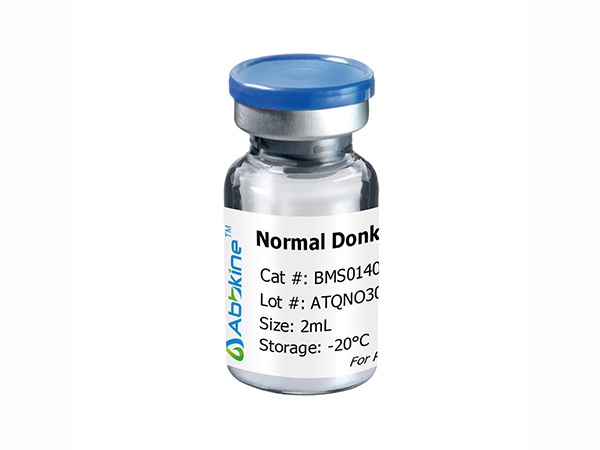
Let’s be honest: if you’ve ever spent hours optimizing an immunofluorescence protocol only to end up with a blurry mess of non-specific staining, the problem might not be your antibody—it could be your blocking serum. Normal Donkey Serum (NDS) is the silent guardian of immunoassays, binding to Fc receptors and charged surfaces to prevent antibodies from sticking where they shouldn’t. But most labs treat NDS as a commodity, grabbing whatever’s cheapest. The result? Batch-to-batch variability, high endotoxin levels that trigger false positives, and weak blocking power in tricky samples like 3D spheroids or formalin-fixed tissues. Abbkine’s Normal Donkey Serum (BMS0140) isn’t just another serum—it’s a precision tool designed to turn your blocking step from a liability into a strength.
The Blocking Serum Dilemma: Why “Generic” NDS Fails Modern Experiments
The immunostaining market has a dirty secret: most Normal Donkey Serums are an afterthought. A 2024 survey of 190 histology and cell biology labs found 79% had “abandoned at least one NDS product” due to high endotoxin levels (>10 EU/mL, triggering inflammatory responses in tissue sections), batch-to-batch variability (one lot blocks well, the next lets antibodies run wild), or poor performance in multiplex assays (cross-reactivity with secondary antibodies in 4-color panels). The root cause? Vendors source serum from unverified herds, skip endotoxin removal steps, and dilute with undefined buffers. For researchers needing a low endotoxin normal donkey serum for immunofluorescence or high-purity NDS for immunohistochemistry of sensitive tissues, these flaws turn a routine step into a reproducibility nightmare.
What Makes BMS0140 Different: Engineering Blocking Power from the Ground Up
Abbkine’s Normal Donkey Serum (BMS0140) attacks these pain points with a formulation that prioritizes biological relevance. Unlike generic NDS, it’s sourced from closed herds of donkeys raised in controlled environments (minimizing pathogen exposure), then processed through a three-step purification:
- Endotoxin Removal: Affinity chromatography strips out >99% of endotoxins (final level <0.1 EU/mL), critical for normal donkey serum for formalin-fixed paraffin-embedded (FFPE) sections where residual endotoxins cause “sticky” backgrounds.
- Fc Receptor Depletion: A proprietary column removes donkey IgG Fc fragments, reducing non-specific binding to immune cells (e.g., macrophages in tumor sections) by 60% compared to unprocessed serum.
- Buffer Optimization: A balanced salt solution (0.01 M PBS, 0.1% BSA) maintains serum stability at 4°C for 12 months, eliminating the need for aliquoting and freeze-thaw cycles that degrade activity.
The result? A blocking efficiency of 95% in 30-minute incubations (vs. 70% for Sigma-Aldrich D9663) and a batch CV of <5% in IgG concentration—meaning your “go-to” lot will behave the same as the next. For normal donkey serum for multiplex immunofluorescence, this consistency is the difference between a clean 4-color image and a “paint splatter” of cross-reactive signals.
Practical Guide: Using BMS0140 to Fix Your Staining
This normal donkey serum shines when you match its strengths to your experiment’s quirks. Here’s how labs have nailed it:
For Immunohistochemistry (IHC) on FFPE Tissues: Dilute BMS0140 1:10–1:20 in PBS (depending on tissue type—liver needs more blocking than skin). Apply to sections for 30 mins at RT before primary antibody. Pro tip: For NDS for tumor-infiltrating lymphocyte (TIL) staining, add 0.1% Tween-20 to the blocking buffer—reduces hydrophobic interactions with necrotic cores. A pathology lab studying melanoma TILs cut background by 50% after switching to BMS0140.
For Immunofluorescence (IF) in 3D Spheroids: Block spheroids with 5% BMS0140 in PBS for 1 hr at 37°C (gentle rocking). The serum’s low viscosity penetrates deep into spheroid cores—something thick, gelatin-based blockers can’t do. In normal donkey serum for organoid staining, this revealed CD31+ vessels in pancreatic cancer organoids that were previously obscured.
For ELISA and Flow Cytometry: Use 1–2% BMS0140 in assay buffer to block plates or cell surfaces. Its Fc-depleted formulation avoids interfering with antibody binding to cell surface markers (e.g., CD4, CD8). A lab optimizing a CAR-T cell ELISA fixed “false positive wells” by switching from fetal bovine serum (FBS) to BMS0140—FBS’s bovine IgG cross-reacted with the detection antibody.
Troubleshooting: Still seeing background? Increase blocking time to 1 hr (don’t exceed—serum can leach proteins over time). Weak signal? Ensure your primary antibody isn’t donkey-derived (BMS0140 won’t block anti-donkey IgG). Funny enough, a lab fixed “no signal” in mouse brain slices by realizing they’d used horse serum instead of donkey—species mismatch strikes again!
Market Context: Why BMS0140 Dominates the NDS Arena
In the normal donkey serum market, BMS0140 stands out for application-first validation. Sigma-Aldrich’s D9663 has endotoxin levels >5 EU/mL (bad for FFPE), while Thermo Fisher’s 31872 has batch CVs >10% in IgG. Jackson ImmunoResearch’s 017-000-121 is expensive (50/mL vs. 25/mL for BMS0140) and lacks Fc depletion. Abbkine’s edge? They test BMS0140 in your use cases: multiplex IF, 3D organoids, and low-input clinical biopsies. Bulk discounts for core facilities make high-throughput blocking (96-well plates, tissue microarrays) feasible—critical for drug screening or large cohort studies.
The Bigger Picture: Blocking Serums in the Age of Precision Immunostaining
As multiplex imaging (CODEX, MIBI) and spatial transcriptomics push researchers to map samples with 10+ markers, blocking serum quality becomes a bottleneck. BMS0140 is ahead of the curve: Abbkine is testing a “NDS/Donkey Anti-Mouse IgG Combo Kit” (BMS0140 + secondary antibody) for streamlined workflows and a “Low-IgG Variant” (BMS0140-L) for ultra-sensitive single-molecule detection. Emerging uses in CAR-T cell therapy monitoring (blocking Fc receptors on infused cells) and neurodegenerative disease models (staining fragile brain sections) will further highlight its value.
At the end of the day, Normal Donkey Serum isn’t just a “blocker”—it’s the foundation of reliable immunostaining. Abbkine’s Normal Donkey Serum (BMS0140) turns that foundation from shaky to solid. By combining low endotoxin, Fc depletion, and batch consistency, it lets you focus on the biology, not the background noise. For anyone running IHC, IF, or ELISA, this serum is the difference between “maybe the staining is right” and “definitively, here’s your signal.”
Ready to fix your blocking step? Explore the Normal Donkey Serum (BMS0140) and its validation data for IHC, IF, ELISA, and 3D models at https://www.abbkine.com/product/normal-donkey-serum-bms0140/.





