




CheKine™ Micro Coenzyme Ⅰ NAD(H) Assay Kit — FAQ for Redox and Metabolism Researchers
CheKine™ Micro Coenzyme Ⅰ NAD(H) Assay Kit: Your Questions Answered
Nicotinamide adenine dinucleotide (NAD) is an enzymatic cofactor involved in many redox reactions, cycling between the oxidized (NAD⁺) and reduced (NADH) forms[reference:94]. NAD is essential for cellular respiration, glycolysis, and the TCA cycle — as an electron carrier in redox reactions. Beyond metabolism, NAD plays critical roles in ADP-ribosylation reactions and as a substrate for sirtuins[reference:95].
Abbkine's CheKine™ Micro Coenzyme Ⅰ NAD(H) Assay Kit (KTB1020) provides a convenient tool for sensitive detection of NAD⁺, NADH, and their ratio[reference:96]. With 7 publications citing this kit[reference:97], including a Nature publication with IF 15.4[reference:98], it's a trusted tool in the research community. Here are answers to the most common questions about this kit.
What is the detection principle?
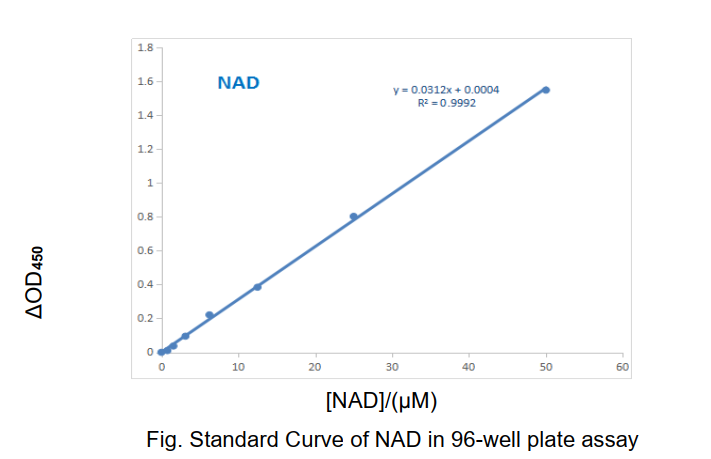
This kit is based on an enzyme cycling reaction that specifically recognizes NAD⁺ and NADH — it does not recognize NADP⁺/NADPH[reference:99]. In the cycling reaction, the formed NADH reduces a formazan (MTT) reagent. The intensity of the reduced product color, measured at OD450 nm, is proportionate to the NAD⁺/NADH concentration in the sample[reference:100].
What's the detection range and sensitivity?
| Parameter | Value |
|---|---|
| Calibration range | 0.78 µM – 50 µM[reference:101] |
| Limit of detection | 0.78 µM[reference:102] |
| Format | 96-well plate assay[reference:103] |
This sub-micromolar sensitivity enables detection of NAD⁺/NADH in small samples.
What sample types can I use?
The kit is designed for detection in[reference:104]:
- Serum
- Plasma
- Cell extracts
- Plant tissue extracts
- Animal tissue extracts
Can I measure NAD⁺ and NADH separately?
Yes — the kit provides separate extraction buffers for NAD⁺ and NADH[reference:105], allowing you to:
- Measure total NAD⁺/NADH (combined)
- Measure NAD⁺ alone
- Measure NADH alone
- Calculate the NAD⁺/NADH ratio
What substances interfere with the assay?
The following substances interfere and should be avoided in sample preparation[reference:106]:
- EDTA (>0.5 mM)
- Ascorbic acid
- SDS (>0.2%)
- Sodium azide
- NP-40 (>1%)
- Tween-20 (>1%)
How should I store and handle the kit?
- Storage: Store at –20°C and protect from light immediately upon receipt[reference:107]
- Shelf life: 6 months from receipt[reference:108]
- Shipping: Gel pack with blue ice[reference:109]
Critical handling tips:
- Addition of Working Reagent should be quick and mixing should be brief but thorough[reference:110]
- Run samples and standards in duplicate or triplicate
- Protect all reagents from light
What applications is this kit suitable for?
This kit is designed for research use only[reference:111]. Applications include:
- Cellular respiration and energy metabolism studies
- Redox biology (oxidative stress, antioxidant defense)
- Aging research (NAD⁺ decline in aging)
- Metabolic disease research (diabetes, obesity)
- Neurodegenerative disease (NAD⁺ in neurodegeneration)
- Sirtuin and ADP-ribosylation research
- Drug development (NAD⁺ boosters, PARP inhibitors)
- Cancer metabolism
Why measure NAD⁺/NADH?
The NAD⁺/NADH ratio is a critical indicator of cellular redox state:
- A high NAD⁺/NADH ratio favors oxidative metabolism (glycolysis, TCA cycle)
- A low NAD⁺/NADH ratio favors reductive biosynthesis
- NAD⁺ levels decline with age — NAD⁺ boosters are a hot area of research
- NAD⁺ is a substrate for sirtuins, linking metabolism to longevity
Has this kit been validated in publications?
Yes — this kit has been cited in 7 publications[reference:112], including research in Nature (IF 15.4)[reference:113], providing strong real-world validation.
What's included in the kit?
| Component | Included |
|---|---|
| Assay Buffer | ✅ |
| EtOH Solution | ✅ |
| WST-8 Solution | ✅ |
| Enhancer | ✅ |
| NAD Cycling Enzyme Mix | ✅ |
| NAD standard (10 mM) | ✅ |
| NAD Extraction Buffer | ✅ |
| NADH Extraction Buffer | ✅ |
A complete, ready-to-use kit[reference:114].
📌 Reference Link: CheKine™ Micro Coenzyme Ⅰ NAD(H) Assay Kit — KTB1020





