




Kill the FBS in Your Cryopreservation: Why a Defined, Serum/Protein-Free Freezing Medium Is the Upgrade Your Cell Bank Has Been Waiting For
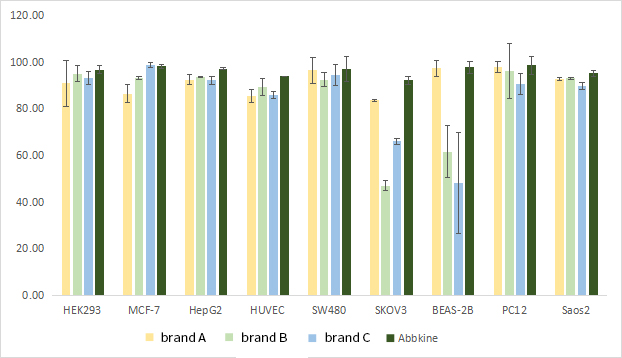
If you've ever stood at a biosafety cabinet at 11 p.m., mixing ice-cold FBS with DMSO while praying your cells don't ice-crystal themselves to death overnight, you already know the dirty little secret of cell cryopreservation: the gold standard everyone cites is actually a biological crapshoot in a bottle. Traditional freezing medium — 90% FBS + 10% DMSO — has been the default since the 1970s not because it's optimal, but because "it usually works enough." But FBS is undefined, batch-variable, expensive, ethically fraught, and carries xeno-protein contamination risk that quietly sabotages downstream omics, primary cell purity, and any path toward clinical/commercial translation. The SuperKine™ Serum/Protein-Free Cell Freezing Medium (BMU108-EN) from Abbkine is the modern answer: a ready-to-use, chemically defined, protein-free cryoprotective formulation that replaces the FBS lottery with a reproducible, low-toxicity, xeno-free freeze–thaw workflow — so your recovered cells wake up the same way they went down, not "mostly alive but weirdly differentiated."
The FBS Problem Nobody Likes to Admit Out Loud
Every lab inheritance includes a half-empty bottle of FBS-labeled freezing mix sitting in the -20°C rack, and the unspoken assumptions are:
Assumption Reality Check
"FBS is just inert nutrition" It's a complex soup of >1,000 proteins, peptides, lipids, hormones, and growth factors — meaning every thawed vial carries an undefined signaling history that can subtly (or dramatically) alter primaries, stem cells, and sensitive phenotype assays
"Batch variation doesn't matter for freezing" It matters for post-thaw attachment, morphology drift, and long-term passage stability — two different FBS lots can give you the same viability % at 24 h but completely different growth trajectories by p3–p5
"DMSO is the only active ingredient" True — but how the DMSO is buffered, osmotically balanced, and delivered determines whether your cells survive at -80°C and recover cleanly at 37°C without a toxic spike on thaw
"Serum protects during freeze" Serum proteins do provide some colloidal/osmotic buffering — but they also introduce the variability you're trying to eliminate
The scientific bottom line: if your cells are valuable enough to bank, they're valuable enough to freeze in a defined system.
What "Serum/Protein-Free" Actually Means (And Why It's Better)
BMU108-EN is formulated to give you all the cryoprotection, none of the biological noise:
• No fetal bovine serum → eliminates batch-to-batch variability, BSE/TSE risk, and xeno-antigen exposure
• No animal-derived proteins → truly defined; ideal for primary cells, PBMCs, and any workflow that eventually eyes GMP/clinical translation
• Chemically defined base → balanced salts, osmolality-controlled, with DMSO as the permeating cryoprotectant cushioned by non-permeating disaccharide(s)/osmolyte(s) (trehalose-type stabilization) and pH buffering so the intracellular → glass-transition transition is smooth
• Ready-to-use liquid → no weighing hyroscopics, no filtering DMSO-FBS slush, no "wait 30 min for it to dissolve"
The result is a 1-step workflow: collect cells → count → dilute directly into BMU108-EN → aliquot → controlled-rate freeze → store.
The Cryobiology in Plain English: Why DMSO Works, and Why "Defined Additives" Make It Safer
Cell freezing survival lives or dies by the two-phase danger zone:
- Between 0°C and -5°C (ice nucleation zone): extracellular ice forms first; water leaves the cell osmotically to maintain equilibrium → cell shrinks. If cooling is too fast here, intracellular ice nucleation (IIF) forms lethal crystals. Too slow, and the cell dehydrates excessively and salts-poison itself.
- Below ~-50°C to -80°C: the goal is vitrification/glass transition — water is so viscous it behaves as a glass, halting damaging phase transitions.
DMSO saves cells by permeating the membrane and lowering the freezing point / raising the unfrozen fraction at any given sub-zero T, buying time for controlled dehydration before ice locks in. But pure DMSO is cytotoxic at 37°C, which is why how you dilute it back out on thaw matters as much as the freeze itself.
The secret sauce of a premium protein-free medium is the supporting cast:
• Trehalose (or similar non-permeating disaccharide) → stabilizes membranes during dehydration, replaces some of the colloidal osmotic protection serum used to provide, and protects protein/lipid interfaces at the ice interface
• Optimized inorganic buffer → keeps pH from crashing during the exothermic DMSO mixing step
• Defined osmolarity → prevents "salt shock" during the controlled-rate ramp
The 3-Minute Workflow (Why It's Called SuperKine)
This is one of the few reagents where the protocol is genuinely boring — in the best way:
- Harvest cells at the end of log phase (or at your planned passage). Count viability (trypan blue ≥ 90% is the goal; if you're at 70%, change your culture conditions, not your freezing medium).
- Pellet gently (e.g., 300–400 ×g, 5 min, RT or 4°C depending on cell type). Remove all supernatant.
- Resuspend dropwise in BMU108-EN at your target density (commonly 1–10 × 10⁶ cells/mL depending on line; see notes below).
- Aliquot into cryovials (0.5–1.0 mL/vial typical), label with cell line, passage, date, and density.
- Controlled-rate freezing:
• Ideal: Nalgene® cryo container with isopropanol (≈ -1°C/min through nucleation) → -80°C overnight → transfer to liquid N₂ vapor (-135 to -196°C) for long-term.• Acceptable shortcut: -80°C directly if you must, but expect ~10–20% extra attrition vs. controlled-rate. - Thaw fast: 37°C water bath → as soon as ice just melts, wipe vial, move to hood, dilute DMSO out immediately with warm complete medium (dropwise first, then gentle swirl), spin, resuspend, plate. Do not leave cells sitting in thawed DMSO medium.
Where BMU108-EN Earns Its Place (Use Cases That Go Beyond "Stocked CHO")
① Cell Banking & Core Facility Standardization
If your lab freezes >10 lines or runs a shared cell bank, the #1 reproducibility killer is freezer-to-freezer, batch-to-batch inconsistency. Switching to a serum/protein-free, defined medium means:
• Every vial freezes under the same chemical spec
• Recovery curves become predictable
• QC logs stop blaming "bad FBS"
② Primary Cells & PBMCs (Where Serum Proteins Are the Enemy)
Human PBMCs, monocytes, neutrophils, and delicate primaries (hepatocytes, endothelial progenitors) are exquisitely sensitive to xeno-proteins and undefined factors that can pre-activate, skew, or silently differentiate them before your experiment even starts. Protein-free freezing keeps them functionally naïve.
③ Stem Cell & iPSC Workflows (With Caveats)
Many pluripotent and mesenchymal stromal cell (MSC) protocols can use defined, serum-free freezing — but always validate: some hESC/hiPSC lines are pickier than others, and the safe path is a side-by-side recovery test (BMU108-EN vs. your current FBS method) before banking your most precious lines.
④ Bioproduction & Process Scale-Up (CHO, HEK, hybridoma)
Industrial cell banks increasingly demand animal-origin–free / xeno-free documentation. A defined freezing medium simplifies the audit trail and eliminates one more animal-derived node from the chain.
⑤ High-Value Lines (Engineered Clones, CRISPR Pools, Patient-Derived)
When losing 20% of a vial means re-deriving a line for three weeks, "usually works" isn't good enough. Defined freezing → defined outcome.
Practical Rules That Decide Whether Your Recovery Is 85% or 30%
Rule Why It Matters
Never freeze in log-phase over-confluence Overgrown cells are already stressed; they'll die in the vial, not magically survive it
Keep BMU108-EN at 2–8°C (or as directed) and protected from light DMSO oxidizes slowly; rotate stock bottles and toss if discolored or old
Cool slowly (≈ -1°C/min) through nucleation Nalgene isopropanol box is the cheap gold standard; programmable controllers are better
Thaw fast, dilute DMSO fast DMSO cytotoxicity is time-at-temperature, not just concentration — the 37°C→dilution step should take <90 sec
Label vials on the cap AND side Side labels fall off in LN₂ frost; cap labels save you from the "which clone is this?" disaster
The Bottom Line
Traditional FBS+DMSO freezing is the duct tape of cell culture — it holds, but it leaks, warps, and leaves a mess. The SuperKine™ Serum/Protein-Free Cell Freezing Medium (BMU108-EN) from Abbkine replaces that mess with a defined, ready-to-use, xeno-protein–free cryoprotective formulation that gives you controlled ice management + defined osmotic buffering + zero animal-protein baggage in a 1-step pipetting workflow. Your cells freeze cleaner, thaw more predictably, and — most importantly — arrive in tomorrow's experiment in the same biological state you left them in today.
Product Reference: BMU108-EN – SuperKine™ Serum/Protein-Free Cell Freezing Medium
Learn more and order: https://www.abbkine.com/product/superkine-serum-protein-free-cell-freezing-medium-bmu108-en/
(For Research Use Only; not for diagnostic or therapeutic use in humans.)





