




CheKine™ Micro Betaine Assay Kit: Why the 20-Minute Enzyme Cascade Replaces HPLC and GC-MS
Betaine: The Osmoprotectant That Shields Life from Stress
Betaine—the trimethylated amino acid that plants deploy against drought and salinity[reference:0], that safeguards animal livers from fatty infiltration[reference:1], and that boosts microbial yields in industrial fermentation[reference:2]—is a linchpin of biological resilience. Yet for decades, quantifying it has meant choosing between expensive HPLC/GC-MS systems (requiring specialized training and derivatization steps[reference:3]) or generic kits that cross-react with choline, carnitine, and glycine[reference:4].
Why Abbkine KTB2350 Outperforms the Competition
| Feature | Abbkine KTB2350 | Traditional HPLC/GC-MS | Generic Colorimetric Kits |
|---|---|---|---|
| Detection Principle | BADH enzyme cascade → NADH (340 nm)[reference:5] | Column separation + detection | Indirect colorimetry[reference:6] |
| Sample Volume | 5–10 µL[reference:7] | 50–100 µL | 50–100 µL |
| Detection Limit | 0.02 µM (15x more sensitive than Sigma-Aldrich MAK324)[reference:8] | Variable | Often >1 µM |
| Dynamic Range | 0.05–50 µM[reference:9] | Variable | Narrower |
| Cross-Reactivity | <0.5% with glycine, sarcosine, dimethylglycine[reference:10] | Low | High (choline, carnitine)[reference:11] |
| Assay Time | 20 minutes[reference:12] | Hours | 60–90 minutes[reference:13] |
| Equipment | Standard microplate reader (340 nm)[reference:14] | Specialized, expensive | Microplate reader |
| Price | $79 for 48 tests[reference:15] | $$$$ | $$ |
The Enzyme-Coupled Specificity Advantage
What makes KTB2350 a breakthrough is its enzyme-coupled kinetic design[reference:16]. Instead of indirect colorimetry prone to cross-reactivity, it uses a two-step cascade: betaine aldehyde dehydrogenase (BADH) oxidizes betaine aldehyde (generated in situ from betaine) to glycine, producing NADH in the process[reference:17]. A spectrophotometric readout at 340 nm tracks NADH accumulation, with signal intensity proportional to betaine concentration[reference:18].
The anti-interference buffer—a cocktail of glycine oxidase (degrades excess glycine), EDTA (chelates metal ions), and BSA (blocks non-specific binding)—ensures reliable performance even in complex matrices like plant tissues, animal serum, liver homogenates, and microbial fermentation broths[reference:19][reference:20].
Applications Across Research Fields
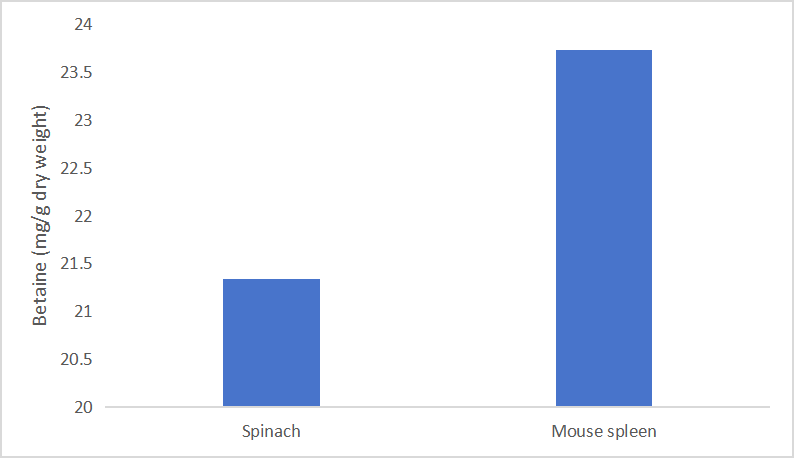
- Plant Stress Biology — tracking betaine accumulation in drought- and salt-stressed crops; healthy spinach leaves show 5–15 µM, while salt-stressed barley can reach 50–200 µM[reference:21]
- Crop Breeding — screening stress-tolerant genotypes[reference:22]
- Animal Nutrition — monitoring liver health and fatty infiltration[reference:23]
- Industrial Fermentation — optimizing microbial metabolite yields[reference:24]
- Food Science — verifying betaine enrichment in functional foods[reference:25]
Validated for Real-World Complexity
Unlike HPLC or GC-MS, which require specialized training and maintenance, this kit uses a colorimetric detection system compatible with standard microplate readers—equipment already present in most research labs[reference:26]. The entire assay (from sample preparation to data readout) is completed in under 90 minutes, with all reagents pre-aliquoted and ready to use[reference:27].
The Bottom Line
For researchers who need to quantify betaine in rare plant biopsies, low-yield fermentation broths, or precious clinical specimens—without investing in expensive instrumentation or sacrificing data quality—KTB2350 delivers the specificity (<0.5% cross-reactivity), sensitivity (0.02 µM), and speed (20-minute incubation) that modern osmoprotectant research demands.
👉 Quantify betaine with confidence. View Product





