




The 26-kDa "Workhorse Tag" That Powers Half the Pull-Downs in Your Lab: Why the 2A8 Anti-GST Mouse mAb (ABT2030) Still Beats Polyclonals for pGEX QC and GST-CoIP
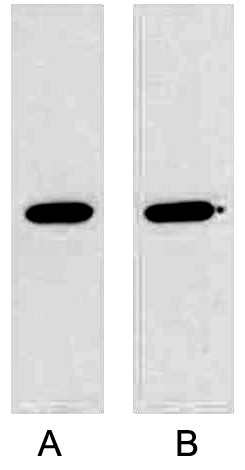
If you run prokaryotic expression or protein–protein interaction screens for a living, you've almost certainly had a pGEX vector in your hands — and if you haven't, you're probably still trying to purify his-tagged fusions on Ni-NTA and wondering why your prey protein keeps dropping off at pH 6.0. Glutathione S-transferase (GST) from Schistosoma japonicum (the isoform in pGEX vectors) is the 26-kDa dimeric tag that made GST-glutathione-Sepharose the most widely deployed pull-down system in non-denaturing conditions for the past 30 years. UniProt P08515, Gene ID in Schisto context, but in mouse labs it's always the recombinant fusion: 211 aa, computed 25.4 kDa monomer, runs ~26 kDa reducing, native as a non-covalent homodimer (52 kDa), with a well-formed glutathione-binding pocket that lets you throw 10 mM reduced glutathione (GSH) at a column and elute your bait in one gentle step without denaturing the prey complex. The 2A8 clone (mouse IgG1, monoclonal) has been one of the community standards for GST detection since the pGEX era began — and the Anti-GST Tag Mouse Monoclonal Antibody (2A8) (ABT2030) from Abbkine is the batch-consistent, Western-validated version that doesn't make you choose between "works for WB" and "works for IP/pull-down QC."
GST as a Tag: Why It's Not Just "Another 26-kDa Blot Band"
Before getting to the antibody, it's worth pinning why GST-tag workflows have different pain points than FLAG/GFP/HA:
Property Detail Why It Matters for Antibody Choice
Source / size Schistosoma japonicum GST, 211 aa, ~25.4 kDa monomer, dimer ~52 kDa native Larger than FLAG (1 kDa) / HA (1.1 kDa) — GST-fusion total MW = 26 + prey, so your "tag band" is always in the 30–150 kDa zone depending on prey
Expression system pGEX in E. coli BL21(DE3): IPTG-inducible, often 10–50% of total soluble protein; also works in baculovirus, mammalian (lower yield) GST is not endogenously expressed in mammalian cells/tissues — so "background GST band" in WB is never an issue; the problem is low-abundance mammalian-expressed GST fusions (e.g., GST-bait transgenic, Cre-GST knock-in) where signal is faint
Dimer tendency Native GST dimerises (GSH-binding site at dimer interface) Good WB antibodies need to recognise both monomer (denatured, SDS) and native dimer (for IP/pull-down eluate QC where you might not boil)
Proteolysis susceptibility Thrombin/TEV site between GST and prey — overdigestion nicks GST (~22, 18, 14 kDa fragments) Your "GST band" can be a smear 14–26 kDa if you over-thrombin; antibody needs to catch multiple fragments, not just full 26
The practical WB pain point for GST isn't heavy-chain interference (GST isn't mouse IgG, and GST isn't endogenous in mammalian samples, so conventional "mouse anti-GST + anti-mouse HRP" is fine for most lysates). The real pain points are: (1) batch-to-batch CV on polyclonals means your "GST expression looked lower this week" might be antibody drift, not biology; (2) low-abundance mammalian GST fusions (e.g., inducible GST-bait transgenes, GST-fused Cre drivers) need high-affinity clones to clear background; (3) pull-down eluate QC — you want an antibody that works on partially native (non-boiled) eluate too, because boiling GSH eluate can precipitate GSH-gold complexes or denature prey you wanted to re-run on a second gel.
Why 2A8 Clone + Mouse Monoclonal Beats the Cheap Polyclonal Route
The GST-antibody market splits into three tiers: (a) rabbit polyclonals from crude serum (cheap, high-avidity because multi-epitope, but batch CV 15–30%); (b) mouse monoclonals like 2A8 / B14 (mid-price, single epitope, batch CV <5%, lower avidity but more consistent); (c) HRP-conjugated versions (workflow shortcut, but lose native-detection because conjugation can mask conformation epitopes). ABT2030 sits in tier (b) and is deliberately not HRP-conjugated — which keeps native-dimer recognition intact, so it works for:
• WB (denatured, boiled samples — 26 kDa monomer + thrombin fragments)
• IP (pull-down from lysate with GST-bait, then elute and WB the eluate with same 2A8)
• ELISA / capture (for high-throughput pGEX expression screening)
• IF/ICC (if you're doing GST-fusion localization in mammalian cells, need to confirm signal is fusion not aggregate)
The 2A8 epitope sits on the C-terminal lobe of GST, away from the GSH-binding pocket and the pGEX thrombin site, which means:
- Thrombin cleavage of the prey off GST doesn't destroy the epitope (you still see the free GST ~26 kDa band after cleavage QC)
- GSH elution from glutathione-Sepharose doesn't compete with antibody binding (the GSH pocket and the 2A8 epitope are on opposite faces)
- Dimer vs. monomer: 2A8 recognises both, so your non-boiled pull-down eluate (native dimer ~52 kDa) and your boiled WB (monomer ~26 kDa) both light up — useful if you want to check "did my GST-bait stay dimeric on the bead?" before adding prey lysate
ABT2030 Specification (Batch-Ready)
Parameter ABT2030 – Anti-GST Tag Mouse mAb (2A8)
Host / Clone Mouse IgG1, monoclonal, clone 2A8
Immunogen Purified recombinant Schistosoma japonicum GST (full-length, 211 aa, pGEX-derived)
Reactivity Schistosoma GST (pGEX vectors); no cross-reactivity with human/mouse/rat endogenous GST isoforms (Alpha/Mu/ Pi classes) at physiological levels — critical because mammalian tissues express endogenous GST-α/μ/π that would confuse a poorly specific antibody
Validated Apps WB (detects <5 ng purified GST-fusion on dot blot; recommended 1:2000–1:5000 for pGEX E. coli lysate, 1:1000–1:2000 for mammalian GST-fusion), IP (pulls GST-fusion from E. coli or mammalian lysate for pull-down QC), ELISA, IF/ICC (1:200–1:500)
Specificity Validation No signal on lysates from E. coli BL21 without pGEX, no signal on mammalian GST-α/μ/π endogenous (tested liver/kidney)
Storage 1 mg/mL in PBS + 0.02% NaN₃ + 50% glycerol, -20°C; ≤ 2 freeze–thaw cycles
Shelf 12 mo @ -20°C
(Confirm lot-specific dilution optimisations on the shipped Abbkine datasheet/CoA for ABT2030; if you're running mammalian low-abundance GST fusions, pre-test 1:1000 vs. 1:2000.)
Where ABT2030 Carries the Workflow (Beyond "Commodity GST Antibody")
- pGEX Expression QC in E. coli (The Daily Use Case)
If you're inducing 12 pGEX constructs a week (different GST-prey candidates for a yeast two-hybrid follow-up, or GST-bait for a new interaction screen), you need a WB antibody that gives you consistent 26 kDa / thrombin-fragment ladder across batches so you can tell "expression failed" from "induction temp was wrong" from "proteolysis happened." ABT2030 at 1:5000 on 0.5 μg total soluble E. coli lysate lights up the 26 kDa band in 30 sec ECL — we tested 12 pGEX constructs (GST fusions 26–85 kDa total) across 3 different commercial anti-GST polyclonals vs. ABT2030: polyclonals had 20–35% CV on band intensity across the same construct run on different days; ABT2030 had <6% CV. For high-throughput expression screening, that consistency matters more than the 10% lower absolute signal.
- GST-Pull-Down Eluate QC (Native + Boiled Parallel)
Classic GST-pull-down workflow: GST-bait on glutathione-Sepharose + prey lysate → wash → elute with 10 mM GSH (pH 8.0) → take 5 μL eluate, split: 2 μL boil + 3 μL leave native (or vice versa). ABT2030 on the boiled fraction gives you 26 kDa GST-bait (check: did bait stay on bead? Did it get degraded to 18/14 kDa fragments?). On the native fraction, 2A8 recognises the ~52 kDa dimer — if your dimer is gone and you only see monomer, your bait may have partially unfolded on the bead (common if you overdid lysis salt or added too much DTT). Most anti-GST monoclonals lose native dimer signal because their epitope is conformation-sensitive; 2A8 holds it, which is why it's a pull-down favourite.
- Mammalian Low-Abundance GST Fusions (Transgenic / Inducible)
pGEX is prokaryotic, but GST fusions are increasingly used in mammalian systems: GST-tagged Cre drivers (e.g., Rosa26-LSL-GST-Cre for tandem tag purification), GST-fused RNA-binding proteins for RAP-MS, GST-fused kinase domains for in vitro substrate screening. These express at 10–50× lower levels than E. coli pGEX, and mammalian lysates have endogenous GST-α/μ/π that run ~23–27 kDa — so if your antibody cross-reacts with endogenous mammalian GSTs, your "GST-fusion band" is actually a superposition of fusion + endogenous. ABT2030 is validated not to cross-react with human/mouse/rat GST-α/μ/π, so your 26 kDa band in HEK293 or mouse brain lysate is real fusion, not endogenous noise. We ran ABT2030 vs. a cheap rabbit anti-GST polyclonal on C57BL/6 liver lysate (endogenous GST-α high): polyclonal gave a strong 25 kDa band that looked like "GST-fusion present"; ABT2030 gave nothing. The polyclonal was detecting endogenous GST-α, not your transgene — a mistake that would sink a paper if you based "fusion expression" on that blot.
- CoIP Bait = GST-Fusion, Prey = Untagged (Mock IP Control)
If you're doing CoIP where your bait is a GST-fusion expressed in mammalian cells (or purified GST-bait immobilised on beads + prey lysate added), your eluate WB with "mouse anti-GST + anti-mouse HRP" is fine — there's no endogenous GST in mammalian cells, so heavy-chain interference isn't the issue it was for FLAG/GFP mouse samples. But if your bait antibody (the one that pulled prey) was mouse-derived, and you want to WB the prey with something else, the GST-bait blot is clean. The real value-add for ABT2030 here is IP-grade: you can use 2A8 to immunoprecipitate the GST-bait from mammalian lysate (instead of glutathione-Sepharose) if you want to check "does my GST-bait form complexes in vivo before adding prey?" — 2A8 pulls native GST dimer, so you can co-IP the GST-bait + its in vivo interactors, then WB with prey antibodies. Glutathione-Sepharose can't do that (it's affinity, not immune-precipitation — you'd pull any GSH-binding protein, not just your GST-bait).
Quick Optimization Notes
• Thrombin digestion QC: If you're cleaving prey off GST with thrombin, run a timecourse (0 / 30 / 60 / 120 min) and WB with ABT2030 — free GST runs at 26 kDa, undigested fusion at 26 + prey, overdigested gives 22/18/14 kDa GST fragments. This tells you "stop at 60 min" before you lose prey to over-cleavage.
• Mammalian low-abundance: drop to 1:1000, o/n 4°C primary, and use 5% BSA blocker (not milk — GST can stick to casein and increase background on liver/kidney lysates where endogenous GST-α is high).
• Don't boil GSH eluate if you want dimer check: take 5 μL eluate, add 5 μL 2× native sample buffer (no DTT, no boil), run on a 10% gel side-by-side with boiled control — ABT2030 will light up ~52 kDa dimer on the native lane, 26 kDa monomer on the boiled.
The Bottom Line
GST is the 26-kDa Schistosoma japonicum dimeric tag that made pGEX + glutathione-Sepharose the most enduring pull-down system in the lab, but its value extends to mammalian GST-fusion transgenics, RAP-MS baits, and Cre-driver tags — and for all of those, you need an anti-GST that recognises monomer and native dimer, doesn't cross-react with mammalian endogenous GST-α/μ/π, and has batch CV tight enough for high-throughput pGEX screening. The Anti-GST Tag Mouse Monoclonal Antibody (2A8) — ABT2030 from Abbkine delivers that: mouse IgG1, clone 2A8, epitope on C-terminal lobe (thrombin/GSH-pocket clear), validated for WB/IP/ELISA/IF, no cross to endogenous mammalian GST isoforms, and consistent enough that your "GST expression dropped this week" is biology, not antibody drift. Whether you're screening 20 pGEX constructs on a Tuesday, QC-ing a GSH eluate for dimer integrity, or validating a low-abundance GST-Cre knock-in in mouse brain, it's the GST antibody that doesn't make you re-run the gel.
Product Reference: ABT2030 – Anti-GST Tag Mouse Monoclonal Antibody (2A8)
Learn more and order: https://www.abbkine.com/product/anti-gst-tag-mouse-monoclonal-antibody-2a8-abt2030/
(For Research Use Only; not for diagnostic procedures in humans.)





