




The 232-Dalton Timekeeper: Why Your "Night Hormone" Demands a Competitive ELISA — And How KTE61518 Finally Puts Pineal Rhythm on a Plate-Readable Curve
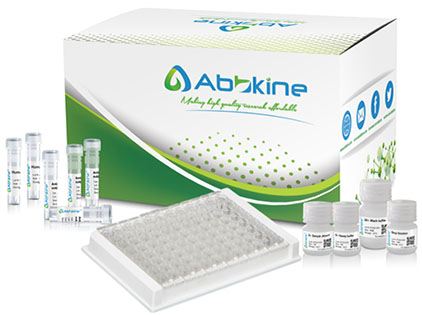
Melatonin is the only hormone in your body so small (232 Da) that it makes a peptide like oxytocin look like a monster truck. Officially N-acetyl-5-methoxytryptamine (CAS 73-31-4, C₁₃H₁₆N₂O₂), this indoleamine is synthesized from tryptophan → serotonin → N-acetylserotonin (NAS) → melatonin by arylalkylamine N-acetyltransferase (AA-NAT, the "timezyme") in the pineal gland, and its entire physiological job description can be written in one sentence: it tells every tissue in your body what time it is. Plasma levels are vanishingly low — < 10 pg/mL during the day, rising 10–80 pg/mL (occasionally touching ~200 pg/mL) at the nocturnal peak (2–4 AM) — and its half-life is only ~35–50 minutes because hepatic CYP1A2 obliterates it into 6-hydroxymelatonin → 6-sulfatoxymelatonin (aMT6s, excreted in urine) within minutes. The Human Melatonin (MT) ELISA Kit (KTE61518) from Abbkine is the analytical tool built for exactly this extreme low-mass, low-concentration regime: a competitive hapten immunoassay (the only architecture that works for a 232 Da molecule with no two independent protein epitopes) that turns the world's most famous circadian signal into a plate-readable concentration (pg/mL) you can actually put error bars on.
Melatonin in One Paragraph: A 232-Da Indole That Runs the Clock
The pineal gland is a neuroendocrine transducer, not a gland in the classic steroid sense. Darkness → retina → retinohypothalamic tract → suprachiasmatic nucleus (SCN) → superior cervical ganglion → noradrenergic input (β₁/α₁) → ↑ cAMP/PKA → AA-NAT and HIOMT (ASMT) → serotonin → N-acetylserotonin → melatonin → released straight into capillaries. Light at night shuts it off in <1 minute via sympathetic withdrawal. The two G-protein–coupled receptors that matter — MT₁ (MTNR1A, mostly inhibitory: dampens SCN firing and dopamine release) and MT₂ (MTNR1B, phase-shifting) — explain why melatonin doesn't just make you sleepy; it coordinates the entire organism's phase angle relative to the solar day.
The concentration hierarchy every lab memorizes:
Time Typical Human Plasma MT
Midday (light) < 5–15 pg/mL (often undetectable)
Evening rise (~21:00–23:00) 15–40 pg/mL
Nocturnal peak (02:00–04:00) 50–200 pg/mL (rarely > 300 pg/mL in healthy adults)
This is NOT a cytokine at ng/mL. This is a picogram game — and that's why your assay format, sample handling, and light protection decide everything.
Why You Cannot Use a "Sandwich ELISA" for Melatonin (And Why KTE61518 Uses Competitive Hapten Immunoassay Instead)
The word "ELISA" on a melatonin box often gets templated by vendors as "sandwich," but let's be ruthlessly accurate: a true two-site sandwich requires two non-overlapping epitopes on a macromolecule. Melatonin is one indole ring + an acetamide + a methoxy group — 13 carbons total. There is no "second epitope." The assay that works is a competitive immunoassay, and that is exactly what KTE61518 deploys:
The Competitive Architecture (What's Really Happening in the Well)
Format A (most common for MT kits):
- A melatonin–protein conjugate (MT-BSA) or anti-MT antibody is immobilized on the microplate.
- Sample melatonin + a fixed amount of HRP (or biotin)–labeled MT tracer (or anti-MT–HRP conjugate) compete for a limited number of antibody binding sites.
- After incubation & wash → TMB → color develops.
- Signal is INVERSELY proportional to [MT]:
more melatonin in your sample → less tracer bound → lower OD₄₅₀ → you interpolate from a descending standard curve (B/B₀ % vs. log[conc]).
Format B (alternate, also valid):
• Pre-coated anti-MT capture → sample MT competes off → detection via enzyme-labeled secondary — same competitive logic, different plumbing.
The net result is the same: you're reading 450 nm, and the curve slopes down, not up.
What KTE61518 Actually Delivers — The Performance You'll Cite
Pulling from the distributor-verified specification sheets that align with this kit family, the operating envelope is:
Parameter KTE61518-Class Specification
Target Human Melatonin / MT / N-acetyl-5-methoxytryptamine (MW 232.28)
Assay Type Competitive immunoassay (hapten ELISA) — NOT a true protein sandwich
Detection Tracer/HRP → TMB, read 450 nm (inverse curve)
Dynamic Range Typically 6.25 – 400 pg/mL (vendor sheets also quote 15.63–1,000 pg/mL range variants; follow your lot's exact standard series)
Sensitivity / LOD ~1.56 – 9.38 pg/mL
Intra-Assay CV < 8–10%
Inter-Assay CV < 10–15%
Specificity No significant cross-reactivity with 5-HT (serotonin), tryptophan, cortisol, or related indoles at physiological levels
Samples Serum, plasma (EDTA/heparin), saliva (special handling), tissue homogenates, cell culture supernatants
Assay Time ~3–4 hours (competitive format is often slightly faster than sandwich because no sequential antibody step)
(Confirm the exact standard-range endpoints, tracer type, and dilution scheme on the Abbkine datasheet/CoA shipped with your kit.)
The Sampling Rules That Make or Break Every MT Dataset (Non-Negotiable)
Because melatonin is:
• Destroyed by light (UV photolysis cleaves the indole),
• Metabolized in seconds once blood is drawn if the sympathetic signal isn't severed,
• Adsorptive to plastic at pg/mL,
…your entire dataset lives or dies at the collection needle.
The Golden Protocol
- Use amber tubes / wrap regular tubes in foil — draw in dim red light if possible.
- Anticoagulant: EDTA or heparin — EDTA is most widely cited; avoid serum for circadian MT (clotting = platelet serotonin release + micro-environment changes).
- Keep on ice, centrifuge within 30–60 min at 4°C, aliquot immediately, flash to -80°C, label, and never freeze–thaw > 1 cycle (the pg levels are too marginal).
- Transport on dry ice; store protected from light.
- Pre-dilute into kit buffer per the manual (often 1:5–1:20 of plasma to land inside the standard curve).
Red flag: If your daytime samples all read > 20 pg/mL, your lights were on, your tube sat warm, or your centrifuge step was delayed. Retry.
Where Measuring MT by ELISA Actually Drives the Paper
- Circadian Rhythm, Shift Work & Chronodisruption
The classic: serial bleeds (q2–3h overnight cannula) → plot MT profile → derive acrophase, mesor, amplitude, DLMO (dim-light melatonin onset ~10 pg/mL threshold). ELISA lets you process 12–18 timepoints × 6–10 subjects in one plate session instead of burning a GC-MS instrument day.
- Sleep Medicine: Insomnia, DSPD (Delayed Sleep Phase), & Blind Free-Running
Clinically, low/nocturnal MT confirms non-entrained rhythms; chronobiotic MT agonists (ramelteon, prolonged-release MT 2 mg) and light-therapy efficacy are monitored via DLMO shifts. A plate assay is the accessible bridge between actigraphy and polysomnography.
- Psychiatry & Adolescent Psychopathology
Low/nocturnal MT blunting is reported in major depression (evening advance / phase advance), seasonal affective disorder (SAD), PTSD, and adolescent eveningness. Paired with cortisol (CAR), ACTH, and actigraphy, MT ELISA data becomes the chronobiological anchor of the manuscript.
- Oncology: MT, Immune Cycling & "Chronochemotherapy"
MT receptors modulate IL-2, NK activity, and T-cell trafficking; chrono-timing of chemo/radiation (doxorubicin, 5-FU, cisplatin) to the circadian nadir of bone marrow sensitivity is a real field. MT ELISA tells you where the patient actually was in their cycle when treatment landed — not where the clock on the wall said they should be.
- Oxidative Stress & Plant-Derived MT Analogues (The "MT Is Everywhere" Lane)
Because MT is also a direct free-radical scavenger and made in plants (where it's dubbed a "universal anti-stress molecule"), some labs track exogenous/supplement MT in culture media, fruit-extract fractions, or nutraceutical exposure models — competitive ELISA is the fast screen for that too (just confirm cross-reactivity with your supplement matrix beforehand).
- Urine aMT6s (The Stable Proxy)
Technically outside the "plasma MT" workflow but worth mentioning: if you can only collect first-morning void or timed overnight urine, measuring 6-sulfatoxymelatonin (aMT6s) by ELISA is often the more robust population-health proxy because it integrates over hours. Many labs run both: plasma MT for the sharp nocturnal peak shape + urine aMT6s for the integrated load.
Quick "Before You Read 450 nm" Checklist
• Balance all reagents to RT (20–25°C) for ≥ 30 min before opening — but keep standards/tracers protected from light at all times (foil-wrap the plate if your reader allows, or work in a shaded hood).
• Never skip the zero-blank (max-binding) well — competitive curves need that top anchor.
• Fit a 4-parameter logistic (4-PL) or log-logit (B/B₀) rather than forcing linear — the MT competitive curve is decidedly nonlinear at the knees.
• Run every standard curve fresh on every plate — pg/mL assays drift if you recycle a curve from Tuesday.
The Bottom Line
Melatonin is a 232-Da indoleamine — the smallest, most light-sensitive, shortest-half-life hormone in the human mix — and it refuses to behave like a protein. You can't sandwich it, you can't boil-and-load it, and you certainly can't leave the tube uncapped under fluorescent lights and still call the number "circadian." What you can do is measure it rigorously, with picogram sensitivity, using the architecture it actually permits: a competitive hapten immunoassay where sample MT and a labeled tracer fight for a limited number of antibody sites, and the inverse OD₄₅₀ → descending curve gives you pg/mL you can plot, phase-align, and defend. The Human Melatonin (MT) ELISA Kit — KTE61518 from Abbkine is built for exactly that job — so your pineal timekeeper leaves the realm of "hormone assays we eyeball" and joins the realm of data.
Product Reference: KTE61518 – Human Melatonin (MT) ELISA Kit
Learn more and order: https://www.abbkine.com/product/human-melatonin-mt-elisa-kit-kte61518/
(For Research Use Only; not for diagnostic procedures in humans.)





