




CheKine™ Micro Total Carbohydrate Assay Kit: The Complete Picture of Carbohydrate Content
Total Carbohydrates: The Foundation of Biological Energy
Total carbohydrates encompass the full spectrum of saccharides—from simple sugars to complex polysaccharides—that serve as energy sources, structural components, and signaling molecules in all living organisms[reference:106]. Total carbohydrates mainly refer to reducing glucose, fructose, maltose, lactose, sucrose, and starch that can be hydrolyzed into reducing monosaccharides under the measurement conditions[reference:107]. Accurate total carbohydrate quantification is essential for understanding nutritional composition, metabolic status, and biological function.
Abbkine's CheKine™ Micro Total Carbohydrate Assay Kit (KTB1350) provides a simple, convenient, rapid, and colorimetric total carbohydrate detection method[reference:108] compatible with plant tissues, animal tissues, serum, and plasma[reference:109].
Food & Nutritional Science
Total carbohydrate measurement is fundamental for:
- Nutritional labeling — determining carbohydrate content in foods
- Quality control — ensuring consistency in food products
- Dietary research — assessing carbohydrate intake in human studies
- Functional food development — evaluating carbohydrate profiles of novel ingredients
Plant & Agricultural Research
Total carbohydrates are critical for:
- Crop quality assessment — evaluating grain, fruit, and vegetable quality
- Stress physiology — tracking carbohydrate accumulation under drought, salinity, and cold
- Yield optimization — understanding carbohydrate allocation to seeds and storage organs
- Bioenergy research — assessing biomass carbohydrate content for biofuel production
Animal & Clinical Research
Total carbohydrate measurement enables:
- Metabolic studies — assessing carbohydrate metabolism in health and disease
- Serum/plasma analysis — monitoring carbohydrate levels in biological fluids[reference:110]
- Nutritional research — evaluating dietary carbohydrate impacts
How It Works
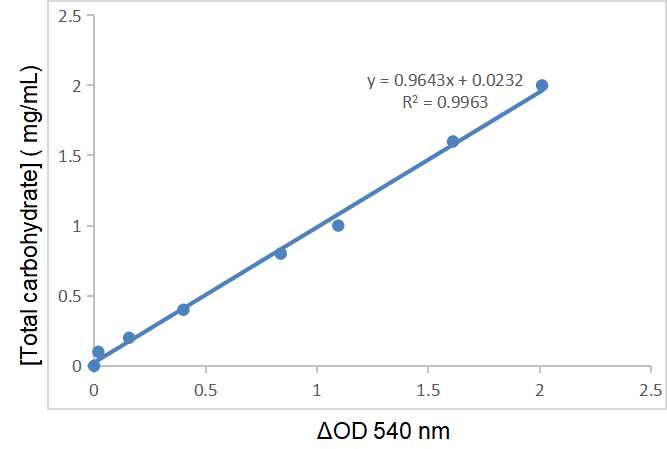
Total carbohydrates are hydrolyzed into reducing sugars, and reducing sugars are heated with DNS reagents under alkaline conditions to reduce DNS to generate amino compounds, which are reddish-brown in alkaline solution and have a characteristic absorption peak at 540 nm[reference:111]. Within a certain concentration range, the reducing sugar content has a linear relationship with the absorbance at 540 nm[reference:112]. Total carbohydrate content is calculated according to the standard curve[reference:113].
Critical Sample Handling Tips
- Do not mix components between different batch numbers and manufacturers[reference:114]
- Avoid bubbles while mixing or redissolving components[reference:115]
- Change pipette tips frequently to avoid cross-contamination[reference:116]
- Do a pre-experiment with 1-2 samples to guarantee accuracy[reference:117]
- If the sample value is higher than the maximum standard value, dilute with distilled water[reference:118]
- Hydrochloric Acid and Sodium Hydroxide are corrosive; DNS Reagent is toxic—take protective measures[reference:119]
Important Note
This kit cannot achieve 100% degradation of cellulose[reference:120].
📊 Your Research Area?
Food Science | Plant Physiology | Nutrition | Animal Metabolism | Bioenergy
👉 Quantify total carbohydrates with confidence. View Product





