Live and Dead Cell Double Staining Kit (KTA1001): Membrane Integrity vs Esterase Activity Compared
A single viability dye tells you that something happened to a cell. It says less about which cellular function was lost first.
The Live and Dead Cell Double Staining Kit (KTA1001) measures two recognized parameters at once: plasma membrane integrity and intracellular esterase activity. Live cells take up LiveDye, a cell-permeable green fluorescent probe (Ex/Em = 488/530 nm); dead cells are marked by NucleiDye, a cell non-permeable red fluorescent probe (Ex/Em = 535/617 nm).
Two Parameters Instead of One
One probe reports membrane status, the other reports enzymatic activity. That pairing is the whole design.
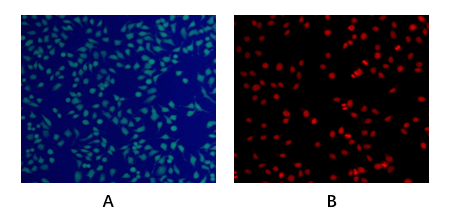
The product page describes the assay as "a convenient assay to evaluate the viability of cells, based on the simultaneous determination of live and dead cells with two probes that measure recognized parameters of cell health: plasma membrane integrity and intracellular esterase activity." The background section explains why the distinction is useful: cell-mediated cytotoxicity involves cytolysis of a compromised cell, and telling live from dead cells matters for studies of growth control and cell death. In the demonstration image, live HeLa cells stain green and cells incubated 30 minutes in 70% ethanol stain red.
Green Live, Red Dead, Distinct Channels
The spectral separation is explicit: 488/530 nm for the live signal, 535/617 nm for the dead signal.
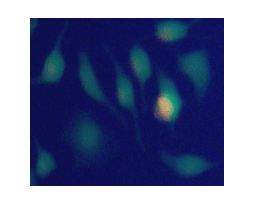
Because LiveDye is cell-permeable and NucleiDye is not, the color difference follows membrane status rather than dye preference. The two emission windows sit far enough apart to be read in separate channels on a fluorescence instrument, and the format translates cleanly to imaging where morphology matters. A second figure shows HeLa cells after 20 minutes of incubation with the staining solution, which gives a concrete starting point for protocol timing.
Pack Sizes That Scale With Throughput
Three formats are listed: 100T, 500T, and 2500T.
That range covers a small pilot experiment and a screening-sized series without changing the staining logic. The 2500T option is relevant for labs running repeated viability checks across treatment conditions, while 100T suits a first pass on a new cell model. Check the product page for the current component and storage details before ordering, since the page's specification section is brief.
| Feature | This Product | Conventional / typical approach |
|---|---|---|
| Parameters measured | Membrane integrity plus intracellular esterase activity | commonly a single viability parameter |
| Live-cell probe | LiveDye, cell-permeable, Ex/Em = 488/530 nm | varies by dye |
| Dead-cell probe | NucleiDye, cell non-permeable, Ex/Em = 535/617 nm | often a separate exclusion dye |
| Illustrated staining time | 20-minute incubation shown in HeLa cells (Fig. 2) | varies by protocol |
| Available sizes | 100T, 500T, 2500T | may offer fewer pack options |
For viability work where two independent readouts strengthen the interpretation, KTA1001 offers a defined, dual-probe setup. Use the product page to confirm which format fits your sample count.
Reference: https://www.abbkine.com/product/live-and-dead-cell-double-staining-kit-kta1001/
For research use only. Not for diagnostic or therapeutic use.