Cell Counting Kit-8 (CCK-8) (KTA1020): Sensitivity Compared With MTT and Other Tetrazolium Salts
Viability assays are easy to run and easy to misread. A solubilization step, a bubble in the well, or an incubation that is too short can move the OD enough to change the conclusion.
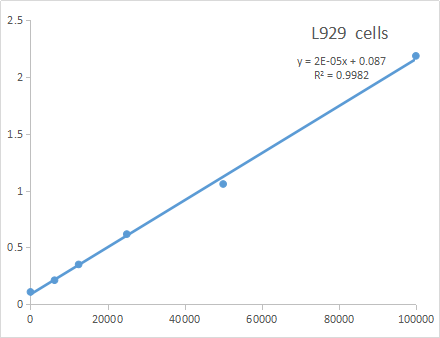
The Cell Counting Kit-8 (CCK-8) (KTA1020) detects cell proliferation and cell toxicity using WST-8, which is reduced by dehydrogenases in cells to an orange formazan product. The amount of formazan is directly proportional to the number of living cells. The page states that "the detection sensitivity using CCK-8 is higher than assays using other tetrazolium salts such as MTT, XTT, MTS or WST-1."
Higher Sensitivity Than the Tetrazolium Alternatives
The comparison is explicit on the product page, not inferred from the chemistry.
WST-8 is a water-soluble tetrazolium salt — the page gives the full name as 2-(2-methoxy-4-nitrophenyl)-3-(4-nitrophenyl)-5-(2,4-disulfophenyl)-2H-tetrazolium, monosodium salt — that produces a water-soluble formazan dye in the presence of an electron mediator. Because the product forms directly in the culture medium, the readout is colorimetric and nonradioactive. That is the basis of the stated sensitivity advantage over MTT, XTT, MTS, and WST-1 assays.
Water-Soluble Formazan, No Solvent Step
No organic solvent and no isotope are required to read the plate.
The page states that the formazan produced by WST-8 is water soluble, stable, and safe. For a workflow that runs many plates, removing a solubilization step removes one source of well-to-well variation. The assay measures dehydrogenase activity in viable cells, so any condition or chemical that alters that activity may cause a discrepancy between the actual viable cell number and the number determined by the assay — worth noting when testing compounds that act on metabolism.
One Bottle, Ready to Use
The formulation is a liquid solution, and the only component listed is CCK-8 solution.
"One-bottle, ready-to-use solution" is how the page describes the format. For labs running routine proliferation curves or cytotoxicity screens, that removes reconstitution from the workflow. The kit is supplied as 1000T or 10000T, with storage specified as one year at 0–5°C protected from light; -20°C is recommended for longer storage, and repeated freeze-thaw cycles are noted to increase background. For frequent use, the page recommends keeping it at 0–5°C.
Low Toxicity Keeps Cells Available Downstream
The same wells can feed another assay after the OD read.
According to the product page, "the same cells can be used for other cell assays because of the low toxicity of CCK-8." That matters when sample is scarce and a proliferation read is only one of several endpoints planned for the same plate. The page also lists conditions that affect readout quality: avoid introducing bubbles because they interfere with the OD reading; incubation time varies by cell type and number, with leukocytes giving weak coloration and requiring up to 4 hours or about 10⁵ cells per well; and if long culture has changed the color or pH of the medium, replace it before adding CCK-8.
| Feature | This Product | Conventional / typical approach |
|---|---|---|
| Detection sensitivity | Page states higher than MTT, XTT, MTS, or WST-1 | varies by tetrazolium salt |
| Formazan | Water soluble; no organic solvents or isotopes required | may require a solubilization step |
| Format | One-bottle, ready-to-use liquid solution | often needs reconstitution before use |
| Downstream assays | Low toxicity allows reuse of the same cells | may be limited by reagent toxicity |
| Storage | One year at 0–5°C protected from light; -20°C for longer storage | varies by reagent formulation |
For proliferation or cytotoxicity work where sensitivity and plate throughput both matter, KTA1020 gives a defined, single-reagent workflow. Check the product page for pack sizes and confirm that your compound does not directly affect dehydrogenase activity before interpreting the OD.
Reference: https://www.abbkine.com/product/cell-counting-kit-8-cck-8-kta1020/
For research use only. Not for diagnostic or therapeutic use.