




Kill the Purple Crystals: Why the Ultra-Sensitive WST-8/CCK-8 Format Is the Real MVP of Your Cell Viability Pipeline
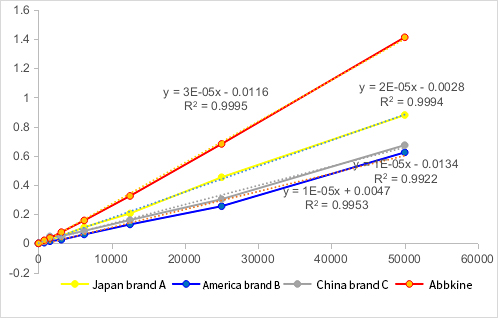
Every lab has that one reagent drawer where the MTT powder sits untouched for three years — not because nobody needs cell viability data, but because everyone remembers the afternoon they wasted dissolving purple formazan crystals in DMSO while questioning their life choices. The truth is, the Cell Counting Kit-8 (CCK-8) assay — built on the water-soluble tetrazolium salt WST-8 — didn't just replace MTT; it quietly became the most-run quantitative readout in drug screening, cancer biology, stem cell expansion, and biomaterials cytotoxicity on the planet. And when you crank it up to "maximum sensitivity," the math changes: you stop needing 5,000 cells per well to get a clean signal and start reading reliable OD shifts at the low‑hundreds. That's exactly what Abbkine's SuperKine™ Maximum Sensitivity Cell Counting Kit-8 (CCK-8) — BMU106-EN is built for: a single‑component, ready‑to‑use WST-8 reagent so well optimized it behaves more like a plate‑reader standard curve than a finicky biological stain.
The Chemistry in Plain English: Why "Water-Soluble Formazan" Changes Everything
The core of CCK-8 isn't magic — it's mitochondrial dehydrogenase activity as a proxy for metabolic competence, packaged into a colorimetric readout you can trust.
• The active ingredient is WST-8 (2-(2‑methoxy‑4‑nitrophenyl)‑3‑(4‑nitrophenyl)‑5‑(2,4‑disulfophenyl)‑2H‑tetrazolium monosodium salt), a cell‑impermeant, colorless tetrazolium salt that sits harmlessly in your culture medium.
• In the presence of an electron carrier (typically 1‑Methoxy PMS / 1‑mPMS) already stabilized inside the reagent, NAD(P)H‑dependent cellular dehydrogenases at or near the plasma membrane/mitochondria reduce WST-8 → orange‑yellow water‑soluble formazan.
• The amount of formazan produced is directly proportional to the number of metabolically active (viable) cells, and you read it on any standard microplate reader at ~450 nm (sometimes with a 650 nm reference correction if your plate/fluid is slightly scattering).
The sentence that matters most: the formazan product is water‑soluble. No DMSO. No scratching crystals off the plastic. No "did I lose half the signal in the wash" anxiety. You literally add → incubate → read.
Why "Maximum Sensitivity" Isn't Just Marketing — It's About the Lower Edge of Your Curve
Every CCK-8 protocol technically works. What separates a passable reagent from the SuperKine™ ultra‑sensitive formula is where your detection limit lands and how straight your line stays:
Feature What It Buys You
Optimized WST-8 / electron mediator ratio Stronger signal at low cell density without blowing up background in high‑density wells
High‑purity format Less interfering colored impurity → less "phenol‑red‑plus‑reagent color" noise, especially in serum‑rich media
Low residual cytotoxicity (<0.1% by most product data) You can harvest RNA/protein or reseed the same well after reading (yes, really) — ideal for longitudinal tracking or sequential assays
Extended incubation tolerance (up to 24–48 h in slow‑growth models) Reagent remains stable in the well; signal keeps climbing with cell number instead of poisoning the culture mid‑experiment
Published performance envelopes for this class consistently cite a linear range roughly from ~10³ to ~10⁷ cells/mL, with reliable detection thresholds often around 500 viable cells/well depending on cell type and incubator conditions — the regime where "standard CCK-8" starts getting wobbly but the maximum‑sensitivity formulation still holds a clean slope.
The 10‑Minute Workflow (Because It's a One‑Bottle Reagent by Design)
This is one of the few assays where the protocol is genuinely boring — in the best way:
- Seed cells into your 96‑well plate (in 100–200 µL complete medium). Allow attachment (if adherent) — typically 24 h, 48 h, or your treatment window.
- Add CCK-8 reagent directly on top of the medium — the recommended working addition is commonly 10 µL per 100 µL medium (i.e., ~1/10 volume; always confirm the exact ratio on your kit's sheet).
- Incubate — often 1–4 h depending on cell density and signal strength (many labs get great data in 2 h; low‑density or slow‑dividing cells sometimes need longer).
- Read Absorbance at 450 nm on a microplate reader (optional reference wavelength 650 nm if you want to pull out residual scatter).
- Subtract blank (medium + CCK‑8, no cells) → normalize to your control → calculate % viability or IC₅₀ via your preferred fitting (4‑PL / log‑logit).
No washing. No medium removal. No solvent. Just add‑and‑read.
The Comparison That Actually Matters: CCK-8 / WST-8 vs. MTT vs. MTS vs. WST-1
MTT MTS / WST-1 CCK-8 / WST-8 (BMU106-EN)
Formazan solubility Insoluble → needs DMSO/SDS Water‑soluble Water‑soluble
Reagent format Powder, multi‑step prep 1–2 components Single ready‑to‑use liquid
Cell toxicity during assay Higher (purple crystals + eventual solvent exposure) Low Ultra‑low (<0.1% residual)
Sensitivity / lower limit Good, but needs more cells Better Best in class among colorimetric tetrazoliums
Throughput fit Okay Good Excellent (add‑and‑read, robotics‑friendly)
Phenol‑red tolerance Tricky (purple background) Okay Handles phenol‑red + serum well
The verdict is why CCK-8 has effectively retired MTT in most core facilities: it's the only legacy‑era colorimetric format that feels like a modern plate‑reader assay rather than a histochemistry relic.
Where BMU106-EN Pulls Its Weight (Use Cases That Go Beyond "Day 3 MTT")
① Hit‑to‑lead drug / compound screening
Running 20–40 conditions × duplicates across multiple plates? The single‑reagent, low‑tox, linear‑over‑4‑logs behavior is exactly what lets you stack plates, walk away, and come back to numbers — not judgment calls.
② Cancer cell IC₅₀ panels & chemo/radiosensitivity
CCK-8 is the standard for dose–response curves across cancer lines (NCI‑60‑style workflows at the bench scale). The higher sensitivity means you can run lower seeding densities that better mimic sparse tumor microenvironments or early colonization.
③ Biomaterials, hydrogels, and extract toxicity (ISO 10993‑5 style)
Elution extracts, leachable screens, and scaffold leachates often produce subtle, non‑lytic metabolic hits before they kill everything outright. This is where "maximum sensitivity" matters most — catching a 15–20% metabolic dip with confidence instead of writing it off as noise.
④ Stem cell expansion & engineered tissue QC
When you're culturing iPSC‑derived cardiomyocytes / hepatocytes / organoids in 96‑well format and need a quick proliferation or metabolic fitness check before the real spendy assays (qPCR/RNA‑seq/flux), CCK-8 is the fast gatekeeper.
⑤ siRNA / CRISPR viability counterscreen
Testing whether your genetic manipulation killed cells vs. slowed growth? CCK-8 gives you the viability anchor that keeps your target‑gene "effect" from being a secret death‑curve in disguise.
Three Rules That Prevent 90% of CCK-8 Headaches
- Don't use the outermost wells for data — edge evaporation always biases OD. Fill edge wells with PBS + medium or skip them.
- If your compound is colored or reducing (e.g., polyphenols, ascorbate, some metal‑based nanoparticles), run a compound‑only blank (no cells) + CCK‑8 to subtract compound background, or move to a luminescence ATP assay for orthogonal confirmation.
- Validate cell‑number linearity once for your specific line (seed 0 → 5k → 10k → 20k → 40k in a pilot) so you know your working linear window before you commit 10 plates.
The Bottom Line
Cell viability isn't a "basic assay you do because you have to" — it's the primary dependent variable for every toxicity curve, proliferation claim, and drug‑screen hit in the building. The SuperKine™ Maximum Sensitivity Cell Counting Kit-8 (CCK-8) — BMU106-EN from Abbkine takes the classic WST‑8 chemistry and tunes it for the regime that actually stresses people: low cell numbers, long incubations, and high‑throughput reproducibility, all while staying gentle enough on the biology that your cells survive the read and your data survives peer review. One bottle. One addition. One wavelength. Done.
Product Reference: BMU106-EN – SuperKine™ Maximum Sensitivity Cell Counting Kit-8 (CCK-8)
Learn more and order: https://www.abbkine.com/product/superkine-maximum-sensitivity-cell-counting-kit-8-cck-8-bmu106-en/
(For Research Use Only; not for diagnostic use in humans.)





