




The Contractility Switch Hidden in Plain Sight: Why MYPT1 pThr⁸⁵³ Is the ROCK-MLCP Readout Your Stress-Fiber Experiment Is Missing
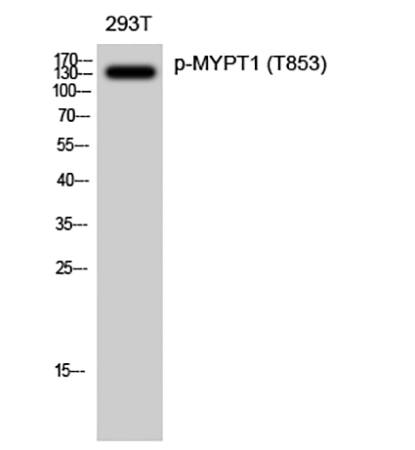
Every time a cell contracts, rounds up under tension, tightens its cortical actin, or pulls a stress fiber taut enough to deform the nucleus, a single phosphatase complex is deciding whether that tension holds or relaxes—and a single phosphorylation event is pulling the emergency brake on it. That event is phosphorylation of MYPT1 (Myosin Phosphatase Target subunit 1, gene PPP1R12A) at Thr⁸⁵³, the Rho-kinase (ROCK) consensus inhibitory site on the regulatory subunit of the MLCP (Myosin Light Chain Phosphatase) holoenzyme. When ROCK or related kinases clip this site, MLCP activity collapses, myosin light chain (MLC2/RLC) stays hyperphosphorylated, and actomyosin tension ramps up—driving vasoconstriction, endothelial barrier breakdown, focal adhesion reinforcement, cytokinesis failure, and the invasive contractile phenotype that makes ROCK inhibitors such a perennially attractive target class. The MYPT1 (phospho Thr853) Polyclonal Antibody (ABP55324) from Abbkine is the reagent that lets you intercept this one decisive post-translational modification—rabbit-derived, affinity-purified, phospho-Thr⁸⁵³-site-specific—and read it cleanly by Western blot, IHC-P, ICC/IF, and ELISA with none of the ambiguity that plagues generic "anti-MYPT1" or non-modification-specific detection.
MYPT1 & the MLCP Holozyme: The Gatekeeper of Cellular Relaxation
MYPT1 (PPP1R12A, ~110–130 kDa depending on isoform and SDS behavior due to its long helical HEAT-repeat scaffold) does not carry catalytic activity itself—it is the targeting/regulatory subunit that tethers the catalytic subunit PP1cδ (PPP1CB) into the MLCP holo-complex that specifically dephosphorylates MLC₂₀ at Ser¹⁹ (and Thr¹⁸). In simple terms:
Relaxed state → MLCP ON → pMLC ↓ → actin–myosin detaches → tension drops
Contracted/tense state → ROCK phosphorylates MYPT1 (Thr⁶⁹⁶ & Thr⁸⁵³) → MLCP inhibited → pMLC ↑ → actin–myosin locked together → tension ↑
The two canonical inhibitory phosphorylations are:
Site (classical numbering) Kinase Input Functional Impact
Thr⁶⁹⁶ (PKC / ROCK / ZIPK consensus) ROCK, PKC, ZIPK Direct inhibition; also partly interferes with PP1c binding
Thr⁸⁵³ (ROCK consensus R/KXXTXXXR/K) Primarily ROCK1/ROCK2 Inhibits PP1c catalytic turnover; often the cleaner, more specific readout of acute ROCK activation in cells
Thr⁸⁵³ is the more purely ROCK-correlated of the two in many cellular contexts, which is why it is the go-to phospho-site for anyone trying to prove "my treatment actually engaged ROCK→MLCP" rather than guessing from a pMLC band that could come from multiple kinases (MLCK, ROCK, MRCK, ZIPK, p21-activated kinase crosstalk).
Why a Phospho-Site-Specific Polyclonal Is the Right Tool Here
Detecting a single phosphate on a ~120 kDa scaffold is unforgiving. The difference between "signal" and "cross-reactivity to the unphosphorylated protein" is often a single epitope, and that's why generic anti-MYPT1 can leave you wondering whether your band moved or just changed intensity due to loading. A phospho-Thr⁸⁵³-specific polyclonal solves this through two complementary strengths:
- Site-specific immunogen design — the antibody is raised against a phosphothreonine-containing synthetic peptide spanning the Thr⁸⁵³ motif, then affinity-purified to retain only those IgGs that require the phosphate for binding. This means:
• Signal should collapse when you pre-treat lysates with λ-PP1 (λ phosphatase) — your built-in specificity control.• Signal should be minimal in ROCK-inhibited conditions (Y-27632 / fasudil / GSK429286) or ROCK knockdown — your biological control. - Multi-epitope backup for total-MYPT1 — because it's a polyclonal, the same serum system (run in parallel on a stripped/separate blot) can give you the total MYPT1 loading control if you choose the right secondary strategy, or you can pair it with a separate total-MYPT1 mAb/pAb for cleaner normalization.
Product Profile: ABP55324 — MYPT1 (phospho Thr853) Polyclonal Antibody
Attribute Detail
Target MYPT1 / PPP1R12A — phospho Thr⁸⁵³ (ROCK consensus site)
Host / Format Rabbit IgG, affinity-purified (anti-phosphopeptide)
Phospho-Specificity Requires pThr⁸⁵³; signal abolished by phosphatase treatment (classic validation)
MW observed ~110–130 kDa (isoform / gel system dependent; HEAT-repeat protein runs broad)
Species reactivity Human (endogenous); also cited for mouse, rat cross-reactivity (highly conserved motif RKT*GTIDNKFK)
Validated apps WB, IHC-P (FFPE), ICC/IF, ELISA
Suggested dilution ballpark WB 1:500–2,000 / IHC 1:100–300 / IF 1:50–200 (optimize for your tissue & fix)
Buffer PBS, pH 7.4; 50% glycerol; 0.5% BSA; 0.09% NaN₃ (store −20 °C)
(As always, align final dilutions and fixation conditions to the lot-specific datasheet on the Abbkine page.)
The One Experiment Everyone Runs — and How pThr⁸⁵³ Makes It Defensible
The canonical stress-fiber / contractility experiment looks like this:
- Serum-starve cells → establish low-baseline tone
- Stimulate: LPA (1–10 µM), thrombin, UTP, ET-1, bradykinin, or histamine → activates G₁₂/₁₃ → RhoA → ROCK
- Inhibit control: Y-27632 (10 µM) or fasudil → should erase the phospho-signal
- Lyse in RIPA + phosphatase inhibitors + Na₃VO₄ + β-glycerophosphate + PMSF (phosphatase inhibition is non-negotiable here)
- Blot: pMYPT1 Thr⁸⁵³ / total MYPT1 / pMLC₂₀ Ser¹⁹ / total MLC / GAPDH or Vinculin
What the reviewer wants to see is not just "pMLC went up" (that could be MLCK-driven), but the causal intermediate: ROCK phosphorylated its specific substrate MYPT1 at Thr⁸⁵³, MLCP dropped out, and pMLC rose as a consequence. ABP55324 is the reagent that lets you close that causal chain at the PTM level.
Where pMYPT1 Thr⁸⁵³ Antibody Pulls Its Weight Across Fields
- Vascular biology & pulmonary hypertension
ROCK–MYPT1 hyperactivation is a central mechanism of vasoconstrictive tone, arterial stiffening, and PH-associated remodeling. IHC on aortic/media sections or Western on lung lysates gives you a contractility-axis biomarker to pair with wire myography, pMLC, and endothelial NO-synthase readouts.
- Endothelial barrier / permeability & sepsis ARDS
Edema and barrier breakdown during inflammation involve MLC hyperphosphorylation; showing the upstream pMYPT1 Thr⁸⁵³ in lung endothelial lysates or in situ pins the blame on the ROCK→MLCP axis rather than hand-waving "MLCK increased."
- Cancer invasion & metastatic contractility
Invasive tumor cells and CAFs use ROCK-driven cortical tension to squeeze through ECM pores and form invadopodia. pMYPT1 Thr⁸⁵³ (together with pMLC and cofilin phospho-status) is the cleanest way to demonstrate your genetic/manipulated condition actually hyper- or hypo-activated the contractility engine.
- Neurite outgrowth, glaucoma & retinal ganglion cell injury
ROCK inhibitors (fasudil, netarsudil/Y-39983) promote neurite outgrowth and lower IOP by relaxing TM contracture — pMYPT1 Thr⁸⁵³ is the mechanistic biomarker that proves the drug hit its target kinase in the relevant cell type.
- Platelet activation & thrombosis
Platelet shape change and granule secretion are myosin-II–driven; ROCK–MYPT1 participates, and phospho-MYPT1 readouts can complement pMLC and PAC-1/aggregometry when you're dissecting kinase redundancy.
Quick Rules to Keep Your pThr⁸⁵³ Signal Legitimate
• Phosphatase inhibitors in lysis are mandatory — add Na₃VO₄ + NaF + β-glycerophosphate + protease inhibitors, keep cold, process fast.
• Run a λ-PP1 control lane on every new prep: if pThr⁸⁵³ doesn't collapse, your inhibitors failed.
• Total MYPT1 normalization matters — MYPT1 can shift modestly with certain differentiation/stress states; a total lane protects you from false "fold-change" inflation.
• LPA time course is your best friend for optimization: 5, 10, 15, 30 min usually brackets the pThr⁸⁵³ peak in most fibroblasts and endothelial cells.
The Bottom Line
pMYPT1 Thr⁸⁵³ is the molecular receipt that ROCK actually engaged the myosin phosphatase brake — without it, your contractility story is just "pMLC is up" and anyone who knows the field will ask what else could have caused it. The MYPT1 (phospho Thr853) Polyclonal Antibody (ABP55324) from Abbkine gives you the site-specific, affinity-purified, phosphothreonine-conditioned readout you need to make that story airtight, whether you're on a Western blot, a paraffin section of strained vasculature, or a high-content IF of cortical actin under tension.
Product Reference: ABP55324 – MYPT1 (phospho Thr853) Polyclonal Antibody
Learn more and order: https://www.abbkine.com/product/mypt1-phospho-thr853-polyclonal-antibody-abp55324/





