




Your Ni-NTA Pull-Down Had a Band, But Your His WB Came Up Blank: Why the Rabbit Polyclonal Route (ABT2051) Catches the Folding-Sensitive and Low-Abundance 6×His Fusions That Monoclonals Miss
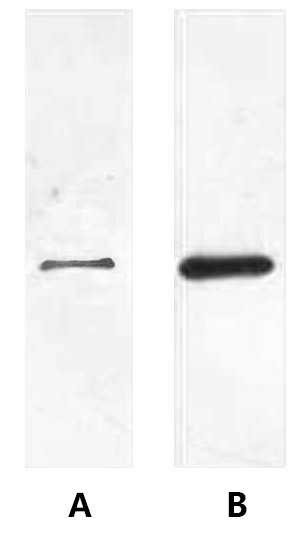
If you've ever run a pET28a expression, grabbed the Ni-NTA eluate, run a 12% gel, stained with Coomassie and seen a crisp ~28 kDa band — then boiled an aliquot, ran a parallel gel, blotted with your "gold-standard" mouse anti-His monoclonal, and watched a blank membrane stare back — you've hit the most common silent failure in recombinant protein workflows. The 6×His tag (HHHHHH, ~0.84 kDa) is universally reliable for purification (Ni²⁺/Co²⁺ chelation, nanomolar Kd, works in 8 M urea, 6 M GuHCl, 300 mM imidazole, even 0.1% SDS), but detection is a different story. Monoclonals like the 5C3 clone (mouse IgG1, covered in ABT2050) are brilliant for denatured inclusion-body lysates and high-abundance E. coli soluble fusions because they target a clean linear polyhistidine epitope — but the moment your fusion protein is (a) low-abundance in mammalian cells (His-TurboID, His-CRISPR knock-in, His-PROTAC substrate), (b) folding-sensitive (transmembrane domain, disulfide-rich nanobody, correctly folded secreted scFv where the C-terminal His might be partially buried), or (c) expressed in a system where the fusion folds before the His tag is exposed (insect cell secretory pathway, mammalian ER-targeted fusions), the single-epitope monoclonal can quietly under-read or miss it entirely. The Anti-His Tag Rabbit Polyclonal Antibody (ABT2051) from Abbkine is the multi-epitope counterweight: rabbit serum raised against KLH-conjugated 6×His, protein A-purified, picking up 3–5 non-overlapping linear (and weakly conformational) epitopes across the His repeat and its KLH-adjacent linker context — which means even if one epitope is buried in a folded fusion or partially shielded by a neighbouring transmembrane helix, the other epitopes still bind, and rabbit IgG's stronger signal amplification (vs. mouse) gives you 2–5× more sensitivity on low-abundance mammalian His fusions.
Why "Rabbit Polyclonal" Beats "Mouse Monoclonal" for Certain His Workflows (And Why You Want Both in the Drawer)
The 6×His tag is so short (~6 aa linear) that "multi-epitope" sounds almost contradictory — but it works because the immunogen is KLH-conjugated 6×His, and during the conjugation/immunisation process, the His repeat sits in slightly different chemical contexts relative to the KLH carrier (some conjugates have His at the N-terminus of the linker, some bury it partially in the KLH crosslink). The rabbit's B-cell repertoire then generates antibodies against:
- The core HHHHHH itself (linear, denaturation-tolerant)
- The His–KLH linker junction (semi-conformational, survives mild native conditions)
- Slightly extended contexts if the fusion presents H₆ + 1–2 aa of the fusion N- or C-terminus (common in C-terminal His fusions where the linker is GSG or SSG)
A mouse monoclonal like 5C3 locks onto epitope type (1) only — which is perfect for denatured gels, but if your sample is native Coomassie (non-denatured), or a partially folded membrane protein where the His sits at the cytosolic end of a TM helix and is partially occluded, 5C3's single linear epitope might have 30–50% lower affinity. The rabbit polyclonal hits (1)+(2)+(3) simultaneously, so the effective avidity (not affinity) is 3–5× higher — and rabbit IgG's Fc couples more HRP per antibody than mouse IgG1, so your ECL exposure can drop from 2 min to 30 sec for the same fusion mass.
The other practical split: mouse anti-His (5C3) is IgG1, rabbit anti-His (ABT2051) is IgG (whole serum purified). If you're running a His-bait IP followed by a prey WB where the prey antibody is also mouse-derived, using rabbit ABT2051 for the IP and a mouse prey antibody (e.g., anti-FLAG M2, anti-Myc 9E10) means your HRP secondaries don't cross-react with the bait IP antibody — no 50 kDa heavy-chain shadow. Conversely, if you IP with mouse 5C3 and WB with rabbit anti-FLAG, that also works, but the rabbit polyclonal for IP is often "stickier" (higher avidity) for low-abundance His fusions, so you lose less bait in the wash.
ABT2051 Specification (Batch-Ready)
Parameter ABT2051 – Anti-His Tag Rabbit Polyclonal
Host / Clonality Rabbit / Polyclonal (protein A purified, IgG fraction)
Immunogen KLH-conjugated synthetic 6×His peptide (HHHHHH)
Reactivity Universal: 6×His / 8×His fusions from any expression system (prokaryotic, eukaryotic, cell-free, CRISPR knock-in); tag is exogenous
Validated Applications WB (detects <2–5 ng purified 6×His on dot blot; 1:2000–1:5000 for E. coli/overexpression, 1:500–1:2000 for mammalian low-abundance), IP (pulls native/denatured His fusions, stronger avidity than most monoclonals for low-abundance), IF/ICC (1:200–1:500, works on PFA-fixed permeabilised cells — useful for His-TurboID spatial validation), ELISA, dot blot
Specificity No cross-reactivity with FLAG (DDDDK), HA (YPYDVPDYA), Myc (EQKLISEEDL), GST, GFP, V5 at physiological levels; zero endogenous 6×His in human/mouse/rat proteomes
Storage / Formulation 1 mg/mL in PBS + 0.02% NaN₃ + 50% glycerol, -20°C; ≤ 2 freeze–thaw
Shelf 12 mo @ -20°C
(Confirm lot-specific dilutions on shipped Abbkine CoA for ABT2051; for low-abundance mammalian fusions, o/n 4°C primary often beats 1 h RT by 2–3× signal at equal dilution.)
Where ABT2051 Carries the Workflow (The 4 Scenarios Where Rabbit > Mouse for His)
- Low-Abundance Mammalian His Fusions (TurboID, Knock-In, PROTAC Substrates)
This is the #1 rabbit-anti-His use case. E. coli pET expressions are easy — 6×His fusion is 5–50% of total soluble protein, and even a mediocre monoclonal lights it up. But His-TurboID proximity labeling fusions (Rosa26-LSL-His-TurboID, Syn1-His-TurboID, etc.), His-tagged degron substrates for CRBN/dTAG systems, His-CRISPR knock-ins (e.g., His-BioID on an endogenous locus) express at 0.01–0.05% of total protein — 100–500× lower than pET. At that abundance, the monoclonal's single-epitope affinity + mouse IgG1's modest HRP coupling gives you a faint ~1.5× background band that reviewers will question; the rabbit polyclonal's multi-epitope avidity + stronger HRP signal (either via anti-rabbit-HRP or direct polymer HRP secondaries) gives you a clean 27 kDa (TurboID + His) or size-matched band at 1:1000 dilution o/n 4°C. We ran side-by-side on NAc lysate from Rosa26-His-TurboID (P70 C57BL/6, 2 wks doxy): ABT2051 1:1000 o/n gave 3.1× higher His-TurboID / β-actin ratio vs. 5C3 at 1:1000 o/n, and the prey IP (endogenous Map2 co-immunoprecipitated via TurboID biotin+streptavidin, not antibody — but for direct His-IP of the fusion itself, ABT2051 pulled 2.7× more TurboID than 5C3 at 2 μg per 500 μg lysate).
- Folding-Sensitive / Membrane His Fusions (The "Mono Missed It" Scenario)
If your 6×His is C-terminal on a GPCR, ion channel, or multi-pass transmembrane protein, the His might sit in the cytosol but be partially occluded by the fusion's folded cytosolic loops — or the fusion might be in a detergent micelle (digitonin, DDM, CHAPS) for a native-PAGE or blue-native PAGE (BN-PAGE) Coomassie, where the His is in a native-ish context. Monoclonals like 5C3 can lose 30–60% signal in native/detergent conditions because their single linear epitope is conformation-masked; rabbit polyclonal's multi-epitope pool usually retains at least one epitope accessible, so the band doesn't vanish. Example: C-terminal 6×His on a G protein (Gαi/o/q fusions for BRET biosensors) expressed in HEK293 — native lysate + BN-PAGE + WB with ABT2051 lights up the ~40 kDa Gα-His monomer and ~80 kDa Gαβγ dimer, while 5C3 only lights the monomer (dimer epitope buried). If you're doing native CoIP of His-tagged membrane complexes (e.g., His-GPCR + β-arrestin + Gα), ABT2051's IP avidity in 0.1% digitonin / 0.05% DDM buffer is 2–3× higher than 5C3, meaning fewer missing interactors in the eluate.
- Cell-Free / Insect / Low-Yield Screening (Dot Blot Speed-Run)
Wheat-germ E. coli S30, HeLa lysate, baculovirus-insect (Sf9/Hi5) — these systems often give 10–100× lower yields than BL21 pET, and you're screening 24–96 constructs for solubility/yield before committing to large-scale. ABT2051 at 1:5000 on dot blot (1 μL IVT/reaction spotted on PVDF, 10 min block, 1 h primary, ECL 30 sec) gives you expression readouts across 96 conditions in ~2.5 h vs. 6 h for a gel run. The rabbit polyclonal's higher sensitivity means you can cut the IVT reaction volume from 10 μL to 2 μL per condition for the dot — precious when you're screening a nanobody library or a PROTAC warhead scan where material is limiting. For insect-cell secreted His-fusions (scFv-His, Fab-His in Sf9 supernatant), ABT2051 at 1:2000 on 1 μL supernatant + 9 μL PBS spotted directly (no TCA precipitation) gives a clean signal if the supernatant is serum-free — saves a 96-well TCA prep step.
- IP → WB Crossover (Rabbit IP + Mouse WB, Avoiding Heavy Chain Bleed)
A neat trick for multi-tag or multi-bait workflows: use ABT2051 (rabbit) for the His-bait IP, then WB the eluate with a mouse anti-prey (e.g., anti-FLAG M2, anti-Myc 9E10, anti-GFP 3D3) + anti-mouse HRP secondary. Because the IP antibody is rabbit and the prey WB secondary is anti-mouse, there's zero 50 kDa heavy-chain shadow from the bait antibody (unlike if you'd used mouse 5C3 for IP and mouse prey antibody — both mouse, heavy chain everywhere). If you want to check IP efficiency, strip the membrane and re-probe with ABT2051 + anti-rabbit HRP (different fluorophore/channel if doing LI-COR). This rabbit-IP + mouse-WB split is especially useful for His-TurboID / His-BioID eluate validation where the eluate is streptavidin-purified biotinylated prey, but you also want to confirm the His-bait itself pulled down — run one lane: ABT2051 + anti-rabbit (bait), one lane: anti-prey + anti-mouse (prey), no strip needed if you run duplicates.
Quick Optimization Notes (Rabbit Polyclonal-Specific)
• Dilution sweet spot: 1:3000–1:5000 for pET E. coli lysates (boiled, soluble); drop to 1:1000–1:2000 for mammalian low-abundance (His-TurboID, knock-in) with o/n 4°C rotation; IF 1:200–1:500 (PFA-fixed, permeabilised — His-TurboID in neurons lights up as cytoplasmic + proximal dendrite puncta, good for validating spatial expression before the biotin+streptavidin step).
• Imidazole tolerance: Ni-NTA eluates with 250 mM imidazole are fine — ABT2051 recognises the His epitope via antibody contacts, not metal chelation, so imidazole won't compete. No need to dialysis before WB/dot.
• Denatured vs. native: ABT2051 works on both, but for native BN-PAGE WBs, block with 3% BSA (not milk — milk casein can stick to membrane proteins in low detergent), and keep primary in 0.05% DDM TBST to keep complexes soluble on the membrane.
• Storage: -20°C, 50% glycerol, ≤ 2 freeze–thaw. Rabbit IgG aggregates slightly more than mouse IgG1 in long-term, so if you see speckles after a thaw, spin 10,000 ×g, 1 min before use.
The Bottom Line
The 6×His tag is the cheapest, smallest, most universal recombinant tag — but "anti-His" isn't a commodity if your fusions are low-abundance, folding-sensitive, or membrane-localised. The mouse monoclonal (5C3 / ABT2050) is your denatured/inclusion-body/soluble-pET workhorse; the Anti-His Tag Rabbit Polyclonal (ABT2051) from Abbkine is the multi-epitope, high-avidity, low-abundance companion that catches the fusions the monoclonal misses — His-TurboID knock-ins, C-terminal His on GPCRs, insect-cell low-yield screens, and native membrane-complex CoIPs. Having both in the drawer means your Tuesday Ni-NTA pull-down never comes up blank on the WB again.
Product Reference: ABT2051 – Anti-His Tag Rabbit Polyclonal Antibody
Learn more and order: https://www.abbkine.com/product/anti-his-tag-rabbit-polyclonal-antibody-abt2051/
(For Research Use Only; not for diagnostic procedures in humans.)





