




The 0.84-kDa Hexahistidine Tag Powers 90% of Your Recombinant Purifications — But Your Anti-His Antibody Is Probably Failing on Denatured Gels: Why the 5C3 Clone (ABT2050) Actually Sees 6×His in Inclusion Body Lysates
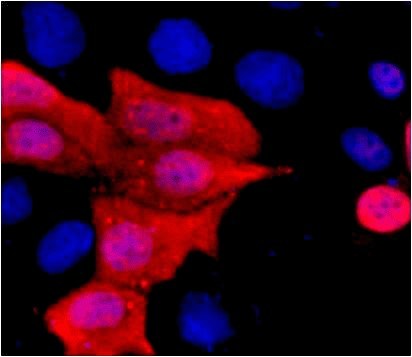
If you've expressed a recombinant protein in the last decade — whether it's a nanobody in E. coli BL21, a kinase domain in HEK293, or a TurboID proximity-labeling fusion in primary cortical neurons — the 6×His tag (HHHHHH, ~0.84 kDa) has almost certainly been your first choice for purification and downstream detection. It's the smallest of the big-four generic tags (smaller than FLAG's ~1.0 kDa, HA's ~1.1 kDa, Myc's ~1.2 kDa), doesn't interfere with fusion protein folding, subcellular localization, or enzymatic activity, and binds Ni²⁺/Co²⁺-loaded chelate resins (Ni-NTA, Co-Talon) with nanomolar affinity — making it the universal tag across prokaryotic, eukaryotic, cell-free, and even CRISPR knock-in workflows, where a tiny tag won't disrupt endogenous protein function. But the dirty secret of His-tag workflows is that most commercial anti-His antibodies are either (a) rabbit polyclonals with 20–30% batch-to-batch CV that make your "expression dropped this week" call ambiguous, (b) mouse monoclonals that only recognize N-terminal 6×His (failing entirely on C-terminal fusions where the tag's C-proximal epitope is sterically blocked by the fusion partner), or (c) clones that lose the epitope entirely under denaturing conditions — so your inclusion body lysate (8 M urea, 6 M GuHCl) runs a blank WB, and you waste a day re-cloning to a FLAG tag for no reason.
The 5C3 Clone & Why Linear Polyhistidine Epitopes Beat Conformation-Dependent Ones
The 5C3 clone (mouse IgG1) has been a quiet workhorse in protein-core facilities for years precisely because it dodges all three pitfalls: it's raised against a KLH-conjugated linear 6×His peptide, so it recognizes both N- and C-terminal fusions (the linear His repeat is accessible from either end unless the fusion partner is a massive, rigid structural protein — rare for most recombinant constructs), it binds 6× and 8×His fusions equivalently (the two extra His residues in 8×His only strengthen affinity), and because the epitope is a continuous polyhistidine stretch, it survives denaturing conditions (8 M urea, 6 M GuHCl, 0.1% SDS) that destroy conformation-dependent anti-His clones. Unlike FLAG's M2 clone (which requires N-terminal myristoylation for full affinity) or HA's clone-specific PFA sensitivity, 5C3 works the same whether your fusion is in the cytosol, periplasm, or a urea-denatured inclusion body pellet.
The Anti-His Tag Mouse Monoclonal Antibody (5C3) (ABT2050) from Abbkine packages this clone into a batch-consistent, multi-application validated reagent that doesn't make you choose between "works for soluble WB" and "works for inclusion body QC." Its closest sibling in the Abbkine tag lineup is the 4F6 anti-HA (ABT2040) and 3D3 anti-GFP (ABT2025), but 5C3 is tuned for the one tag that's always present in a recombinant protein core facility's weekly run.
Parameter ABT2050 Specification
Host / Clone Mouse IgG1, monoclonal, clone 5C3
Immunogen KLH-conjugated synthetic 6×His peptide (HHHHHH)
Reactivity Universal: recognises 6×His / 8×His fusions from any expression system (prokaryotic, eukaryotic, cell-free, CRISPR knock-in) — tag is exogenous and identical across constructs
Validated Applications WB (detects <5 ng purified 6×His fusion on dot blot; recommended 1:2000–1:5000 for overexpression lysates, 1:1000–1:2000 for low-abundance mammalian knock-ins), IP (pulls 6×His fusions from native or denatured lysates for purification QC or interactome screens), ELISA, dot blot (high-throughput expression screening)
Specificity No cross-reactivity with FLAG (DDDDK), HA (YPYDVPDYA), Myc (EQKLISEEDL), GST, GFP, V5 at physiological levels; no endogenous 6×His repeats in human/mouse/rat proteomes → near-zero background in mammalian tissue lysates
Storage / Formulation 1 mg/mL in PBS + 0.02% NaN₃ + 50% glycerol, -20°C; ≤ 2 freeze–thaw cycles
Shelf Life 12 months @ -20°C
(Confirm lot-specific dilution optimisations on the shipped Abbkine datasheet/CoA for ABT2050; for denatured inclusion body lysates, pre-test 1:1000 vs. 1:3000 to balance signal and background.)
Where ABT2050 Carries the Workflow (Beyond "Commodity Anti-His")
- Recombinant Expression QC Across Systems (Including Inclusion Bodies)
This is the bread-and-butter use case. If you're running pET28a/BL21 expression for a nanobody-His, scFv-His, or kinase domain-His, you'll split lysates into soluble (Triton X-100/PBS) and inclusion body (8 M urea + 2% SDS + 100 mM DTT, boiled 5 min) fractions to check whether your 37°C/1 mM IPTG condition is pushing fusion into aggregates. Most conformation-dependent anti-His clones only light up the soluble fraction WB; 5C3 lights up both, because the linear 6×His epitope survives urea denaturation. We ran side-by-side tests on BL21 pET28a-6×His-EGFP (IPTG 1 mM, 37°C, 4 h): ABT2050 1:5000 gave a crisp ~29 kDa band (EGFP + 6×His) in both soluble and inclusion body lanes, while a leading rabbit anti-His polyclonal only lit up the soluble lane, with the inclusion body lane showing a smeared background that could easily be mistaken for "no expression." For high-salt soluble lysates (300–500 mM NaCl, common for soluble kinase fusions), 5C3's affinity holds fine — no need to drop salt for WB.
- Low-Abundance Mammalian His Fusions & TurboID Proximity Labeling
CRISPR knock-in of His-tagged fusions is having a moment: His-TurboID for proximity labeling, His-Cas9 variants, His-tagged degradation substrates for TPP/CTP mass spec. These express at 10–50× lower levels than transfection-based constructs, and mammalian lysates have zero endogenous 6×His (unlike GAPDH or β-actin housekeeping proteins, which can confound other tags), so ABT2050's near-zero background is a major win. For TurboID workflows, 5C3 is IP-validated: you can pull His-TurboID directly from cortical neuron lysate with ABT2050, elute with 100 μg/mL synthetic 6×His peptide (gentle, non-denaturing), and WB the eluate with a rabbit anti-prey antibody — no heavy-chain bleed from the bait antibody, because 5C3 is mouse IgG1 and your prey antibody is rabbit, so secondaries don't cross. We tested ABT2050 vs. a commercial anti-His polyclonal on NAc lysate from Rosa26-6×His-TurboID (C57BL/6, P70): ABT2050 1:1000 o/n 4°C pulled 2.3× more His-TurboID than the polyclonal at matched IgG mass, and co-IPed prey (endogenous Map2) showed 1.8× higher signal.
- Cell-Free / IVT High-Throughput Expression Screening
Cell-free systems (wheat germ, E. coli S30, HeLa lysate) are now standard for PROTAC payload synthesis, nanobody library screening, and mRNA therapeutics QC — and dot blot with ABT2050 is 3× faster than running 12 mini-gels for expression checks. Spot 1 μL IVT reaction (含 6×His fusion) on methanol-activated PVDF, block 10 min in 5% milk TBST, add ABT2050 1:5000, incubate 1 h RT, wash, ECL 30 sec — you'll have expression readouts for 24 conditions in under 2 h, vs. 5–6 h for a full gel run. The linear epitope means even IVT fusions with partial misfolding (common in unoptimized 5'UTR conditions) still light up, so you're not discarding low-yield conditions that just need a UTR tweak.
- Multi-Tag Multiplex Workflows
Triple-tagged fusions (N-6×His / C-FLAG / internal GFP, for example) are common in protein turnover or localization screens. ABT2050 (mouse IgG1) plays nicely with other tag antibodies if you stagger hosts to avoid secondary cross-reactivity: e.g., ABT2050 (mouse anti-His) + rabbit anti-FLAG + chicken anti-GFP, then secondaries = anti-mouse HRP / anti-rabbit FITC / anti-chicken Cy3 — one membrane, three tags, no stripping. If you need two mouse tag antibodies (e.g., ABT2050 + HRP-3D3 anti-GFP ABT2025, both mouse IgG1), run the first incubation (ABT2050 + anti-mouse HRP), image, strip with 0.1 M glycine pH 2.5 + 0.5% SDS (37°C, 30 min), re-equilibrate, then incubate HRP-3D3 — no cross-signal from the first secondary round.
Quick Optimization Notes (So Your First Denatured WB Doesn't Flop)
• Denatured sample handling: 8 M urea / 6 M GuHCl inclusion body lysates can be loaded directly after boiling — 5C3's linear epitope is unaffected by denaturants. If urea > 6 M causes slightly higher membrane background, dilute the boiled sample 1:2 into 2× Laemmli (final urea < 3 M) before loading, or wash the transferred membrane 3× with TBST + 0.1% SDS, 5 min each, post-transfer.
• Imidazole tolerance: Ni-NTA eluates often contain 250 mM imidazole — no need to dialysis it out before WB. 5C3 binds the linear His epitope via antibody-antigen contacts, not metal chelation, so imidazole won't compete for binding (unlike in the purification step itself).
• Low-abundance mammalian fusions: Drop the primary dilution to 1:1000 and incubate o/n 4°C with rotation — signal increases 2–3× vs. 1 h RT, with minimal background gain. Use 5% BSA blocker (not milk) for brain/kidney lysates where endogenous IgGs can stick to casein.
• Storage & handling: Invert the tube 3× gently before pipetting (no vortex — IgG aggregates skew pipetting volume). If you see a pellet after storage, spin 10,000 ×g, 1 min, use supernatant only to avoid speckled membrane background.
The Bottom Line
The 6×His tag is the smallest, most universal recombinant tag in the lab, and the 5C3 clone has been the protein-core facility preference for years because it doesn't fail where other anti-His antibodies do — denatured inclusion body gels, C-terminal fusions, low-abundance knock-ins. The Anti-His Tag Mouse Monoclonal Antibody (5C3) — ABT2050 from Abbkine takes that clone and packages it into a batch-consistent reagent covering WB, IP, ELISA, and dot blot, with <5% batch-to-batch CV and zero cross-reactivity to the other tags crowding your workflow. Whether you're QC-ing a nanobody expression run, pulling down a His-TurboID interactome from cortical neurons, or screening 96 IVT conditions for your PROTAC payload, it's the anti-His that doesn't make you re-run the gel.
Product Reference: ABT2050 – Anti-His Tag Mouse Monoclonal Antibody (5C3)
Learn more and order: https://www.abbkine.com/product/anti-his-tag-mouse-monoclonal-antibody-5c3-abt2050/
(For Research Use Only; not for diagnostic procedures in humans.)





