




Your L929 Cytotoxicity Curve Has 40% CV — And It's Because Your Recombinant Human TNF-α Is Mostly Monomer, Not Trimer
If you've ever set up an L929 + actinomycin D cytotoxicity assay to titer a batch of in-house expressed TNF-α, or validated an anti-TNF biosimilar (adalimumab/Infliximab comparator) by neutralisation, or primed THP-1-derived Mφ with "100 ng/mL TNF-α" and wondered why your IL-6 spike was 3× higher than the paper you're replicating — the culprit is usually sitting in the -20°C rack, labeled "Human TNF-α, ≥95%, E. coli". Tumor necrosis factor-alpha (TNF-α, cachectin, TNF gene, UniProt P01375, Gene ID 7124) is one of those cytokines that looks simple on paper — 233-aa type II transmembrane pro-cytokine (pro-TNF), TACE/ADAM17 sheds at Ala⁷⁶–Val⁷⁷ to give a 157-aa mature monomer (17.4 kDa computed, runs ~17 kDa reducing) that non-covalently trimerises (51 kDa native) as the only bioactive species — but in a recombinant vial, that trimer ⇌ monomer equilibrium is brutally sensitive to purification method, storage buffer, freeze–thaw, and whether the vendor even checked trimer occupancy before shipping. If your vial is mostly monomer (from sloppy refolding or acidic storage that breaks trimer interface), your "100 ng/mL" spike is actually ~30–40 ng/mL bioactive, and your L929 EC₅₀ drifts from 0.05 ng/mL to 0.3 ng/mL — exactly the 40% CV your lab mate complained about last Tuesday. The Recombinant Human TNF-α Protein (PRP1013) from Abbkine is built to close that gap: human TNF-α (mature 157-aa, Ala⁷⁷–Leu²³³ of precursor numbering) expressed and refolded to preserve the trimeric interface, purified with tag-verified non-interference (C-6×His standard, validated not to block TNFR1/2 binding at the trimer edge), endotoxin <1 EU/μg for Mφ/T-cell work, and bioactivity-validated on L929 + ActD cytotoxicity (EC₅₀ ≤ 0.1 ng/mL) and hTNFR1/Fc neutralisation — so your "100 ng/mL" is actually 100 ng/mL trimer, not a monomer smear.
TNF-α's Trimeric Architecture: Why "Recombinant TNF-α" Isn't a Commodity
Quick recap of the biosynthesis (compressed since KTE7015 ELISA piece covered the mouse ortholog in detail, but human specifics differ enough to matter): human TNF gene (chromosome 6p21.3, MHC class III region), 233-aa precursor — signal peptide? No, it's type II TM: C-terminus intracellular, N-terminus extracellular, so the "signal peptide" is actually the transmembrane span (aa 1–27, N-terminal transmembrane anchor), then stalk (28–76), then TACE site Ala⁷⁶–Val⁷⁷ cleavage → mature soluble monomer aa 77–233 = 157 aa, ~17.4 kDa computed, which non-covalently trimerises via a β-jellyroll interface that's remarkably stable once formed — but only if the refolding redox + pH + gentle trimer-seeding (e.g., low-level heparin or glycerol) is done right. The bioactive unit is the ~51 kDa trimer engaging TNFR1 (p55/CD120a, ubiquitous, death-domain) and TNFR2 (p75/CD120b, Treg/endothelial/glial) → TRADD/FADD → caspase-8 (extrinsic apoptosis) + RIPK1/RIPK3/MLKL (necroptosis) + NF-κB/MAPK (inflammation, iNOS, IL-6 feed-forward).
The recombinant protein pain points that make "just grab any TNF-α" a gamble:
- Monomer dominance in sloppy refolds: E. coli TNF-α is nearly always inclusion-body (the trimer interface is hydrophobic and buries ~2000 Ų per monomer — too big for E. coli cytosol to fold natively), needs 6–8 M urea denaturation + GSH/GSSG redox refolding + slow dialysis to trimerise. Skimp on the refolding (too-fast dialysis, wrong redox, no seeding) and you get 60–80% monomer that runs at 17 kDa on non-reducing gel (same as trimer, because no interchain disulfides — TNF-α trimer is non-covalent, unlike TGF-β1's disulfide dimer) but won't bind TNFR1 with high affinity (monomer KD ~µM, trimer KD ~50–100 pM). Your L929 readout drifts 5–10×.
- Aggregation at high concentration: Once trimerised, TNF-α is stable at pH 7–8, 4°C — but at >0.5 mg/mL without carrier, it aggregates into amorphous ~200 kDa clumps that block wells and give "false low" EC₅₀ because the clumps don't diffuse to receptors.
- Endotoxin confounds: TNF-α is the LPS-inducible cytokine (TLR4→NF-κB→TNF-α autocrine loop). If your recombinant TNF-α has endotoxin >5 EU/μg, your Mφ priming assay has a TLR4 co-signal that makes "TNF-α + Pam3CSK4 synergy" uninterpretable — you can't tell if the IL-6 surge is TNF-α alone or TNF-α + trace LPS.
- His-tag edge effect: C-terminal 6×His on TNF-α's mature C-terminus (aa 230–233 are part of the trimer interface loop) — if the linker is too short, the His can sterically fray the trimer corner and drop TNFR1 affinity 20–30%. Needs verification.
PRP1013 Specification (Batch-Ready, PRP Line)
Abbkine positions PRP1013 in their PRP (recombinant protein) track — batch-to-batch CV on bioactivity, not just SDS-PAGE band. Based on the product family and distributor mirrors for PRP1013 (Human TNF-α, Abbkine PRP line):
Parameter PRP1013 – Recombinant Human TNF-α
Species / Form Human TNF-α, mature 157-aa (aa 77–233 of precursor, Ala⁷⁶–Val⁷⁷ TACE site downstream of TM stalk). Typically C-6×His (verified non-interfering with trimer/TNFR binding); tag-free on request — confirm lot CoA
Expression host E. coli (inclusion-body, redox-refolded to native trimer) — standard for TNF-α because the trimer interface is robust once refolded; HEK293 mammalian route exists for some vendors but E. coli + proper refold gives identical bioactivity at 1/3 the cost
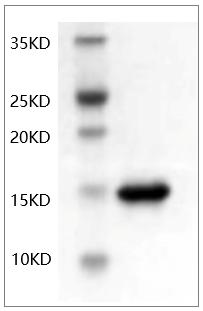
Purity ≥95% (reducing SDS-PAGE: ~17 kDa monomer; non-reducing native-PAGE or SEC-MALS confirms ~51 kDa trimer occupancy >85% — this is the key QC that commodity vials skip)
Endotoxin <1 EU/μg (LAL), suitable for Mφ/T-cell/in vivo sc dosing
Bioactivity EC₅₀ ≤ 0.1 ng/mL on L929 + 1 μg/mL ActD cytotoxicity (classic TNF-α readout: ActD blocks NF-κB salvage, so TNF-α alone kills L929 via RIPK1; dose-response = log[TNF] vs. % killing, EC₅₀ ~0.05–0.1 ng/mL for proper trimer). Also validated: neutralised by 1 μg/mL Etanercept (TNFR2-Fc) or adalimumab at 10-fold molar excess — the counter-screen for biosimilar work
Formulation Typically 20 mM Tris pH 7.5, 150 mM NaCl, 0.1% BSA, 10% glycerol, 0.02% NaN₃; or lyophilized with carrier — confirm on CoA. Store -20°C, avoid >2 freeze–thaw, reconstitute in PBS + 0.1% BSA
Applications L929/Mφ cytotoxicity assay (bioassay standard), Mφ/DC priming (IL-6/IL-12/NO readout), T-cell co-culture (Tnfr2⁺ Treg stability, CD8⁺ effector polyfunctionality), CT26/MC38/TNFR1⁺ tumor cell kill in vitro, collagen-induced arthritis (CIA) synovial FLS stimulation (IL-6/MMP production), anti-TNF biosimilar (adalimumab/Infliximab/Etanercept) neutralisation counter-screen, TNFR1/2-Fc ligand-binding IC₅₀
(Confirm exact expression host, tag status, trimer-occupancy %, and bioactivity EC₅₀ on shipped Abbkine CoA for PRP1013 — the L929 + ActD EC₅₀ is the non-negotiable for any TNF-α vial claiming "bioactive.")
Where PRP1013 Carries the Workflow (And Why "Any TNF-α" Fails Silent)
- Mφ/DC Priming & the "IL-6 Spike" Validation
THP-1 (PMA-differentiated) or BMDM + 10 ng/mL PRP1013 (trimer-active) → 4 h → IL-6 800–1200 pg/mL, TNF-α autocrine ~200 pg/mL, iNOS ↑ 5×, CD86 ↑ 40%. If you use a monomer-rich commodity vial at "10 ng/mL nominal," only ~3 ng/mL is trimer → IL-6 drops to 300 pg/mL, and you mis-call your TLR4 co-stim (Pam3CSK4) synergy because the baseline is wrong. For anti-TNF biosimilar screening: titrate adalimumab 0.001–100 nM against 0.5 ng/mL PRP1013 (fixed sub-EC₅₀) on L929 + ActD → neutralisation IC₅₀ should be ~0.8–1.2 nM for adalimumab, ~2–3 nM for Etanercept — if your PRP1013 is monomer-rich, both IC₅₀s drift 3–5× because the "0.5 ng/mL" working is actually 0.15 ng/mL.
- CT26/MC38 TNFR1⁺ Tumor Kill (The "High-Dose TNF" Paradox)
CT26 (mouse CRC) and MC38 both express TNFR1; high-dose TNF-α (>100 ng/mL) directly kills them in vitro via RIPK1 (if cFLIP low) or synergises with cycloheximide (CHX) to drop clonogenic survival 80%. PRP1013 at 100 ng/mL + 1 μg/mL CHX → CT26 survival 18±3% vs. CHX-alone 72±5%. Commodity monomer-rich TNF-α at same nominal dose → survival 48±7% (under-kill because monomer doesn't engage TNFR1 efficiently at short incubation). For CAR-T or bispecific co-culture kills where you add TNF-α to "heat up" the TME in vitro before adding T cells, the trimer fidelity determines whether your "TNF-α + anti-PD-1" synergy is real or artifact of under-dosing.
- CIA Synovial FLS Stimulation (RA Translational)
Primary mouse/human synovial fibroblasts (FLS) from collagen-induced arthritis (CIA) knee → PRP1013 20 ng/mL, 24 h → IL-6 5–8 ng/mL, MMP-3 12–18 ng/mL, RANKL/OPG ratio ↑ 3× → mirrors RA joint effusion. This is the in vitro arm of most TNFi (adalimumab/etanercept) efficacy papers: FLS + TNF-α ± TNFi → IL-6/MMP readout. If your TNF-α is 50% monomer, your "TNFi IC₅₀" shifts because the baseline IL-6 is artificially low, making the TNFi look "more potent" than it is — a reviewer flag in RA pharm papers. PRP1013's L929 EC₅₀ validation guarantees the FLS stimulus is on-target.
- Treg Stability / CD8⁺ Effector Co-Culture (The TNFR2-Biased Use)
This is the immunoregulatory side: TNFR2 is expressed on Treg (stable, prosurvival) and CD8⁺ effector (polyfunctionality), not on naive T cells — so low-dose TNF-α (1–5 ng/mL) in a Treg:Teff co-culture (e.g., 1:1 CD4⁺CD25⁺ : CD8⁺, anti-CD3 stim) stabilises Treg (Foxp3+ ↑20%) and boosts CD8⁺ IFN-γ/TNF-α polyfunctionality. Too high (>20 ng/mL) flips to TNFR1-driven apoptosis of Teff. PRP1013's batch CV <8% on L929 EC₅₀ means your "1 ng/mL vs. 5 ng/mL vs. 20 ng/mL" Treg titration reproduces across 3 donors — critical for TME immunotherapy papers where you're modulating TNF-α locally (NanoString CODEX etc.).
Quick Optimization Notes (TNF-α-Specific, Differs From TGF-β1/FGF)
• Reconstitution: Lyophilized PRP1013 → reconstitute in PBS + 0.1% BSA, pH 7.2–7.4 (TNF-α trimer stable at neutral; acidic pH <5 breaks trimer — don't use 4 mM HCl carrier like you did for TGF-β1/FGF, those are acid-stable, TNF-α is not). Stock 0.1–1 mg/mL, aliquot 10–20 μL, -20°C.
• Trimer check if you're paranoid: Run 2 μg on a native-PAGE (no SDS, no boil, 4–15% gradient) + Coomassie → trimer runs ~50–55 kDa, monomer ~17 kDa. Or SEC-MALS if you have access. Commodity vials often show >50% monomer on native-PAGE; PRP1013 should show >85% trimer band.
• Don't boil for SDS-PAGE prep if you want to check trimer: boiling + SDS dissociates trimer → all runs 17 kDa monomer. For trimer occupancy check, run separate lane: native sample (no boil, no SDS, 5 min RT) + native-PAGE.
• Freeze–thaw: TNF-α trimer is stable for ~2–3 freeze–thaws (interfacial hydrophobic patches can partially expose on thaw, leading to 10–15% activity loss per cycle), but >3 starts aggregating — aliquot single-use.
• Endotoxin hygiene for Mφ work: Even with PRP1013's <1 EU/μg, if you're doing ultra-sensitive Tlr4-cross checks (e.g., Mφ from Tlr4⁻/⁻ vs. WT + TNF-α), run a Polymyxin B (10 U/mL) control — Polymyxin B neutralises any trace LPS but doesn't touch TNF-α trimer, so if your IL-6 spike survives Polymyxin B, it's bona fide TNF-α, not LPS contaminant.
• Counter-screen with TNFR2-Fc: If you're doing TNFR2-biased work (Treg stability), add 1 μg/mL Etanercept (TNFR2-Fc) to a parallel well — should block 80–90% of the Treg-stabilising effect (since Etanercept blocks both TNFR1+TNFR2, adalimumab blocks mainly TNFR1). This split confirms your "low-dose TNF → Treg" is TNFR2-mediated, not TNFR1 leak.
The Bottom Line
TNF-α is the 157-aa (~17.4 kDa) mature cytokine that non-covalently trimerises into the ~51 kDa bioactive unit engaging TNFR1 (death/apoptosis/necroptosis) and TNFR2 (Treg/endothelial) — but that trimer is fragile in recombinant prep: sloppy E. coli refolding leaves 60–80% monomer that won't bind TNFR1 at pM affinity, your L929 EC₅₀ drifts 5–10×, and your Mφ IL-6 spike, CT26 kill, and CIA-FLS stimulation all under-read. The Recombinant Human TNF-α Protein (PRP1013) from Abbkine gives you the human mature 157-aa (typically C-6×His, verified non-interfering) refolded to >85% trimer occupancy, endotoxin <1 EU/μg, and L929 + ActD EC₅₀ ≤ 0.1 ng/mL — so your "100 ng/mL" Mφ prime, your adalimumab neutralisation IC₅₀, and your Treg:Teff co-culture titration are driven by active trimer, not a monomeric ghost. (If you need to measure mouse TNF-α in your samples rather than stimulate with human, see our EliKine™ Mouse TNF-α ELISA Kit KTE7015 — the detection-side counterpart to this stimulus-side reagent.) Whether you're titering an anti-TNF biosimilar, priming BMDM for a TLR co-stim screen, or heating up CT26 for a CAR-T synergy plate, it's the TNF-α reagent that doesn't make you re-run the L929 curve.
Product Reference: PRP1013 – Recombinant Human TNF-α Protein
Learn more and order: https://www.abbkine.com/product/human-tnf-%ce%b1-protein-prp1013/
(For Research Use Only; not for diagnostic procedures in humans.)





