




Your Entire Redox Story Hangs on One Tiny Tripeptide—So Why Are You Still Trusting a Hand-Mixed DTNB Hack? How Abbkine's KTB1600 Turns GSH Quantification From a "Vibe" Into Defensible Science
There is a very specific moment of dread that visits every oxidative-stress lab around week six of a grant cycle: your Seahorse XF data looks fantastic, your SOD and CAT activities are dancing in perfect opposition, and your MDA (lipid peroxidation) bars are telling a crisp story of membrane damage. Then comes the pivot every reviewer secretly waits for—"the authors should provide direct evidence of the cellular redox state, preferably via GSH/GSSG ratio..."—and suddenly you're staring at a cuvette of hand-mixed Ellman's reagent (DTNB) that's gone slightly yellow-orange before you even added your sample. The truth nobody enjoys admitting: your GSH number might be real biology, but it might also be an artifact of ambient thiols, degraded DTNB, or a standard curve you eyeballed from a 2018 lab notebook.
GSH Isn't Just "An Antioxidant." It's the Redox Linchpin Reviewers Demand You Prove
Reduced glutathione (γ-L-glutamyl-cysteinyl-glycine, GSH) is the cell's most abundant low-molecular-weight thiol and the central node of the intracellular antioxidant defense network. In erythrocytes especially, GSH is the gatekeeper that keeps hemoglobin in its Fe²⁺ (ferrous) reduced state, preventing oxidative methemoglobin formation. But its real power—and the reason every redox paper eventually needs it—lies in the GSH/GSSG ratio, which serves as the primary dynamic indicator of cellular redox state. When that ratio collapses, you're looking at irreversible protein thiol oxidation, disrupted amino acid transport, and the early stages of apoptotic commitment.
The experimental catch? GSH lives at the micromolar-millimolar level but is fiercely labile, and any quantification method that doesn't control for:
- Selective thiol (–SH) detection vs. total acid-soluble sulfhydryl noise,
- Fresh, active DTNB (Ellman's reagent) with a reliable extinction coefficient, and
- A calibrated GSH standard curve run the same day...
…is essentially giving you a number you hope represents biology.
Enter CheKine™ Micro Reduced Glutathione (GSH) Assay Kit — KTB1600 (Abbkine)
This kit wraps the classic DTNB/Ellman's reaction—the gold-standard thiol-specific chemistry—into a microplate-ready, component-controlled system so your GSH readout finally behaves like data instead of a chemistry experiment gone rogue.
The principle is elegant and battle-tested:
GSH's free sulfhydryl group (–SH) reacts with DTNB (5,5′-dithiobis(2-nitrobenzoic acid), the Chromogen in the kit) to produce a yellow-colored TNB⁻ (2-nitro-5-thiobenzoate) anion, with a characteristic maximum absorbance at 412 nm. The optical density at 412 nm is directly proportional to the concentration of GSH in your sample.
Parameter KTB1600 Specification
Assay type Colorimetric (Ellman/DTNB method) — read at 412 nm
Target Reduced Glutathione (GSH) exclusively (–SH selective)
Sample types Serum · Plasma · Animal & plant tissues · Blood cells · Cultured cells · Bacteria · other biological fluids
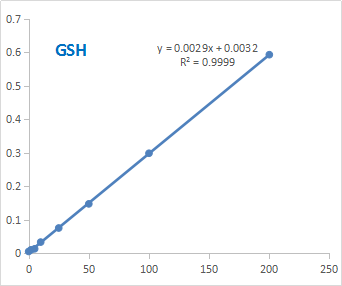
Detection range ~2–200 µg/mL (linear, calibrated)
Sensitivity (LOD) ~2 µg/mL
Key components Extraction Buffer (contains protein precipitant) · Assay Buffer · Chromogen (DTNB) · GSH Standard
Format 48 T/48 S and 96 T/96 S micro-scale configurations
Storage / Ship 4°C, protected from light, shelf ~12 months from receipt; ships blue-ice gel pack
Critical note Extract supernatant cannot be used for protein assays (precipitant present); do a parallel H₂O extraction for BCA if normalizing by protein
And here's the "pro tip" buried in the fine-print that saves more papers than people realize: the same GSH-extracted supernatant can be used to measure oxidized GSSG using Abbkine's companion kit (CheKine™ GSSG Assay Kit, KTB1610)—meaning you can generate the GSH/GSSG ratio from a single extraction, with zero extra tissue sacrifice.
What Actually Changes When Your GSH Assay Stops Being a DIY Project
① Your "GSH/GSSG ratio" becomes a number you can sign your name to.
A defensible redox story needs two things: (a) GSH measured on a calibrated standard curve run fresh the same day, and (b) the recognition that diluted GSH standard is unstable and must be used within ~4 hours. KTB1600 forces the discipline you should be following anyway: the GSH Standard is supplied, the Extraction Buffer is pre-formulated to halt enzymatic GSH turnover on ice, and the Chromogen (DTNB) is stored protected-from-light so its reactivity doesn't drift between plates.
② You stop burning precious tissue on a cuvette ritual.
The micro format means you can work from ~0.1 g tissue (homogenized in cold Extraction Buffer, centrifuged, supernatant on ice) and still run triplicates + standard curve + a GSSG companion assay from the same prep. For limited specimens—needle biopsies, microdissected brain regions, FACS-purified immune subsets processed in lysis buffer—that scalability is the difference between a paper and a "we need more n" email to your PI.
③ Your Methods section transforms from apology to authority.
You can write:
Reduced glutathione (GSH) was quantified using a DTNB-based colorimetric microplate assay (CheKine™ Micro GSH Assay Kit, KTB1600; Abbkine). Samples were extracted in the provided Extraction Buffer on ice, centrifuged, and supernatants were reacted with Assay Buffer + DTNB Chromogen; absorbance was measured at 412 nm. Values were interpolated from the supplied GSH standard curve and expressed as µg GSH/g FW (or µg GSH/mg protein where separately determined by BCA on an H₂O-extracted parallel).
That's a paragraph that makes a Methods reviewer relax.
The Bench-Level SOP (Written So You Won't Waste a Saturday)
Sample Prep (the step where most people silently fail):
• Animal tissue: weigh ~0.1 g → add 1 mL cold Extraction Buffer → homogenize on ice → 8,000 × g, 4°C, 10 min → collect supernatant → keep on ice, use immediately (or -80°C ≤ ~10 days).
• Plant tissue: similar mass:buffer ratio → ice-bath sonication (e.g., 200 W, 3s on/7s off, ~30 cycles) → same centrifugation → supernatant on ice.
• Serum/plasma: collect properly, centrifuge, mix with Extraction Buffer, centrifuge again, collect supernatant on ice.
• Cells/bacteria: wash with cold PBS → resuspend in 3× pellet vol Extraction Buffer → ice sonication → centrifuge → supernatant on ice.
⚠️ The Extraction Buffer contains a protein precipitant. The cleared supernatant is perfect for GSH/GSSG but NOT for protein quantification. If you need GSH normalized per mg protein, do a parallel extraction in deionized water or PBS on a matched aliquot and run BCA (e.g., Abbkine KTD3001) on that parallel.
The Reaction (96-well / spectrophotometer at 412 nm):
- Add Sample (or Standard) + Assay Buffer per the protocol layout.
- Add Chromogen (DTNB) → mix → incubate at room temperature, protected from light, ~2 min.
- Read A₄₁₂ immediately. Subtract blank (Extractor Buffer + Assay Buffer + Chromogen) → interpolate from GSH Standard curve → calculate.
Survival rules from the protocol notes:
• 🌑 Chromogen/DTNB = light-sensitive. Store 4°C, wrap, minimize exposure. Degraded DTNB = fading yellow = drifting slope.
• ⏱️ Fresh standards only. Diluted standard solutions are unstable; use within 4 hours. Do NOT prep Monday's standards on Friday.
• 🧊 Samples on ice until the moment of reaction setup. GSH is thiol-labile; warm supernatants quietly oxidize to GSSG and your "GSH" number drops before you read it.
• 🔄 Predict first. Run 2–3 expected-high-vs-low samples as a quick pilot to pick the right dilution before committing your 96-well layout.
Where KTB1600 Earns Its Line in Real, Cited Work
Research Context Why GSH (and This Kit Format) Is the Linchpin
NAFLD / AFLD & drug-induced liver injury Hepatocyte redox collapse → GSH depletion precedes ALT surge; pairing GSH/GSSG with MDA + TAC makes an ironclad oxidative panel
Neurodegeneration (AD/PD/ALS models) Brain GSH is ~3–10× plasma levels; regional micro-samples demand microplate sensitivity (2 µg/mL floor)
Plant abiotic stress (drought, salinity, heavy metal) GSH is the first-line redox buffer; tracking it in leaf punches across a time course is quintessential plant physiology
Immunometabolism & macrophage polarization Pro-inflammatory M1 states burn through GSH fast; pairing GSH with iNOS/IL-1β ties redox to phenotype
Aging & caloric restriction / exercise physiology Longitudinal GSH/GSSG is the redox-biomarker consensus panels keep pointing people back to
Explore the CheKine™ Micro Reduced Glutathione (GSH) Assay Kit (KTB1600) full specs, manual & ordering options here:
🔗 https://www.abbkine.com/product/chekine-micro-reduced-glutathione-gsh-assay-kit-ktb1600/
(For research use only. Not for human or clinical diagnostic use. Handle reagents per the manual; protect DTNB/Chromogen from light; do not use GSH-extraction supernatant for protein assays—run a parallel water/PBS extraction for BCA normalization.)





