




You Spent Three Months Perfecting That STED/Confocal Sample—Don't Let a $15 Mounting Medium Erase It in 4 Minutes. Why Abbkine's SuperKine™ BMU104-EN Is the Unsung Hero Your Fluorescence Images Deserve
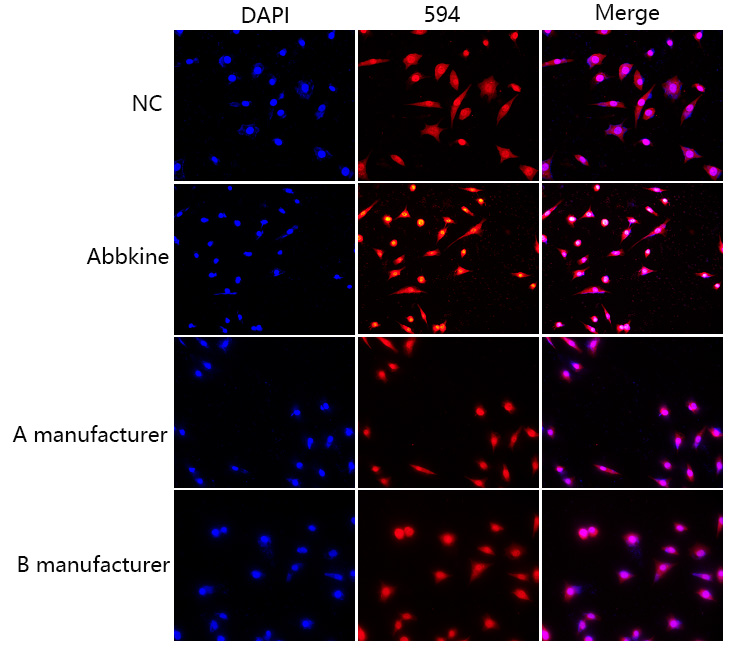
Every fluorescence microscopist has lived through this particular brand of heartbreak: you've spent weeks optimizing your immunostaining, your phalloidin/antibody cocktail finally looks perfect under the eyepiece, and then—three laser scan passes later—your brightest channels are fading before your eyes. The culprit isn't your staining. It isn't even your microscope's laser power calibration. It's the mounting medium. A poorly formulated antifade mountant is basically a slow-motion eraser for everything you just built, and ironically, it's the last reagent people think to upgrade.
Fluorescence Quenching Is a Chemistry Problem, Not a "Laser Power" Problem
The mechanism is brutally simple and unforgiving. Under illumination—especially the high-intensity beams in confocal, SIM, and STED systems—excited fluorophores transfer energy to ambient oxygen, generating singlet oxygen and other reactive oxygen species (ROS) that irreversibly destroy the fluorophore's conjugated π-system. The result? Photochemical bleaching that no amount of "lowering the laser to 2%" can fully salvage if the local chemical environment is working against you.
This is where most labs shoot themselves in the foot. They buy the cheapest glycerol-PBS "mounting medium" on the shelf—or worse, DIY it with a pinch of DABCO and some old glycerol—and then wonder why their Alexa Fluor 488 signal collapses in 8 minutes and their carefully acquired Z-stacks have a brownish, hollow look by frame 20.
Enter SuperKine™ Enhanced Antifade Mounting Medium — BMU104-EN (Abbkine)
The BMU104-EN variant is Abbkine's DAPI-free formulation—meaning it's a pure antifade vehicle that gives you full control over your nuclear counterstain (add DAPI, Hoechst, or skip it entirely for dye combinations where 405 nm excites something you'd rather keep dark). The formula is ready-to-use right out of the tube: no mixing, no pH-adjusting, no "dissolve DABCO overnight" rituals.
What's actually inside that matters:
Attribute BMU104-EN Specification
Format Ready-to-use liquid (no prep required)
DAPI? No — clean vehicle for user-selected nuclear stain (or none)
Antifade system Oxygen-scavenging + ROS-suppression chemistry that preserves fluorophores across the full visible + infrared spectrum
Proven signal retention Maintains original emission intensity ≥2 weeks post-mounting (when stored protected from light at 4°C)
Refractive index Optimized (~n≈1.51-class) to match glass coverslip → minimizes spherical aberration at high NA (oil-immersion 1.4–1.49 objectives)
Dye compatibility DAPI/Hoechst · FITC / GFP / Alexa 488 · TRITC / TxRed / Alexa 568 · Cy5 / Alexa 647 · IR-Dye 800 — full-spectrum protection
Sample types FFPE & frozen tissue sections · adherent & suspension cells (on coverslips) · cytospins · tissue arrays (TMA)
Storage / Ship -20°C, protected from light, 12-month shelf life; ships blue-ice gel pack
Sizes Typically 10 mL / 50 mL
The practical upshot? Your Alexa 568 stress fibers and Alexa 647 nuclear envelope signals survive prolonged confocal dwell times, and your multi-day imaging campaigns don't require "re-staining" or accepting increasingly anemic projections.
Why "Compatible with the Entire Spectrum" Isn't Marketing Fluff
A lot of legacy antifade recipes (Borax-glycerol + 1% DABCO, Mowiol-DABCO, etc.) were designed in an era when most people ran single-channel FITC and called it a day. Modern multiparametric IF/IHC routinely stacks 4–5 channels (DAPI/Hoechst 405 nm + 488 + 561/594 + 647 + occasionally 750–800 nm IR). Each fluorophore has its own photostability envelope, and a one-size antioxidant mix that only protects green will leave your far-red channels bleaching via a different ROS pathway.
BMU104-EN's formulation is tuned for broadband protection—the difference you'll see the first time you run a 3-channel colocalization Z-stack where all three channels hold steady through frame 40 instead of the green channel tapping out at frame 12.
The RI (Refractive Index) Advantage Nobody Talks About
There's a second, sneakier way a bad mountant ruins data: optical mismatch. If your mounting medium's refractive index drifts far from n = 1.518 (borosilicate glass coverslip standard), high-NA oil-immersion objectives suffer spherical aberration—your optical sections get slightly smeared, fine neurite branches lose contrast, and deconvolution software has to work overtime to compensate. A well-matched RI mountant like BMU104-EN means sharper Z-resolution at depth without touching your hardware.
How to Use It (The 30-Second SOP)
- After your final PBS wash post-staining, gently tap the slide/coverslip edge on lint-free wipe to remove excess buffer — don't let it dry completely, but avoid a puddle.
- Apply 1 drop (~15–25 µL for a standard 18×18 mm coverslip; scale up slightly for 22×22) of BMU104-EN directly onto the sample area.
- Lower your coverslip at a 45° angle to avoid trapping air bubbles (air pockets = black voids in your stack).
- Seal with nail polish or commercial sealant if long-term storage is needed.
- Store flat, protected from light, 4°C for day-to-day; for long-haul keep at -20°C short term? No — store sealed slides at 4°C; the reagent bottle lives at -20°C.
- Add your DAPI last if you want nuclear ID — BMU104-EN is intentionally DAPI-free so you pick the concentration and timing.
⚠️ Key handling note: this is a light-sensitive formulation — keep the bottle/stock protected from light whenever possible, and bring to room temp briefly before use (the viscosity is glycerol-based; cold = thick).
Where a Premium Antifade Mountant Quietly Saves Papers
Application What BMU104-EN Protects
Confocal Z-stack of thick tissue (50–200 µm) Prevents top-slice from bleaching before you finish the bottom; RI match keeps the deeper planes sharp
Super-resolution (STED / SIM) on coverslips Extended dwell times per pixel demand aggressive ROS suppression — this is where cheap mounts visibly fail
4–5 channel multiplex IF on TMAs Each extra channel = extra illumination rounds → cumulative bleaching; broadband antifade = all channels survive to the export
Live-to-fixed comparison (same slide architecture) Consistent RI and zero-DABCO-interference means your intensity thresholds are comparable across conditions
The Bottom Line
Your mounting medium is the final variable between a figure panel that gets accepted and one that gets flagged for "uneven signal quality." If you've already paid for the antibodies, the secondary conjugates, the cryostat sections, and the confocal time — don't let a subpar mountant be the bottleneck. SuperKine™ Enhanced Antifade Mounting Medium (BMU104-EN) is ready-to-use, broadband-protected, RI-matched, DAPI-free by design, and built for the multi-channel, high-NA reality modern imaging actually lives in.
Explore the full specs and ordering options for SuperKine™ Enhanced Antifade Mounting Medium (BMU104-EN) here:
🔗 https://www.abbkine.com/product/superkine-enhanced-antifade-mounting-medium-bmu104-en/
(For research use only. Not for human or clinical diagnostic use. Always protect from light; store -20°C; bring to RT before applying to coverslip.)





