




You Just Spent 3 Hours Running That SDS-PAGE—Don't Let a Toxic Methanol–Acetic Acid Nightmare Ruin Your Gel (or Your Evening). Why Abbkine's BMU105-EN Is Replacing the Old-School Coomassie Ritual for Good
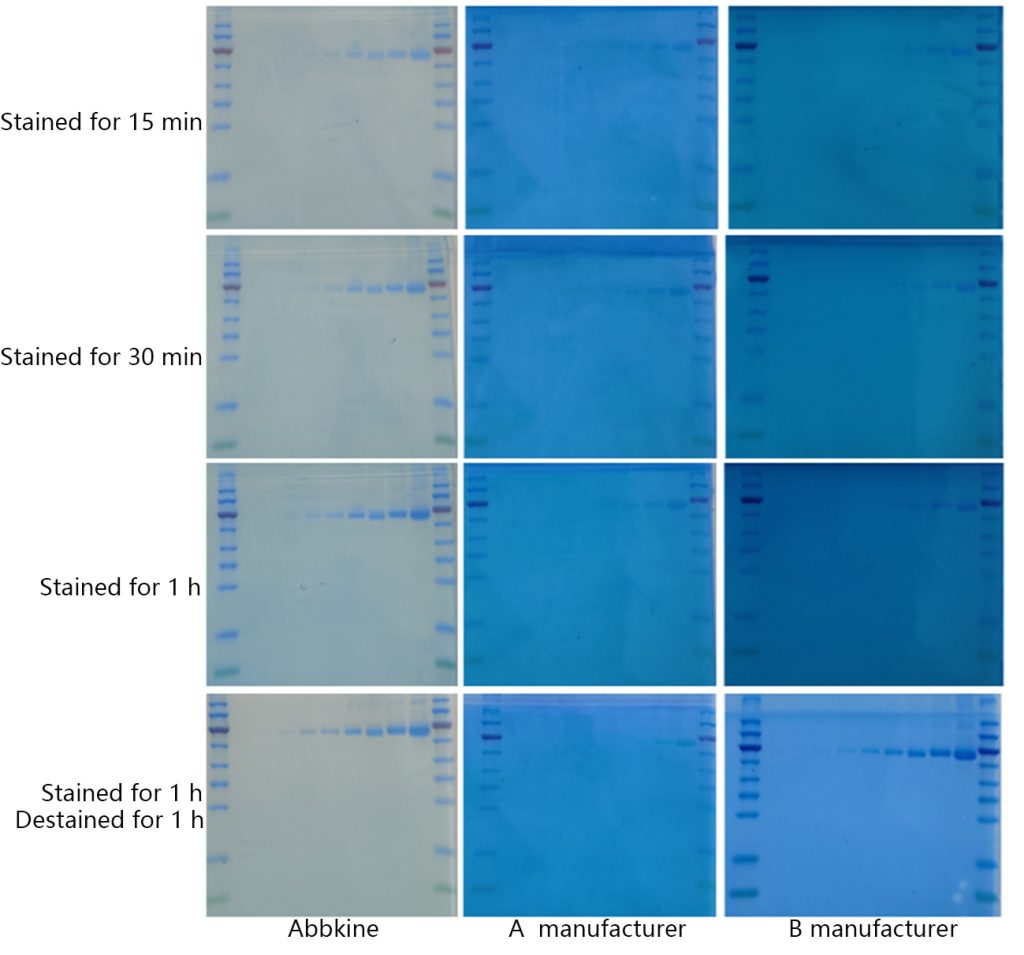
There is a very specific 9:30 PM lab ritual every molecular biologist knows and hates: you finish electrophoresis, fix your gel in 40% methanol / 10% acetic acid for an hour, dump that hazardous waste into the proper (always overflowing) solvent container, pour in your home-mixed Coomassie R250 stain, wait another hour, then start the endless destain–change–destain cycle with fresh methanol–acetic mixes until the background is pale enough to see your bands. By the time you can photograph anything, it's midnight, the fume hood smells like a nail salon, and you're still not 100% sure that faint band at 37 kDa is real or just uneven background clearing.
The truth nobody puts on a poster: traditional Coomassie staining isn't "classic"—it's just horribly optimized for the way we actually work now, with heavier page gels, precious low-input samples, and—critically—more than one gel to image per run.
The Chemistry: Still Coomassie Brilliant Blue—But Rethought from the Ground Up
Coomassie Brilliant Blue R-250 still works on the same beautiful principle it always has: under acidic conditions, the sulfonated aromatic dye binds electrostatically and hydrophobically to alkaline and hydrophobic amino acid residues of separated proteins, turning them a deep, readable blue against a lighter background . That's not changing.
What is changing with SuperKine™ Protein Gel Fast Staining Solution (Coomassie Blue), Cat# BMU105-EN is everything around that reaction—the solvent system, the sensitisation of the dye, and the elimination of the methanol/ethanol fixation and the multi-hour destain grind.
Attribute What BMU105-EN Delivers
Format Ready-to-use liquid — no weighing R250 powder, no filter-stacking, no methanol/acid prep
Fixation/Organic hazard No methanol or ethanol immobilization/fixation step required — dramatically safer, fewer hazardous waste hassles
Speed Bands visible in as fast as ~10 min; 100 ng bands clear at ~15 min, 50 ng by ~60 min, overnight → 10 ng sensitivity
Decolorization Not required — a clear, clean background emerges without a conventional destain regimen
Background cleanup Quick DI-water rinses post-stain (optional 30-min interval rinse × ~3) give an ultra-low-bg gel ready for densitometry
Reusability Economical — same stain volume can be reused up to 3 times (2nd use ≈ same sensitivity; 3rd starts dropping; prolong stain time slightly if reusing)
Downstream compatibility Excised bands suitable for mass spectrometry / sequencing analysis — no methanol fixation residuals interfering
Gel types SDS-PAGE and Native (non-denaturing) PAGE gels; tested for 0.75–1.5 mm thickness (extend for thicker gels per visual effect)
Storage / Ship 4°C, protected from light, 12-month shelf from ship date; blue-ice gel pack; contains volatile substances — keep sealed; acidic / mildly corrosive — lab coat + gloves
Pre-stain prep (critical!) Rinse gel in deionized water 3× to flush residual SDS/electrophoresis buffer — residual impurities = higher bg, lower resolution
What Changes the Moment You Switch (Besides Getting Home Before Midnight)
① Your "fast" gel is finally fast.
The classic protocol is fix → stain → destain → destain → destain. BMU105-EN collapses that to: rinse gel in DI water 3× → add stain → rock 30–60 min at RT → pour off → quick DI rinse → image. That's it. No fixing step. No methanol. No rotating bottles of 40:10:50 in the hood. Bands at 100 ng pop in ~15 min; push a low-abundance lane overnight and the limit of detection hits ~10 ng .
② Your background actually stays clean without destain guesswork.
Because the formulation is engineered so the dye preferentially binds protein and releases cleanly from the polyacrylamide matrix, you don't need to "bleach" the gel's color tone away. A couple of gentle DI-water rinses after staining are usually enough. If you want publication-perfect clarity, a rinse-every-30-min × ~3 cycles knocks background to near-zero without eating your smallest band .
③ Your excised band can still go to MS.
This is the hidden cost of over-fixing gels with methanol-heavy protocols: you lock in modifiers or add solvent-derived adducts that complicate downstream LC-MS/MS. BMU105-EN's no-fix, acid-dye-only approach is explicitly noted as compatible with recovered target proteins for mass spectrometry or sequencing analysis .
The 4-Step SOP (So Simple You Can Text It to a New Undergrad)
- Post-electrophoresis rinse: Transfer gel to a staining container, rinse 3× with deionized water (gently rocking), discarding water each time. This flushes residual SDS/buffer salts that would otherwise raise background or blur fine bands.
- Stain: Add 20–30 mL BMU105-EN (enough to cover the gel comfortably), put the lid on, and rock at room temp (~20–25°C) — optimal ~30–60 min. For low-abundance samples, stain longer or overnight; sensitivity can reach ~10 ng with extended time .
- Discard & quick rinse: Pour stain back into its bottle immediately after use (seal tight — volatile!), add DI water, give the gel a gentle swirl, discard; repeat a couple of times or do the ~3× 30-min interval rinses if you want gallery-quality uniform pale background.
- Image: Lay gel on the illuminator / scan / photograph. Done.
Pro tips from the fine-print that save repeats:
• 🔒 Seal the bottle every time — the stain contains volatile components; evaporation shifts concentration and bg.
• 🧤 Gloves + lab coat — it's acidic and mildly corrosive; respect it.
• ♻️ Reuse wisely — up to 3 cycles per batch; if you stretch to a 3rd reuse, bump stain time a bit and judge by lane visibility .
• Thick gels (>1.5 mm)? Scale stain volume slightly and extend time until your faintest target band is clearly rendered — the formulation is forgiving, not fragile.
Who Should Swap Yesterday
Workflow Why BMU105-EN Beats the Old Way
Daily WB pre-screening (check digestion/expression before committing to transfer) 30–60 min door-to-door vs. 3+ hrs; no methanol waste
Precious low-input preps (IP eluate, microgram-scale fractions) 10 ng sensitivity means you see what matters without overloading
Native PAGE (enzyme complexes, nucleoprotein assemblies) No harsh methanol fixation that can strip non-covalent complexes
Band excision → LC-MS/MS pipeline Cleaner background, no over-fix artifacts, explicitly MS-compatible
Teaching labs / core facilities Ready-to-use eliminates "who mixed the R250 stock last?" variability
Explore the full specs & ordering info for SuperKine™ Protein Gel Fast Staining Solution (Coomassie Blue) — BMU105-EN here:
🔗 https://www.abbkine.com/product/superkine-protein-gel-fast-staining-solution-coomassie-blue-bmu105-en/
(For research use only. Not for human or clinical diagnostic use. Handle as acidic, mildly corrosive liquid; seal tightly to prevent volatile loss; rinse gels with DI water before staining to minimize background.)





