




The Chemistry That Sees What Every Enzyme Misses: How Abbkine's KTB1360 Bypasses the 3:00 AM Signal Collapse in Reducing Sugar Detection
A plant physiologist once told me, with the hollow detachment of someone who has just lost two weeks of their life, that the moment they abandoned their enzymatic reducing sugar assay was not when the standard curve failed. It was when they realized that the phenolics leaching from their drought-stressed rice leaves had been silently crippling the glucose oxidase in every well, and the "metabolic shift" they had been tracking for 14 days was, in reality, a titration curve of a peroxidase inhibitor. That biologist is not alone. The quiet truth of the reducing sugar sector is that the most widely used enzymatic kits rely on a cascade of enzymes—glucose oxidase, peroxidase, and often hexokinase—that are exquisitely sensitive to the secondary metabolites, phenolics, alkaloids, and reductants that plant tissues, bacterial lysates, and stressed animal cells release in abundance. When you crack open a leaf cell, you liberate not just glucose and fructose but also a cocktail of compounds that will systematically poison your detection system. The numbers you get at the end might look precise. They might not be right.
Reducing sugars are not a niche endpoint. In plants, glucose and fructose are the primary substrates of respiration and the metabolic building blocks for sucrose, starch, and cellulose. In plant stress biology, reducing sugar accumulation is a canonical response to drought, salinity, and cold, functioning as both an osmotic adjustment mechanism and a metabolic signal that reprograms gene expression. A 2018 study in Spectrochimica Acta Part A monitoring sucrose, reducing sugar, and total sugar dynamics in rice under water-deficit stress demonstrated that reducing sugar content shifts with genotype-specific kinetics that a total soluble sugar assay simply cannot resolve. When an onion salinity adaptation study published in BMC Plant Biology evaluated the effects of foliar-applied reducing sugars on physiological responses to salt stress, it relied on the ability to distinguish reducing sugars from non-reducing sugars—a distinction that is analytically lost the moment an anthrone or phenol-sulfuric acid method is used. In the food industry, cold-induced sweetening in stored potato tubers is driven by the accumulation of reducing sugars, and the ability to screen transgenic lines for reduced reducing sugar content depends on an assay that reports those sugars specifically. In every one of these contexts, the measurement is not a supplementary data point. It is the primary metabolic readout, and its accuracy determines whether a stress response is correctly attributed or a transgenic event is correctly selected.
Abbkine's CheKine™ Micro Reducing Sugar (RS) Assay Kit (KTB1360) addresses this analytical challenge by stepping entirely outside the enzymatic detection paradigm and returning to a chemistry that has been a workhorse of carbohydrate analysis for over a century: the 3,5-dinitrosalicylic acid (DNS) reaction.
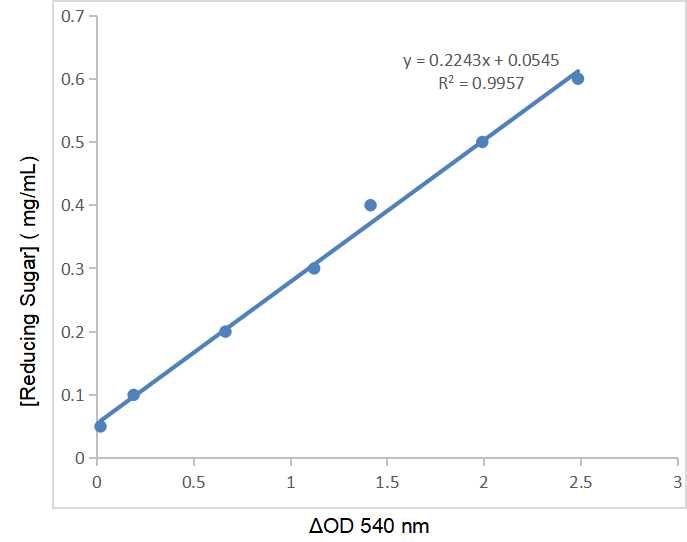
The principle is direct and chemically robust. In alkaline solution, the reducing sugars in the sample—glucose, fructose, maltose, and other monosaccharides and disaccharides carrying a free aldehyde or ketone group—reduce 3,5-dinitrosalicylic acid to 3-amino-5-nitrosalicylic acid, a brown-red amino compound with a characteristic absorption peak at 540 nm. The absorbance at 540 nm is linearly proportional to the reducing sugar content within a defined concentration range, and the concentration in the sample is calculated from a standard curve. There is no glucose oxidase to be inhibited by phenolics. No peroxidase to be poisoned by ascorbate or glutathione. No hexokinase to be competitively inhibited by N-acetylglucosamine or mannose. The DNS reagent reacts directly with the carbonyl group of the reducing sugar, and the resulting chromophore is measured on any standard visible-wavelength microplate reader. The chemistry is stoichiometric, well-characterized, and indifferent to the complex biochemical background of a crude tissue homogenate. A 2025 technical overview published by Abbkine describes the kit as distinguished by an optimized design that integrates simplicity with robust performance, and the molecular basis of that robustness is the decision to use a direct chemical detection principle rather than a coupled enzymatic cascade.
The operational advantages of this DNS-based approach are cumulative rather than singular. The kit components number only three: Extraction Buffer, DNS Reagent, and a Standard. There are no enzyme cocktails to reconstitute from individually sourced components, no cofactor solutions requiring fresh preparation within hours of use, no substrate solutions that oxidize within a working week. The protocol is described as simple, convenient, rapid, and colorimetric. The standard curve is generated with the provided standard, samples are incubated with the DNS reagent under alkaline conditions with heating, and the absorbance is read at 540 nm. If the sample value exceeds the maximum standard value, further dilution with distilled water is recommended, with the dilution factor multiplied into the final calculation. Storage is straightforward: 12-month validity under the conditions specified, shipped on gel packs with blue ice. The usage notes reflect the ordinary precautions of any colorimetric assay—avoid bubbles, change pipette tips frequently, ensure temperature equilibration—plus the explicit safety disclosure that DNS reagent is toxic and requires protective measures during handling. These are not exotic requirements. They are the standard laboratory courtesies that a chemical detection method demands, and the protocol states them clearly.
Sample compatibility in KTB1360 spans the full range of biological matrices in which reducing sugars are actually measured: animal tissues, plant tissues, bacteria, cultured cells (adherent or suspension), serum, and plasma. The product page specifically notes that the kit can detect reducing sugar concentrations from liquid samples such as animal and plant tissue homogenates, bacteria, cells, and serum or plasma. This breadth matters because reducing sugar quantification spans plant physiology, food science, microbiology, clinical biochemistry, and metabolic research, and a single kit that serves all of these domains eliminates the protocol fragmentation that occurs when different sample types demand different detection chemistries. For a core facility processing reducing sugar assays on Monday from a rice drought-stress experiment, on Wednesday from a bacterial fermentation broth, and on Friday from diabetic mouse serum, the availability of a single validated method across all sample types is not a convenience; it is an operational necessity.
The broader biological significance of reducing sugars extends well beyond their role as metabolic intermediates. According to the product page background documentation, reducing sugars are widely distributed in animals, plants, microorganisms, and cultured cells. In plants, the reducing sugars mainly include glucose, fructose, and maltose. Glucose and fructose are not only the main substrates of respiration but also the monosaccharide components of sucrose, starch, and cellulose. This metabolic centrality means that reducing sugar quantification is relevant to virtually every subfield of plant biology—from photosynthesis research and carbon allocation studies to postharvest physiology and abiotic stress tolerance screening—as well as to microbial biotechnology, where reducing sugar content in fermentation media directly reflects carbohydrate utilization efficiency, and to clinical biochemistry, where blood reducing sugar levels are a parameter in metabolic disease research.
The fact that Abbkine describes the kit as a premium solution for precise glycogen analysis in its technical blog is worth noting, as it highlights an application pathway that some researchers may not immediately associate with reducing sugar detection. Glycogen, the primary glucose storage polymer in animals, is not itself a reducing sugar, but its quantification typically requires acid or enzymatic hydrolysis to liberate glucose, which is then measured as a reducing sugar. The DNS method, with its resistance to the inhibitors that compromise enzymatic glucose detection, provides a reliable endpoint for glycogen quantification after hydrolysis, making KTB1360 a dual-purpose tool: it measures reducing sugars directly in native samples and serves as the detection module for glycogen after appropriate sample pretreatment.
The publication record for KTB1360 currently includes one peer-reviewed citation, and the identity of that citation is substantially more significant than the number alone would suggest. The product has been cited in a study published in Nature (impact factor 65), titled "Structural and mechanistic insights into fungal β-1,3-glucan synthase FKS1" (KTB1360-65). This is not a routine methods-section mention in a specialized journal. It is the deployment of a reducing sugar assay kit in one of the most rigorously peer-reviewed scientific journals in the world, in a study characterizing the structural biology and enzymatic mechanism of a fungal glucan synthase—a context in which the quantification of reducing sugars released by enzymatic hydrolysis is analytically central to the paper's conclusions. A kit that has passed peer review in Nature has been validated under scrutiny that no manufacturer's internal quality control dataset can replicate. As of the technical blog published in December 2025, the product page had accumulated over 2,700 views, indicating sustained and growing interest from the research community.
The economic accessibility of KTB1360 deserves direct statement because it differentiates the kit from the premium-priced enzymatic alternatives with which it competes. Priced at 1.65 places quantitative reducing sugar measurement within the budget of laboratories for whom HPLC, LC-MS/MS, or even multi-enzyme commercial assay kits are financially inaccessible. Comparative studies of the DNS method have consistently demonstrated that it delivers reducing sugar quantification statistically equivalent to HPLC while being substantially faster and less expensive, and while being applicable to sample types—particularly plant tissue homogenates rich in phenolic compounds—that cause systematic underestimation in enzymatic glucose oxidase-peroxidase methods. For a plant physiology laboratory in a developing country, an undergraduate biochemistry teaching laboratory, or a field station with a single visible-wavelength microplate reader, this combination of analytical reliability and economic accessibility represents not a purchasing option but a methodological lifeline.
The detection chemistry that KTB1360 employs is not new. The DNS method was developed in the early twentieth century and has been a standard tool of carbohydrate chemistry ever since. The 3,5-dinitrosalicylic acid is reduced to 3-amino-5-nitrosalicylic acid by the reducing sugar in alkaline solution, and the absorbance increase at 540 nm is directly proportional to the reducing sugar concentration. What KTB1360 changes is not the chemistry but the packaging: pre-formulated, pre-stabilized DNS reagent that eliminates the most significant source of inter-laboratory variability in legacy DNS protocols—the manual preparation of DNS reagent from powdered 3,5-dinitrosalicylic acid, sodium hydroxide, and potassium sodium tartrate, a process that generates batch-to-batch variation exceeding 15% even in experienced hands. The Extraction Buffer, DNS Reagent, and Standard arrive pre-validated, pre-standardized, and ready for immediate use, transforming a method that was once the province of carbohydrate chemistry specialists into a routine assay that any laboratory technician can perform on the first attempt.
For the plant physiologist comparing reducing sugar accumulation between drought-tolerant and drought-sensitive rice cultivars across a 200-sample time course, the postharvest biologist screening potato lines for cold-induced sweetening resistance, the food scientist quantifying reducing sugar content as a quality parameter in processed food, the microbiologist monitoring carbohydrate consumption in a fermentation process, the clinical biochemist measuring blood reducing sugars in a metabolic disease cohort, or the structural biologist characterizing the enzymatic activity of a purified glycoside hydrolase by quantifying the reducing sugars it releases from a defined substrate, KTB1360 provides a detection chemistry that is chemically direct, enzymatically indifferent to the inhibitors that cripple oxidase-based methods, compatible with sample matrices spanning microbes, plants, animals, and biological fluids, validated in Nature under peer review, and priced at $79 for 48 tests. The carbonyl group on a reducing sugar molecule reduces DNS to a brown-red chromophore absorbing at 540 nm. The absorbance is proportional to the sugar concentration. The reaction has been working reliably for over a hundred years. It is now available in a three-component kit.
Explore full specifications, access the protocol, and place your order here: https://www.abbkine.com/product/chekine-micro-reducing-sugarrs-assay-kit-ktb1360/





