




The Catalase Blind Spot: Why Your Oxidative Stress Panel Is Incomplete Without a True Quantitative Protein Measurement—And Why Enzymatic Activity Assays Have Been Lying to You
Every redox biologist has stared at a scatterplot that refuses to resolve. You subject your rats to a hepatotoxic dose of carbon tetrachloride, sacrifice them at six hours post-exposure, homogenize the livers, and run your standard antioxidant enzyme panel. Superoxide dismutase activity is down 40%. Glutathione peroxidase is down 35%. And catalase? Catalase shows a 12% increase that makes no mechanistic sense in the context of a known oxidative insult. You repeat the experiment. Same result. You begin to doubt your animal model, your dosing regimen, your entire hypothesis. But the real problem is not your experimental design. The real problem is the fundamental biochemical limitation of the catalase activity assay itself.
Catalase (EC 1.11.1.6) is not a typical enzyme. It is one of the most catalytically active enzymes in biology, capable of converting millions of hydrogen peroxide molecules into water and oxygen every second. This extraordinary turnover number, while evolutionarily advantageous for detoxifying peroxisomal H₂O₂, creates a quantitative nightmare for the researcher who needs to measure catalase protein abundance rather than enzymatic activity. Activity-based assays—whether spectrophotometric monitoring of H₂O₂ disappearance at 240 nm or colorimetric detection of remaining peroxide—are exquisitely sensitive to pH, temperature, and substrate concentration. A two-degree deviation in cuvette temperature during the 30-second measurement window generates a 15% shift in apparent activity. Residual H₂O₂ in the homogenization buffer consumes substrate before the reaction begins. And the peroxisomal localization of catalase means that incomplete organelle lysis produces artificially low activity readings that have nothing to do with actual catalase protein levels in the tissue.
What oxidative stress research has needed for decades is not another activity assay with tighter temperature control. What it has needed is an antibody-based quantitative method that measures catalase protein concentration independent of enzymatic activity, independent of peroxisomal lysis efficiency, and independent of the substrate kinetics that make activity-based measurements so frustratingly variable. Abbkine's Rat Catalase (CAT) ELISA Kit (KTE100847) is precisely that method.
KTE100847: The Sandwich ELISA That Finally Separates Catalase Protein Abundance from Catalase Enzyme Activity—And Why That Distinction Matters for Every Oxidative Stress Study You Will Ever Run
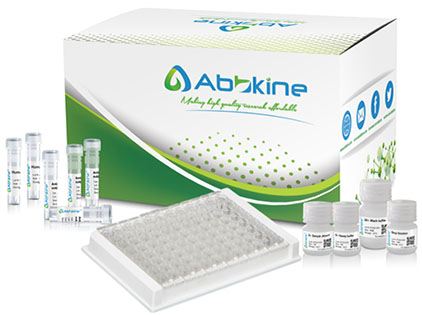
Abbkine's Rat Catalase (CAT) ELISA Kit employs a rigorously validated two-site sandwich ELISA format: an antibody specific for rat catalase is pre-coated onto the microplate. Standards and samples are pipetted into the wells, and any catalase present is bound by the immobilized capture antibody. After washing away unbound substances, an HRP-conjugated detection antibody is added, binding to a spatially distinct epitope on the captured catalase molecule. A chromogen solution is then applied, developing blue color in direct proportion to the amount of catalase bound in the initial step. The reaction is stopped, and the absorbance is read colorimetrically.
This is not a competitive assay with its inverted dose-response curves and high-end signal compression. This is a true sandwich—the geometry that immunochemists prefer when they want linearity, minimal background, and reproducibility that holds across independent runs. The detection system measures catalase protein concentration, not catalase enzyme activity, meaning that the signal is independent of H₂O₂ concentration, pH, temperature, and peroxisomal lysis efficiency. For the researcher who has spent weeks troubleshooting an activity assay that refuses to produce consistent duplicate wells, this distinction between protein quantity and enzyme activity is the difference between data you can publish and data you can only describe qualitatively.
The specifications are precise and unambiguous. Calibration range: 2 ng/L to 32 ng/L, enabling detection across the physiologically relevant spectrum of catalase concentrations in rat serum, plasma, and tissue homogenates. Limit of detection: 0.1 ng/L, a sensitivity that permits quantification even in dilute samples where competing ELISA kits with nanogram-per-mL sensitivity generate signal indistinguishable from background noise. The detection method is standard colorimetric absorbance at 450 nm—hardware that exists in virtually every modern life science laboratory. Sample compatibility spans serum, plasma, cell culture supernatants, and other biological fluids. For the researcher who measures catalase in liver homogenates on Monday, in primary hepatocyte culture supernatants on Wednesday, and in rat plasma from a pharmacokinetic study on Friday, KTE100847 delivers consistent performance without matrix-specific re-optimization.
The Unit Conversion Trap: Why ng/L Matters More Than You Think
A critical note that separates the experienced catalase researcher from the novice: KTE100847 reports catalase concentration in mass units (ng/L), not in activity units (mIU/mL or U/mL). This is not a minor formatting preference. It is a fundamental design choice that reflects the kit's measurement principle. Many commercial catalase ELISA kits report results in mIU/mL—activity-based units calibrated against a catalase standard of known enzymatic activity—which introduces all the variability inherent in the enzyme reaction that generates those units. Different manufacturers calibrate their mIU standards differently, meaning that a catalase value of 1,000 mIU/mL from Vendor A may correspond to a different protein concentration than 1,000 mIU/mL from Vendor B. For laboratories comparing results across studies, across time points, or across collaborating institutions, this unit ambiguity is a reproducibility hazard. KTE100847's mass-based readout eliminates this hazard by reporting catalase protein concentration directly.
Practical Protocol Wisdom: Small Decisions That Determine Whether Your Standard Curve Earns a Figure Panel or a Trash Bin
The instructions packed with KTE100847 reflect the accumulated experience of troubleshooting sandwich ELISA performance across diverse biological matrices. The opening command is unambiguous: do not mix components from different kit lots or use reagents beyond the kit expiration date. This is not legal boilerplate—it is a biochemical reality rooted in the lot-specific calibration of antibody affinity and chromogen sensitivity. Mixing lots introduces standard curve drift that can shift apparent catalase concentrations by 20% or more, transforming a biologically meaningful difference between treatment groups into statistical noise.
Bring all reagents to room temperature for at least 30 minutes before opening. Temperature gradients across the plate produce binding kinetics gradients that manifest as edge effects—the wells along the perimeter of the plate consistently read differently from the wells in the center—and no amount of post-hoc normalization can reliably correct this artifact. Pre-rinse pipette tips with reagent before use, and deploy fresh tips for every sample, standard, and reagent transfer. Catalase adsorbs to plastic surfaces, and carryover contamination from a high-concentration standard well to a low-concentration sample well is a single lapse of attention away.
Unused wells must be kept desiccated at 4°C in the sealed bag provided. Humidity is the silent enemy of pre-coated ELISA plates, slowly degrading the immobilized capture antibody through hydrolysis. Mix thoroughly every 10 minutes during incubations—a low-frequency oscillator or gentle hand shaking is recommended—to ensure homogeneous reagent distribution and prevent concentration gradients within individual wells. And crucially: assay all standards and samples in duplicate or triplicate. Any single well can be an outlier, and the statistical power of your experiment depends on replication at the most fundamental level. The unopened kit is stored at 2–8°C and ships on gel pack with blue ice to maintain temperature integrity during transit. The product is designated for research use only and is not intended for human or clinical diagnostic applications.
Where KTE100847 Fits in the Redox Puzzle—And What Else Abbkine Brings to the Bench
Catalase does not operate in biochemical isolation. It is the terminal detoxification enzyme for hydrogen peroxide, working in concert with glutathione peroxidase and peroxiredoxin to maintain intracellular H₂O₂ concentrations within the nanomolar range that permits redox signaling while preventing oxidative damage. When catalase protein levels decline—whether through transcriptional downregulation, peroxisomal dysfunction, or accelerated protein degradation—the cell's capacity to handle high-flux H₂O₂ challenges is compromised, and compensatory upregulation of glutathione-dependent pathways often follows.
KTE100847 provides the catalase protein quantification that completes the antioxidant enzyme picture. For the full oxidative stress profiling panel, Abbkine offers complementary ELISA kits including the Rat Glutathione (GSH) ELISA Kit (KTE100838), enabling paired measurement of the primary non-enzymatic antioxidant and the enzymatic H₂O₂ detoxification machinery from the same experimental cohort. The broader Abbkine ELISA ecosystem spans cytokine, hormone, and metabolic marker quantification, all sharing consistent sandwich ELISA formats, HRP-TMB colorimetric detection, and protocol logic that reduces training burden and technical variability across multi-analyte studies.
Product Details:
- Product Name: Rat Catalase (CAT) ELISA Kit
- Brand: Abbkine
- Catalog Number: KTE100847
- Method: Quantitative Sandwich ELISA
- Detection Range: 2 ng/L – 32 ng/L
- Sensitivity: 0.1 ng/L
- Sample Types: Serum, Plasma, Cell Culture Supernatants, Other Biological Fluids
- Detection Method: Colorimetric (HRP/TMB)
- Assay Type: Sandwich ELISA
- Reactivity: Rat
- Storage: Unopened kit at 2–8°C; ships on blue ice
Product Link: https://www.abbkine.com/product/rat-catalase-cat-elisa-kit-kte100847/





