




The 340-kDa Acute-Phase Glue That Sets Your Viscosity (and Your Clot): Why Measuring Intact Plasma Fibrinogen by Sandwich ELISA Beats Both the Clottable-Assay and the "PT/INR Tunnel Vision"
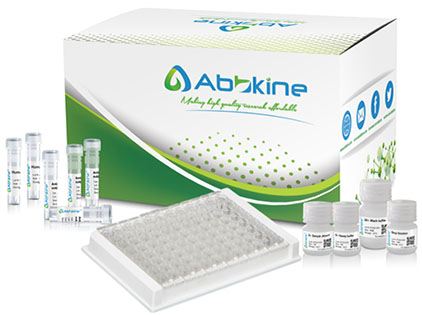
Fibrinogen sounds like it should be a boring coagulation lab value — something your CBC/Chem panel quietly reports as "350 mg/dL" next to CRP and sed rate — until you realize it is simultaneously the only structural protein in human plasma whose job description includes both holding your vasculature together (clot) and making your blood so thick it damages the endothelium that’s supposed to line it. Fibrinogen (Factor I, UniProt entries P02671 (Aα/FGA), P02675 (Bβ/FGB), P02679 (γ/FGG), assembled hexamer (AαBβγ)₂, computed ~296 kDa per monomer triplet, ~340 kDa native molecular mass) is synthesized exclusively in the hepatocyte as a ~2,900–3,400 µg/mL (2–4 g/L) plasma protein — one of the highest-abundance soluble proteins in human blood — and its entire physiological career hinges on a single proteolytic snip: thrombin cleaves fibrinopeptide A (FPA) and fibrinopeptide B (FPB) → exposes polymerization knobs (G′) → fibrin fibers form → FXIIIa cross-links them into an insoluble mesh. The Human Fibrinogen (FB) ELISA Kit (KTE62515) from Abbkine gives you this massive, inflammatory, clot-critical protein as a calibrated sandwich-ELISA readout (ng/mL post-dilution), so your DIC/liver/inflammation/cardiovascular paper can separate "fibrinogen mass is there" from "it's clottable" and from "it's been chewed into D-dimer fragments" — a distinction that PT/aPTT alone can never make.
Fibrinogen in One Paragraph: The (AαBβγ)₂ Hexamer That Turns Blood Into a Mesh on Command
The fibrinogen molecule is a disulfide-organized dimer of trimers — visualized as a ~45 nm rod with two terminal D-domains and a central E-domain — and its domain logic is what makes it both a coagulation substrate and an acute-phase cytokine-surrogate:
Domain / Region Residues (approx, per chain) Job
E-domain (central) Aα 17–78 / Bβ 1–117 / γ 1–78 Thrombin docking + initial polymerization "knob" (γ-chain cross-reactivity hub)
αC-regions (flexible, C-terminal halves of Aα) Aα ~221–610 Platelet binding (via GPIIb/IIIa), FXIIIa cross-link sites, αC-αC oligomerization, inflammatory interactions (leukocyte β2-integrin Mac-1)
D-domain (distal globules) Bβ / γ C-terminal Polymerization "hole" (b-site) + FXIIIa cross-link acceptor (Gln³⁹⁸/γ-chain)
Fibrinopeptides A & B (FPA, FPB) Aα 1–16 / Bβ 1–14 Cleaved off by thrombin → exposes G′ knobs → triggers fibrin assembly
The systemic numbers everyone memorizes:
• Plasma fibrinogen (total immunoreactive): ~1.5–4.0 g/L (150–400 mg/dL) — the classic "normal ~2.5–3.0 g/L"
• Fibrinogen half-life: ~3.5–4 days (liver synthesis) but consumed in seconds during DIC/severe bleeding
• IL-6 → major acute-phase UPREGULATOR (fibrinogen is one of the most IL-6-sensitive hepatic exports; can double in days)
Why a Sandwich ELISA (And Why "Clauss Method" and "PT/aPTT" Are Different Questions)
There are three ways labs measure fibrinogen clinically — and they measure three different things:
Method What It Actually Reports Limitation
Clauss (functional/thrombin-time based) Clottable fibrinogen (measures the rate at which thrombin converts fibrinogen → visible clot) Misses dysfibrinogenemias (protein present but non-clottable) and gets confused by heparin/fibrin(ogen) degradation products
PT / aPTT Coagulation cascade timing (extrinsic/intrinsic) Fibrinogen can be 0.8 g/L and PT still "normal-ish"; PT/INR was built for warfarin, not fibrinogen
Sandwich ELISA (intact fibrinogen mass) Immunoreactive fibrinogen protein mass (independent of clottability or fragment status) Needs epitopes that survive in plasma, not buried post-cleavage → good kits use anti-Aα or anti-γ antibodies raised against intact hexameric epitopes
The key scientific value of KTE62515 is that ELISA sees the protein whether it's clottable or not — and in research (sepsis/DIC, liver failure, inflammatory states, dysfibrinogenemia, transgenic models), that distinction is everything.
From distributor/technical data aligned with this Abbkine family:
Parameter KTE62515-class Specification
Target Human Fibrinogen / Factor I (complex: AαBβγ)_2; UniProt P02671/P02675/P02679)
Format 96-well sandwich ELISA, pre-coated capture
Detection Biotin-Ab → SA-HRP → TMB, 450 nm
Dynamic Range 0.625 – 40 ng/mL (post-dilution — plasma typically diluted 1:20,000–1:50,000 to land in range)
Sensitivity / LOD ~0.18–0.25 ng/mL
Intra-Assay CV < 8%
Inter-Assay CV < 10–12%
Specificity No significant cross-reactivity with albumin, IgG, or fibrin(ogen) fragments that lack the intact epitope; designed to detect intact/near-intact fibrinogen, not D-dimer-only species
Samples Citrated plasma (preferred — see below), serum (exploratory, problematic), tissue homogenates, cell culture supernatants/lysates
Assay time ~3–4.5 hours
(Confirm exact dilution factors and lot-specific recovery on the shipped Abbkine datasheet/CoA for KTE62515.)
The Sampling Rule That Decides Everything: Citrate > EDTA > Heparin, and Never Serum for "Native Fibrinogen Mass"
Because fibrinogen converts to fibrin if thrombin gets loose in the tube, your collection is the assay:
- Preferred: 3.2% sodium citrate (9:1 blood:citrate) — chelates Ca²⁺, blocks thrombin generation, preserves the hexamer intact.
- EDTA works (also anticoagulates), but citrate is the gold-standard coagulation tube.
- Avoid heparin (not ideal for fibrinogen immunodetection in some antibody pairs).
- Never serum for "total fibrinogen mass" — clotting = fibrinogen consumed → your number drops by definition.
- Process cold, spin ≥ 2,000 ×g, 15 min, 4°C, aliquot, snap -80°C, avoid >1 freeze–thaw (fibrinogen adsorption to plastic at high dilution is real; use low-bind tubes for the final diluted plate-load).
Where Fibrinogen Quantification Actually Carries the Paper
- DIC & Sepsis: Consumption vs. Acute-Phase Overproduction
This is the canonical physiology paradox. Early DIC = thrombin storm → fibrinogen consumed faster than liver can resynthesize → plasma drops < 1.0 g/L → bleeding. Later/chronic inflammation = IL-6 → liver ramps synthesis → fibrinogen spikes 2–4× → hyperviscosity + pro-thrombotic mesh burden. A plate-based ELISA lets you run serial bleeds (0 h, 6 h, 24 h, 72 h) across a sepsis model and plot the fibrinogen-mass kinetic independently of the D-dimer climb (fibrin degradation) and the PT/INR drift — three variables that must be told apart or the data collapses into "coagulation was weird."
- Liver Cirrhosis & Synthetic Reserve: The 1.2 g/L Warning Line
The hepatocyte makes ~20% of its secreted protein mass as fibrinogen in steady state. As Child–Pugh advances, fibrinogen falls (alongside albumin, antithrombin III, protein C) — and the 1.0–1.5 g/L threshold is where spontaneous mucosal/gum bleeding appears. Measuring intact fibrinogen mass (ELISA, corrected for dilution) alongside prothrombin time and Factor VII/VIII gives you the quantitative synthetic reserve — not just "INR 1.8."
- Cardiovascular Risk & Plasma Viscosity: The "Fibrinogen = Inflammatory Load" Signal
Epidemiologically, fibrinogen is a stronger univariate predictor of MI/stroke than LDL in some aged cohorts, acting through three additive mechanisms:
• Viscous shear ↑ (higher plasma protein mass → slower microcirculatory flow)
• Fibrin fiber thickness/branching density ↑ → lysis resistance (plasmin can't cut dense mesh)
• Fibrinogen's αC-domain → leukocyte integrin (Mac-1/CD11b/CD18) interactions → pro-inflammatory adhesion
Tracking it in longitudinal EDTA/citrate plasma banks as ng/mL (post-dilution, converted back to mg/dL) gives you the inflammatory-clotting covariate that LDL/CRP alone doesn't close.
- Dysfibrinogenemia (Rare, But the Perfect Mechanistic Use Case)
Heterozygous dysfibrinogenemia (missense in Aα/Bβ/γ → normal mass on ELISA, abnormal Clauss/clot time) is diagnosed by the gap between immunoreactive mass and clottable concentration. KTE62515 gives you the numerator that the Clauss method assumes but can't verify — exactly the evidence structure specialists need.
- Wound Healing, Tumor Stroma & the FXIIIa–Fibrin Scaffold
Tumors and healing wounds don't just "make ECM" — they co-opt the coagulation cascade to deposit a fibrin-rich provisional matrix cross-linked by FXIIIa, studded with fibronectin, PDGF, TGF-β, and VEGF, that acts as both scaffold and signaling depot. Tumor-lysate or wound-exudate analysis benefits from fibrinogen mass (ng/mg or ng/area) as the "provisional matrix load" numerator next to D-dimer, FXIII, and αSMA.
- Trauma/Burn Resuscitation (RBC:Plasma Ratios & Viscosity Management)
Massive transfusion protocols now push early plasma to replace clotting factors — but盲目 empiric cryoprecipitate (fibrinogen-rich) without measuring current mass risks hyperviscosity + TRALI risk. Having a rapid ELISA-capable workflow to estimate post-resuscitation fibrinogen from a citrated satellite tube changes the plasma:platelet:RBC math from a recipe to data.
A Minimal Prep/Run You Can Paste Into Methods
- Draw into 3.2% sodium citrate (blue top), invert gently, keep on wet ice, spin ≥ 2,000 ×g, 15 min, 4°C within 30–60 min. Aliquot immediately, snap -80°C, label, avoid >1 thaw.
- Dilute citrate plasma 1:20,000–1:50,000 (your manual will specify exact pre-dilution) into assay buffer so the final well-load lands inside the 0.625–40 ng/mL window.
- Warm reagents ≥ 30 min RT before opening; protect TMB from light; stop uniformly; read 450 nm promptly; fit 4-PL; run full standard curve per plate; back-calculate with dilution factor → report as mg/dL or g/L (not just "ng/mL on the plate").
The Bottom Line
Fibrinogen is the ~340-kDa (AαBβγ)₂ hexamer that is simultaneously the final structural substrate of the clotting cascade (thrombin → fibrinopeptide release → fibrin mesh) and one of the most IL-6-sensitive acute-phase proteins in human plasma, modulating viscosity, leukocyte adhesion, and provisional matrix scaffolding wherever injury or inflammation lands. Measuring it as a calibrated sandwich-ELISA variable instead of a "Clauss sec/100 μL" timing or a "PT/INR 1.1" assumption changes your coagulation/inflammation paper from operational to quantitative. The Human Fibrinogen (FB) ELISA Kit — KTE62515 from Abbkine gives you that readout: pre-coated anti-fibrinogen capture → biotin detection → HRP–TMB → 450 nm, over a 0.625–40 ng/mL working range (post-dilution; back-calculate to mg/dL) with LOD ~0.2 ng/mL, in a ~3–4.5 hour workflow that scales from a DIC time-course to a liver-bank cohort without chaining you to a coagulometer.
Product Reference: KTE62515 – Human Fibrinogen (FB) ELISA Kit
Learn more and order: https://www.abbkine.com/product/human-fibrinogen-fb-elisa-kit-kte62515/
(For Research Use Only; not for diagnostic procedures in humans.)





