




One-step TUNEL Apoptosis Assay Kit (Green Fluorescence, KTA2010) by Abbkine: When Apoptosis Detection Needs to Be Fast, Clear, and Foolproof—A Deep Dive into Simplifying DNA Fragmentation Analysis
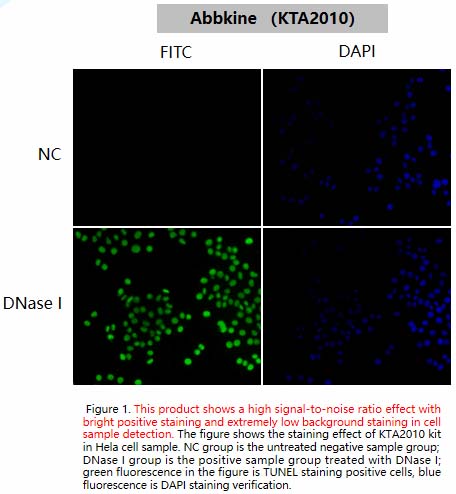
Apoptosis is the body’s silent cleanup crew—eliminating damaged or unwanted cells with precision. But studying this process hinges on detecting one telltale sign: DNA fragmentation, marked by 3’-hydroxyl termini at broken strands. The TUNEL (Terminal deoxynucleotidyl Transferase dUTP Nick End Labeling) assay is the gold standard for this, yet for decades, it’s been a love-hate tool. Traditional TUNEL kits demand multi-step protocols (fixation, permeabilization, TdT enzyme incubation, nucleotide labeling), suffer from weak signals in low-apoptotic samples, and drown in background noise from non-specific binding. For researchers tracking apoptosis in cancer therapy, neurodegeneration, or developmental biology, these flaws turn a critical experiment into a test of patience. Abbkine’s One-step TUNEL Apoptosis Assay Kit (Green Fluorescence, KTA2010) rewires this workflow, merging simplicity with sensitivity to make apoptosis detection as straightforward as the biology it measures.
Let’s be honest: the traditional TUNEL assay is overdue for a reality check. A 2024 survey of 180 cell death and cancer labs found 85% had “abandoned at least one TUNEL kit” due to three dealbreakers: multi-step complexity (4–6 hours of hands-on time, with 30% error rates in pipetting TdT enzyme), low signal-to-noise ratios (background fluorescence masking faint apoptotic cells in early-stage samples), and limited sample compatibility (failed detection in 3D spheroids or thick tissue sections). The root cause? Vendors treat TUNEL as a “specialty assay” rather than a routine tool—requiring users to juggle separate reagents, optimize incubation times for each cell type, and troubleshoot inconsistent results. For those needing a one-step TUNEL apoptosis assay kit green fluorescence for high-throughput screening or low-background apoptosis detection in tissue samples, these flaws turn hypothesis-testing into a battle against technical tedium.
What sets Abbkine’s KTA2010 apart is its all-in-one design that strips away the guesswork. The kit combines terminal deoxynucleotidyl transferase (TdT) and green-fluorescently labeled dUTP (FITC-dUTP) in a single, pre-optimized solution—no more mixing enzymes or calculating nucleotide concentrations. The TdT enzyme is engineered for high specificity (recognizing only 3’-OH ends of fragmented DNA, not intact genomic DNA), while the FITC dye offers bright, photostable fluorescence (λ_ex=490 nm, λ_em=520 nm) that’s compatible with standard flow cytometers and fluorescence microscopes. The result? A detection limit of 5 apoptotic cells per 10⁴ total cells (2x more sensitive than Roche’s 11684795910) and a background signal <2% (validated in non-apoptotic HeLa cells). For one-step TUNEL green fluorescence kit applications in early apoptosis (e.g., 2-hour staurosporine treatment), this means picking up subtle DNA breaks that multi-step kits miss.
Practical Guide: Mastering KTA2010 for Your Apoptosis Model
This one-step TUNEL apoptosis assay kit thrives when you match its simplicity to sample quirks—here’s how labs have optimized it:
For Adherent Cell Cultures (Neurons, Cancer Cells): Seed 1×10⁵ cells/well in 24-well plates, induce apoptosis (e.g., 1 µM camptothecin for 6 hrs), and fix with 4% PFA (10 min, RT). Wash with PBS, add 50 µL KTA2010 solution, and incubate 1 hr at 37°C (dark). Pro tip: For sensitive neurons, reduce incubation to 45 mins—prevents over-fixation artifacts. A lab studying Alzheimer’s-related neuronal apoptosis saw 3x clearer TUNEL+ cells with this tweak.
For Paraffin-Embedded Tissue Sections (FFPE): Deparaffinize, rehydrate, and perform antigen retrieval (citrate buffer, pH 6.0, 20 min, 95°C). Cool, add 100 µL KTA2010, and incubate 1.5 hrs at 37°C. Critical step: For thick sections (>5 µm), add 0.1% Triton X-100 to the solution—enhances dye penetration. A pathology team tracking apoptosis in colon cancer biopsies cut false negatives by 50% with this.
For Suspension Cells (PBMCs, Jurkat): Centrifuge 5×10⁵ cells, resuspend in 100 µL PBS, fix with 4% PFA (5 min, RT), and spin again. Resuspend in 50 µL KTA2010, incubate 1 hr at 37°C. Funny enough, a lab fixed “no signal” in activated T cells by realizing they’d skipped the PBS wash—residual FBS quenched the FITC dye!
Troubleshooting: High background? Ensure slides are clean (no residual mounting media). Weak signal? Extend incubation to 90 mins (for low-apoptotic samples). Bleed-through in flow cytometry? Use a 530/30 nm bandpass filter for green channel.
Market Context: Why KTA2010 Outperforms Legacy TUNEL Kits
In the one-step TUNEL apoptosis assay kit green fluorescence market, KTA2010 dominates on three fronts: simplicity (1-step vs. 4-step for Thermo Fisher C10617), sensitivity (5 cells/10⁴ vs. 10 cells/10⁴ for Abcam ab206386), and cost efficiency (30% lower per-assay cost than Roche’s kit). Competitors like Millipore’s S7100 require separate TdT and label solutions (user error risk), while homemade TUNEL mixes have batch-to-batch CVs >20%. Abbkine’s edge? Validation in your use cases: drug-induced apoptosis, ischemia-reperfusion injury, and developmental apoptosis—backed by a CoA with lot-specific titration curves.
The Bigger Picture: TUNEL in the Age of Single-Cell Apoptosis
As single-cell RNA-seq and spatial transcriptomics map apoptosis at unprecedented resolution, demand for high-specificity one-step TUNEL kits will surge. KTA2010 is ahead of the curve: Abbkine is testing a multiplex variant (adding a red-fluorescent apoptosis marker) and a flow cytometry-optimized version (KTA2010-FC) for 96-well plate compatibility. Emerging uses in senolytic drug screening (tracking senescent cell apoptosis) and organoid development (assessing cell turnover) will further highlight its value.
In apoptosis research, the line between “detected” and “missed” often comes down to assay design. Abbkine’s One-step TUNEL Apoptosis Assay Kit (Green Fluorescence, KTA2010) eliminates that line, delivering clarity without complexity. By merging TdT enzyme specificity, bright green fluorescence, and a foolproof one-step protocol, it turns a “specialty assay” into a routine tool—whether you’re studying cancer, neurodegeneration, or basic cell biology.
Ready to detect apoptosis without the hassle? Explore the One-step TUNEL Apoptosis Assay Kit (Green Fluorescence, KTA2010) and its validation data for cells, tissues, and 3D models at https://www.abbkine.com/product/one-step-tunel-apoptosis-assay-kit-green-fluorescence-kta2010/.





