Universal IP/Co-IP Toolkit (Magnetic Beads/Anti-Rabbit) (KTI1020-EN) — Technical Comparison & Buying Guide for Protein Interaction Researchers
IP/Co-IP: The Experiment That Punishes Every Uncontrolled Variable
Immunoprecipitation (IP) is a small-scale affinity purification method using specific antibodies fixed on solid-phase supports such as magnetic beads or agarose[reference:36]. As an important part of many proteomics-related studies, IP can be used to detect the existence of proteins, relative abundance, up- and down-expression of proteins, stability, and interaction of proteins[reference:37].
But anyone who has run IP knows the ritual: agarose beads settle for the fourth time while you watch, the 50-kDa heavy chain ghost contaminates your Western blot, and the three-wash rabbit hole eats an entire afternoon. These are not operator errors — they are structural flaws of the agarose-bead, unconjugated-secondary-antibody workflow.
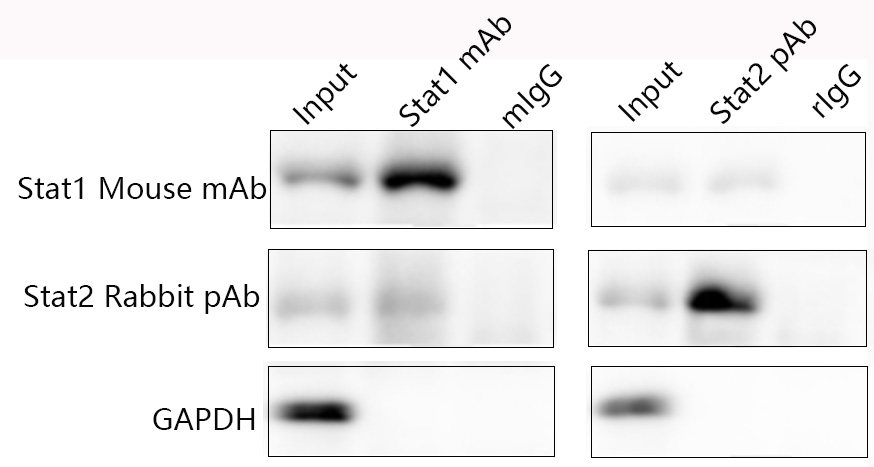
Abbkine's Universal IP/Co-IP Toolkit (Magnetic Beads/Anti-Rabbit) (KTI1020-EN) was developed around the pain points of the traditional IP/Co-IP experiment[reference:38]. It contains optimized natural and denatured lysis buffers, protein A/G magnetic beads, an IP negative control, and the IPkine™ secondary antibody — meeting the IP/Co-IP needs of most users[reference:39]. Here's how it compares to the legacy workflow.
Why Traditional Agarose-Bead IP Falls Short
| Bottleneck | Consequence |
|---|---|
| Gravity settling | Agarose beads settle slowly; repeated centrifugation and supernatant aspiration ("the slurp") introduce bead loss and irreproducibility |
| Heavy/light chain interference | Denaturing elution releases the IP antibody's heavy ( |
| Unvalidated negative control | Without an isotype control, "specific" bands may reflect non-specific IgG binding to the target or other biomolecules |
| Buffer assembly | Labs must individually optimize lysis, wash, and elution buffers — a hidden source of variability |
Abbkine KTI1020-EN: Engineered for the IP Workflow
The toolkit replaces gravity-settled agarose with protein A/G magnetic beads and pairs them with the IPkine™ HRP secondary antibody — a reagent designed to eliminate heavy-chain interference.
Key Specifications
| Parameter | KTI1020-EN |
|---|---|
| Bead type | Protein A/G magnetic beads (0.5 mL)[reference:40] |
| Lysis buffer | Non-Denaturing Lysis Buffer (25 mL)[reference:41] |
| Wash buffer | 10× Wash Buffer (20 mL)[reference:42] |
| Elution | Elution Buffer (2 mL) + Neutralization Buffer (0.2 mL)[reference:43] |
| Protease protection | 100× Proteinase Inhibitor Cocktail (0.2 mL)[reference:44] |
| Negative control | Rabbit IgG (1 mg/mL, 30 µL) — ready-to-use[reference:45] |
| Detection antibody | IPkine™ HRP, Mouse Anti-Rabbit IgG LCS (30 µL)[reference:46] |
| Secondary antibody innovation | IPkine™ LCS — eliminates heavy-chain interference[reference:47] |
Head-to-Head Comparison: KTI1020-EN vs. Traditional Agarose IP
| Feature | Abbkine KTI1020-EN | Traditional Agarose IP |
|---|---|---|
| Separation | Magnetic (seconds; no centrifugation) | Gravity settling (minutes per wash) |
| Heavy-chain interference | Eliminated (IPkine™ LCS secondary)[reference:48] | Present (~50 kDa ghost) |
| Negative control | Included (Rabbit IgG, ready-to-use)[reference:49] | Must be sourced separately |
| Buffer system | Complete (lysis, wash, elution, neutralization)[reference:50] | Individually optimized |
| Antibody consumption | Reduced (efficient binding, low non-specific adsorption)[reference:51] | Higher (bead loss) |
| Workflow | Universal (IP/Co-IP + WB from the same kit)[reference:52] | Separate reagent sourcing |
Why Choose Abbkine KTI1020-EN?
- Magnetic Separation: Protein A/G magnetic beads eliminate the gravity-settling bottleneck — no more watching agarose settle for the fourth time
- IPkine™ Heavy-Chain Elimination: The unique IPkine™ secondary antibody perfectly eliminates heavy-chain interference[reference:53], so your target band is not obscured at ~50 kDa
- Ready-to-Use Negative Control: Rabbit IgG is included to eliminate non-specific binding of IgG itself to the target protein or other biomolecules, ensuring IP antibody specificity[reference:54]
- Complete Buffer System: Lysis, wash, elution, and neutralization buffers are all included — no individual optimization required[reference:55]
- Reduced Antibody Consumption: Efficient antibody binding capacity and low protein non-specific adsorption rate save antibody consumption[reference:56]
- Universal Workflow: Meets the requirements of sample IP/Co-IP or WB at the same time[reference:57]
Who Should Buy This Toolkit?
✅ Buy KTI1020-EN if you:
- Run Co-IP experiments to study protein–protein interactions
- Work with rabbit primary antibodies for IP
- Have struggled with heavy-chain interference obscuring your target band
- Want magnetic bead convenience without optimizing a buffer system from scratch
- Need a ready-to-use negative control for IP specificity validation
- Value a complete, universal toolkit covering IP/Co-IP and WB from a single kit
- Are tired of the agarose settle-wash-centrifuge cycle
❌ Consider alternatives if you:
- Use mouse or other host-species primary antibodies for IP (this kit is anti-rabbit)
- Require automated high-throughput IP (magnetic beads are compatible, but this kit is manual-format)
- Need scale-up purification (this is an analytical-scale IP toolkit, not a preparative purification platform)
📌 Reference Link: Universal IP/Co-IP Toolkit (Magnetic Beads/Anti-Rabbit) — KTI1020-EN