




KTA2031 | EdU Cell Proliferation Image Kit (Orange Fluorescence) — The BrdU Alternative That Finally Respects Your Cells and Your Multiplexing Needs
BrdU Is Dead. Long Live EdU. And Now, It Comes in Orange.
Let‘s be honest about BrdU. That harsh DNA denaturation step—HCl, heat, or DNase digestion—doesn’t just expose the epitope; it destroys sample integrity, distorts morphology, and introduces variability that haunts your data[reference:0]. Abbkine‘s EdU Cell Proliferation Image Kit (Orange Fluorescence, KTA2031) replaces this brutal process with elegant click chemistry—a copper-catalyzed covalent reaction between an azide and an alkyne that‘s complete within 30 minutes[reference:1]. No denaturation. No antibody incubations. No compromised samples. Just clean, reliable proliferation data.
Why Orange? Because Your Green Channel Is Already Taken.
Here’s the problem nobody warns you about: green fluorescence is crowded. GFP-tagged proteins, FITC-conjugated antibodies, and autofluorescent cellular components all compete for the same spectral real estate. KTA2031 breaks through this congestion with orange fluorescence, giving you a clear, interference-free channel for proliferation detection[reference:2]. Pair it with Hoechst 33342 nuclear staining (included in the kit) or combine it with green- and red-fluorescent probes for multi-parameter analysis[reference:3]. Your multiplexing experiments just got a whole lot more practical.
Click Chemistry: The 30-Minute Revolution
EdU (5-ethynyl-2′-deoxyuridine) is a nucleoside analog of thymidine that integrates into DNA during active synthesis—just like BrdU[reference:4]. But detection is where EdU leaves BrdU in the dust. Instead of antibodies (which demand DNA denaturation), KTA2031 uses a click reaction: an azide-tagged fluorescent dye covalently bonds to the alkyne group on EdU[reference:5]. The result? A complete, high-contrast staining of proliferating cells in under an hour[reference:6]. Your cells stay intact. Your morphology stays pristine. Your data stays reliable.
One Kit, Every Platform You Use
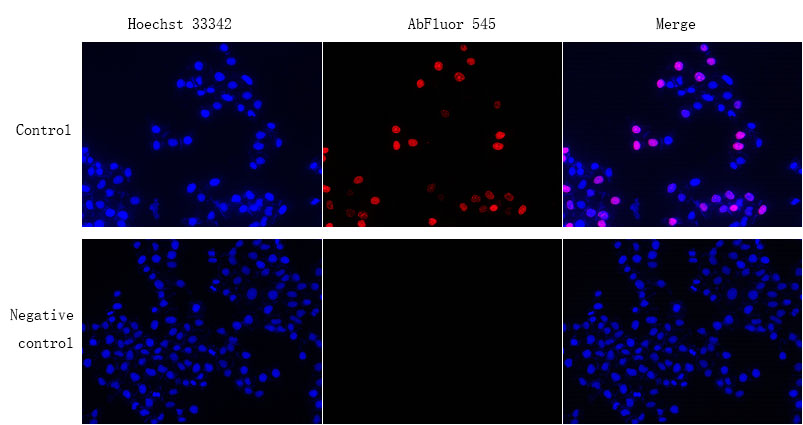
Whether you‘re imaging adherent cells on a coverslip, analyzing suspension cells by flow cytometry, or sectioning in vivo tissue samples, KTA2031 adapts to your workflow[reference:7]. The kit includes everything you need: EdU (10 mM), Permeabilization Reagent, BSA Wash Solution (5×), AbFluor 545 azide, Reaction Buffer (10×), Copper Reagent, Reducing Agent, Hoechst 33342 (1000×), and Hydroxyurea for negative control[reference:8]. A detailed flow chart and operation tutorial video are included—so even first-time users get it right[reference:9].
43 Publications and Climbing
The scientific community has validated KTA2030 (green) in 40+ publications—and KTA2031 (orange) is following the same trajectory, already cited in 43 publications[reference:10]. Researchers are using it to study everything from cardiac fibrosis to cancer cell proliferation[reference:11]. When your proliferation data needs to withstand peer review, this is the kit that delivers.
Who Needs This Kit?
- Cancer researchers tracking tumor cell proliferation
- Stem cell biologists monitoring differentiation and expansion
- Toxicologists assessing compound effects on cell division
- Neuroscientists studying neurogenesis
- Immunologists measuring T cell expansion
🔗 Reference Link: https://www.abbkine.com/product/edu-cell-proliferation-image-flow-cytometry-assay-kit-orange-fluorescence-kta2031/





