




KTA2010 Green Fluorescence One-step TUNEL Kit – Low-Background DNA Fragmentation Staining for Cells & FFPE Tissue Sections
Why Traditional Multi-Step TUNEL Kits Fail Publication Standards
Apoptosis detection via TUNEL staining is a core experiment for oncology and neurodegeneration research, but classic multi-component kits create constant experimental obstacles. Long incubation cycles, excessive repeated washing steps and severe non-specific background signals in paraffin tissue slices often produce fuzzy fluorescence images unable to pass journal reviewer inspection. Most older kits require separate preparation of TdT enzyme and labeling solution, extending operation time and increasing artificial errors during repeated liquid transfer. For limited precious samples such as postmortem brain tissue and mini organoid slices, high background staining forces researchers to repeat staining experiments repeatedly and waste valuable specimens.
Exclusive One-Step Labeling Mechanism of KTA2010
Abbkine KTA2010 integrates TdT enzyme and green fluorescent dUTP labeling mix into a unified ready-to-use working solution, removing separate reagent mixing steps completely. Terminal deoxynucleotidyl transferase specifically marks the 3′-hydroxyl terminals of DNA double-strand breaks generated during apoptosis, without cross-binding to necrotic DNA or intracellular RNA. Its fluorescence spectrum (Ex/Em=490 nm/520 nm) perfectly matches the widely used FITC channel, supporting seamless co-staining with DAPI nuclear dye for clear cell localization analysis in both cell slides and tissue slices.
Complete Supporting Reagents for Multi-Type Biological Samples
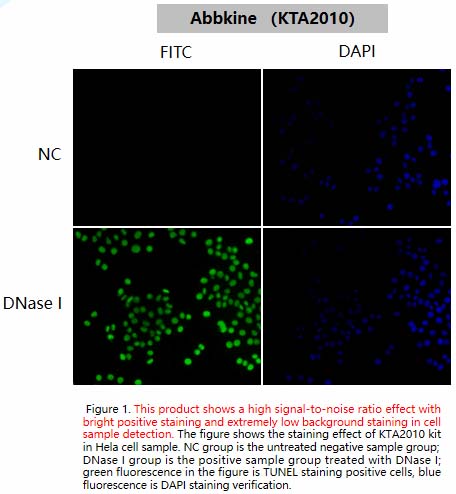
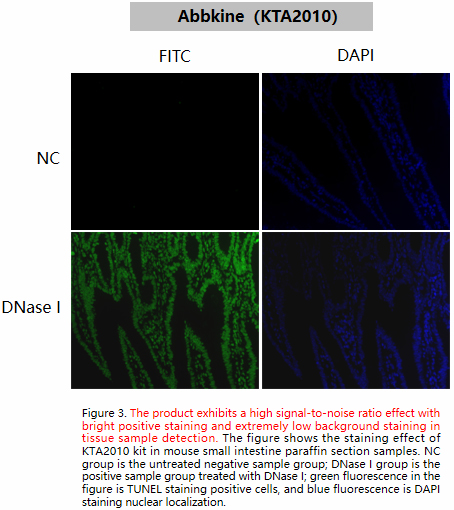
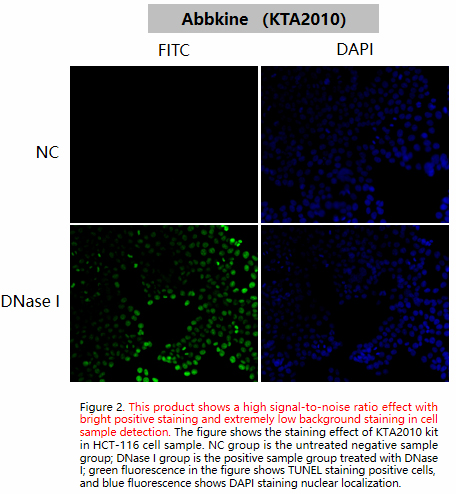
This kit provides a full matching reagent system covering all pretreatment and staining steps for cell slides and FFPE tissue sections: TdT Enzyme, 5× Equilibration Buffer, Green Label Mix, DAPI counterstain, Proteinase K, DNase I positive control reagent and tissue autofluorescence quencher. The included tissue anti-background reagent effectively suppresses inherent fluorescence interference in paraffin slices, delivering bright positive apoptotic signals with ultra-low background as validated in HeLa cell and mouse intestinal paraffin section imaging data.
Multi-Instrument Compatibility & Long-Term Reagent Stability
KTA2010 can be detected via three mainstream lab devices: fluorescence microplate readers, upright fluorescence microscopes and flow cytometers, expanding its application range from static tissue imaging to high-throughput quantitative apoptosis statistics. All reagents maintain stable enzyme activity for at least 12 months at -20°C after shipment; once opened, separate components can be stored according to attached material instructions for long-term repeated use. Over 34 published academic papers have cited this kit for neurodegeneration and tumor apoptosis research.
Safety & Mandatory Experimental Operation Reminders
The reaction equilibration buffer contains highly toxic cacodylate and cobalt chloride. All operators must wear nitrile gloves during operation and flush skin contact areas with large amounts of clean water immediately. Do not eat, drink or smoke while handling toxic reagents. The kit is limited to basic life science research and cannot be deployed for clinical diagnosis of human diseases. All staining steps must strictly follow the detailed protocol enclosed in each kit package.
Product Link: https://www.abbkine.com/product/one-step-tunel-apoptosis-assay-kit-green-fluorescence-kta2010/





