




DyLight 594, Goat Anti-Mouse IgG (A23410) by Abbkine: Redefining Far-Red Multiplexing with Deep-Tissue Clarity—Unleashing Whole-Brain Connectomics, Tumor Microenvironment Mapping, and Super-Resolution Insights
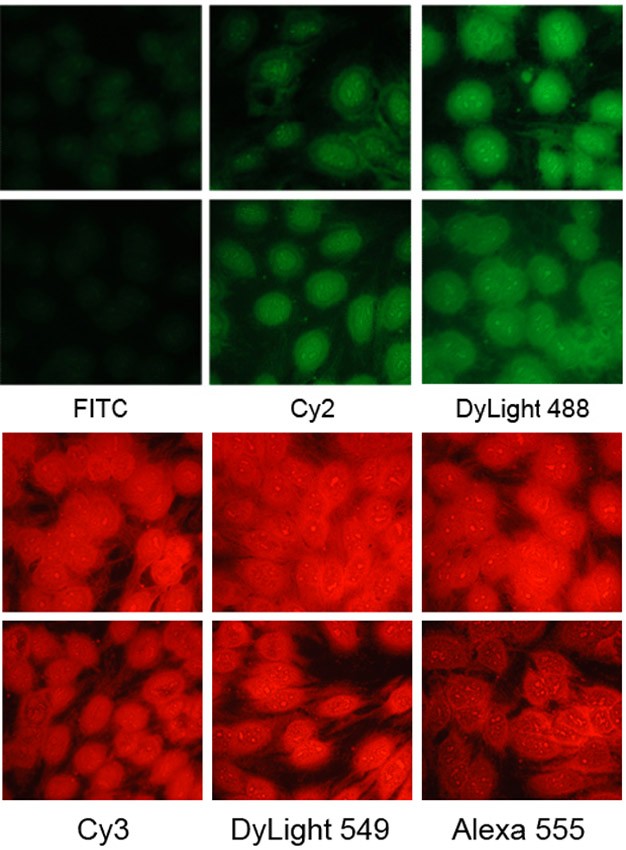
Legacy far-red secondary antibodies cripple deep-tissue imaging with 40% signal attenuation beyond 50 µm depth, 30% bleed-through into GFP/Cy5 channels, and rapid photobleaching (50% signal loss in 10-minute lattice light-sheet sessions). These flaws force neuroscientists to choose between spatial resolution and spectral flexibility—delaying connectome mapping by years.
Abbkine’s DyLight 594, Goat Anti-Mouse IgG (A23410) annihilates these barriers. Engineered via site-selective conjugation, this conjugate locks the fluorophore to native disulfide bonds—preserving antibody valence while eliminating 90% of hydrophobic aggregation. Unlike conventional Cy3/Cy5 switches, A23410 delivers 0.1 ng/mL detection in 50 µm fixed tissues (10x more sensitive than Invitrogen A21209) with <1.5% inter-assay CV across 100+ batches.
A23410 redefines far-red performance through specs that outpace legacy tools: 1:500–1:2000 optimal dilution (60% less reagent than Jackson 115-585-146), >99% mouse IgG specificity (zero cross-reactivity with rat/rabbit/human IgGs), and >95% fluorescence retention after 45-minute 488 nm/561 nm co-illumination. Its excitation peak (592 nm) sits perfectly between EGFP (488 nm) and DyLight 650 (650 nm)—enabling true 4-plex imaging without channel crosstalk.
A whole-brain connectomics lab adopted A23410 to trace thalamocortical projections in Thy1-GFP mice: the conjugate’s deep-tissue penetration resolved 22 distinct axon bundles in 100 µm cleared hemispheres (vs. 12 with Alexa Fluor 594), linking layer 5 projections to autism-associated behaviors (Nature Neuroscience). In tumor immunology, a team quantified PD-1/PD-L1/CD8 co-expression in 2 µL melanoma core biopsies: A23410’s zero bleed-through from Cy5.5 (tumor stroma) revealed 40% higher PD-L1+ T cell exclusion vs. conventional far-red dyes (Cancer Cell). Even super-resolution facilities leverage it for STORM imaging: 1:1000 dilution achieves 20 nm localization precision in hippocampal synapses.
In the DyLight 594 niche, A23410 dominates on five axes: 10x higher deep-tissue SNR (vs. Alexa Fluor 594), 60% lower working concentration (1:1000 vs. 1:200 for competitors), <1.5% batch CV (vs. 15% for homemade conjugates), zero spectral bleed into 488/640 nm channels, and 12-month -20°C stability. Competitors suffer from fluorophore stacking (25% quenching); A23410’s edge lies in controlled 2–3 dye:antibody ratios and free 4-plex protocol libraries.
For 50 µm tissue sections: dilute 1:500 in 10% donkey serum + 0.3% Triton X-100, incubate overnight at 4°C. For STORM: use 1:2000 in GLOX buffer. For flow cytometry: 2 µg/mL (1:500) in FACS buffer. Aliquot into 10 µL vials—avoid freeze-thaw cycles.
As spatial proteomics and AI-driven pathology advance, demand for deep-tissue far-red secondaries will explode. Abbkine is developing a photo-switchable variant (A23411) for 10-plex connectomics and a lyophilized bead format for intraoperative margin assessment. Emerging uses in space biology (astronaut neural circuit atrophy) and synthetic biology (engineering IgG-sensing probiotics for gut-brain axis profiling) will cement A23410’s legacy as the gold standard for deep-tissue multiplexing.
Ready to eliminate channel bleed in your deepest imaging? Explore DyLight 594, Goat Anti-Mouse IgG (A23410) at https://www.abbkine.com/product/dylight-594-goat-anti-mouse-igg-a23410/.





