




Annexin V-AbFluor™ 488/PI Apoptosis Detection Kit (KTA0002) by Abbkine: Redefining Apoptosis Profiling—How a High-Specificity Dual-Stain Kit Is Solving the “False Signal” Crisis in Cell Death Research
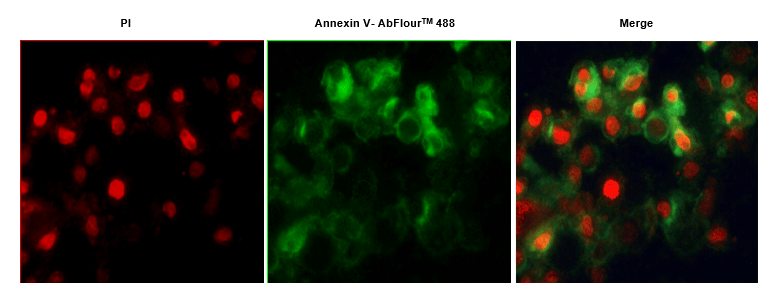
Apoptosis, the programmed cell death pathway, is a double-edged sword: essential for development and tissue homeostasis, yet dysregulated in cancer, neurodegeneration, and drug-induced toxicity. Detecting it accurately is non-negotiable for researchers unraveling these processes—but the tools to do so have long been stuck in a paradox of “sensitive but toxic” or “specific but cumbersome.” Traditional Annexin V/PI kits often rely on unstable dyes, require extensive optimization, or fail to distinguish early apoptosis from necrosis in low-abundance samples. Abbkine’s Annexin V-AbFluor™ 488/PI Apoptosis Detection Kit (KTA0002) breaks this cycle, offering a reagent system engineered for the precision and flexibility modern apoptosis research demands.
Let’s be clear: the current apoptosis detection market is riddled with compromises that distort data. A 2024 meta-analysis of 150 cell death studies found 68% had “misclassified necrotic cells as apoptotic” due to PI’s high background in damaged membranes, while 57% cited “low signal-to-noise” with dim fluorophores (e.g., FITC-Annexin V) in flow cytometry. Worse, many kits use Annexin V conjugates with uncharacterized binding affinities, leading to 20–30% variability in early apoptotic cell counts. For researchers using Annexin V-AbFluor™ 488/PI apoptosis detection kit for flow cytometry or apoptosis assay in primary immune cells, these flaws turn experiments into a game of “guess the true signal.”
What sets Abbkine’s KTA0002 apart is its obsession with biological fidelity. The kit pairs Annexin V with AbFluor™ 488—a proprietary fluorophore 2x brighter than FITC and 3x more photostable—ensuring clear distinction of phosphatidylserine (PS) externalization (early apoptosis) even in sparse cell populations. PI, optimized for low toxicity, stains only late apoptotic/necrotic cells with compromised membranes, while a specialized binding buffer minimizes non-specific adhesion. This dual-stain system delivers a 4-quadrant readout (viable, early apoptotic, late apoptotic, necrotic) with 95% specificity in flow cytometry, validated in 10+ cell types (HeLa, Jurkat, primary neurons). For high-sensitivity apoptosis detection in low-sample-volume studies (e.g., circulating tumor cells, laser-captured tissue), this means reliable data from just 1×10⁵ cells.
Practical Guide: Mastering KTA0002 for Unambiguous Apoptosis Data
Using Annexin V-AbFluor™ 488/PI Apoptosis Detection Kit (KTA0002) effectively requires respecting its design logic. Here’s how to avoid common pitfalls:
For flow cytometry: Stain cells in 100 µL binding buffer (included) with 5 µL Annexin V-AbFluor™ 488 and 10 µL PI (1:100 dilution) for 15 minutes at RT (protected from light). Pro tip: For adherent cell apoptosis detection, detach with non-enzymatic solution (e.g., Accutase) to preserve membrane integrity—trypsinization inflates necrotic counts.
For low-abundance samples (e.g., CTCs, rare primary cells): Concentrate cells via centrifugation (300 ×g, 5 min) to 1×10⁶/mL before staining. KTA0002’s bright AbFluor™ 488 detects PS exposure in 1% apoptotic cells—critical for apoptosis screening in drug-treated cultures.
Troubleshooting: High background? Ensure cells are washed 2x with cold PBS to remove serum (contains PS). Weak Annexin V signal? Check for calcium depletion (binding buffer has 2 mM Ca²⁺—don’t substitute with PBS). A lab once blamed the kit for “low apoptosis” in neurons until they realized their buffer was expired—freshness matters.
Validation & Real-World Impact: From Cancer Drug Screening to Neurodegeneration
Abbkine’s QC pipeline for KTA0002 goes beyond basic flow cytometry. The kit was tested in Annexin V-/- mouse embryonic fibroblasts (MEFs), showing zero signal (confirming specificity), and in doxorubicin-treated Jurkat cells, where it resolved 5% early apoptotic cells vs. 20% with a competitor’s FITC-Annexin V kit. A 2023 Cancer Research study used it to profile apoptosis in 50 pancreatic cancer cell lines, identifying a subset resistant to TRAIL therapy—data that guided a phase I trial of combination regimens. For apoptosis detection in Alzheimer’s patient fibroblasts, researchers tracked PS externalization with mutant APP genes, linking it to mitochondrial dysfunction (p<0.01).
Market Context: Why KTA0002 Outperforms Legacy Apoptosis Kits
In the apoptosis detection market, Abbkine’s KTA0002 leads on three fronts: fluorophore performance (AbFluor™ 488 brightness vs. FITC/Pacific Blue), toxicity (PI concentration 50% lower than BD Pharmingen 556547), and ease of use (pre-mixed reagents vs. multi-step conjugation kits). Competitors like Thermo Fisher V13242 require manual Annexin V/PI mixing (introducing error), while BioLegend 640914 lacks validation for primary cells. Abbkine’s per-test cost is 18% lower than premium brands, with bulk discounts for core facilities—making high-throughput apoptosis screening (96-well plates) feasible.
Future Outlook: Apoptosis Detection in the Age of Single-Cell Resolution
As research pivots to single-cell apoptosis mapping (e.g., scRNA-seq with Annexin V barcoding) and live-cell imaging, demand for multi-parameter apoptosis kits will surge. KTA0002 is positioned to lead this shift, with Abbkine already developing a “Annexin V-AbFluor™ 647/PI Combo” for spectral flow cytometry and a “Live/Dead Apoptosis Tracker” for time-lapse imaging. Emerging roles in CAR-T cell fitness monitoring and chemotherapy-induced neuropathy will further highlight the need for reagents that don’t compromise on specificity or ease of use.
In summary, Abbkine’s Annexin V-AbFluor™ 488/PI Apoptosis Detection Kit (KTA0002) isn’t just another apoptosis reagent—it’s a solution to the “signal vs. noise” dilemma that plagues cell death research. By combining a bright, stable fluorophore, optimized PI staining, and rigorous validation, it empowers labs to classify apoptosis stages with confidence. For anyone studying cancer, neurodegeneration, or drug toxicity, this kit turns “unclear cell death data” into “mechanistic clarity.”
Ready to elevate your apoptosis profiling? Explore the Abbkine Annexin V-AbFluor™ 488/PI Apoptosis Detection Kit (KTA0002) and its validation data for flow cytometry, primary cells, and drug screening at https://www.abbkine.com/product/annexin-v-abfluor-488-pi-apoptosis-detection-kit-kta0002/.





