




Your "Antioxidant" Experiment Just Got Rejected Again? Here's the Quiet Reason Your TAC Data Keeps Failing—and How Abbkine's KTB1500 Finally Makes It Reviewer-Proof
There is a special circle of scientific purgatory reserved for researchers who build an entire oxidative-stress story—neat hypothesis, expensive animal model, beautiful H&E stains—only to watch the reviewer demolish it over "concerns regarding total antioxidant capacity (TAC) quantification methodology." The cruel part? You know TAC matters. It's the single most cited integrative redox metric in the literature: the sum of every small-molecule scavenger (ascorbate, urate, GSH, tocopherols, polyphenols) plus the catalytic antioxidant system (SOD, catalase, GPX contributions funneled through redox cycling). The problem isn't the concept. It's that most labs are still running TAC like it's 1998—hand-mixed iron reagents, ambiguous "TEAC/Trolox" units that don't map cleanly to physiological standards, and zero protection against the metal-chelators and thiols lurking in real biological extracts.
Why "Just Buy Any TAC Kit" Doesn't Save You
Total antioxidant capacity assays live or die by two invisible killers: (1) what the reagent actually responds to, and (2) what's in your sample buffer that shouldn't be there. The FRAP-family principle is elegant—under strictly acidic conditions, sample antioxidants reduce Fe³⁺-tripyridyltriazine (Fe³⁺-TPTZ) to a vivid Fe²⁺-TPTZ blue-purple chromophore, and you read the product at 593 nm on any standard microplate reader. The acid does double duty: it shuts down most endogenous enzymatic interferences and keeps the iron complex stable. But the moment your sample carries EDTA, DTT, β-mercaptoethanol, Tween, Triton X-100, or NP-40, those chelators and reductants hijack the Fe³⁺ pool and your "TAC" number becomes a ghost story.
The second headache is the reference standard. Many kits default to Trolox (a vitamin E analog) because the TEAC literature is deep. But Trolox isn't ascorbate, and ascorbate is the dominant water-soluble antioxidant in many of your real samples (human serum ascorbate ~50–150 µM; plasma urate ~200–400 µM also contributing). Using a poor reference makes your numbers harder to reconcile with clinical/biochemical norms.
Enter CheKine™ Micro Total Antioxidant Capacity (TAC) Assay Kit — KTB1500 (Abbkine)
This kit is purpose-built around the acidic FRAP-aligned colorimetric workflow—but with the three fixes that actually matter for publishable data:
Feature What KTB1500 Delivers
Detection principle Antioxidants reduce Fe³⁺ complex → Fe²⁺-TPTZ → blue chromophore, read at 593 nm
Reference standard Ascorbic acid (Vitamin C) as the supplied positive-control calibrator — a biologically grounded reference instead of a one-size Trolox default
Reaction environment Runs under acidic conditions specifically to suppress endogenous interfering factors that wreck ordinary protocols
Sample types Serum · Plasma (heparin/ citrate — NO EDTA) · tissue / cell lysates · plant tissues · urine · bacterial samples
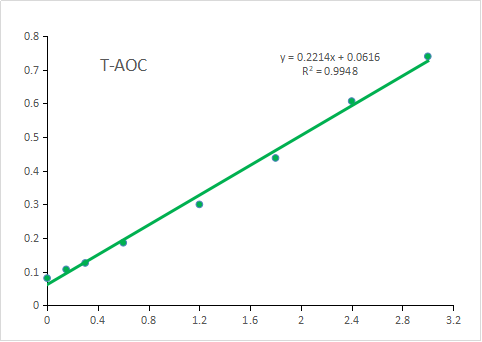
Dynamic range Calibrated across roughly ~0.15–3 mM (expressed as ascorbate equivalents / Fe²⁺ mM-range)
Format Microscale / 96-well plate-friendly; 96 T/96 S and 480 T/480 S sizes available
Storage / ship -20°C, protect from light; shelf ~12 months from receipt; ships blue-ice gel pack
Status For research use only; not for clinical diagnosis
The real value proposition is boring in the best way: the experiment buffer (10X), substrate solution, substrate diluent, and reaction buffer are pre-formulated so the pH / [Fe³⁺-TPTZ] / ionic strength stay locked across every plate you run. That's what turns TAC from a "vibe" into a defensible Methods paragraph.
The Sample Rules That Separate a Paper from a Rewrite
This kit will call you out if your sample prep is sloppy—and that's a good thing:
• 🚫 No EDTA as plasma anticoagulant (EDTA chelates the Fe³⁺ your assay needs). Use heparin or citrate.
• 🚫 No DTT, no β-mercaptoethanol, no Tween, no Triton X-100, no NP-40 in your sample buffer — thiols and detergents act as reductants that bypass your actual biological antioxidants and spike the 593 nm signal.
• Fresh > frozen, but if you must bank: -80°C, ≤ ~1 month, and avoid repeat freeze–thaw.
• Run 2–3 dilutions of every unknown sample type the first time you process it, so you know which dilution lands squarely on the ascorbate standard curve (roughly 0.15–3 mM range).
The workflow itself is the familiar, fast rhythm you want: prep/dilute samples in appropriate buffer → add to plate → add the substrate/reaction mixture → brief incubation at controlled temperature → read A₅₉₃ → interpolate from the ascorbic acid standard curve → express as mM ascorbate equivalents (or per mg protein / per mL / per g tissue as your model demands).
Where KTB1500 Carries Real Papers
Research Context Why TAC (FRAP/593 nm) + Ascorbate Standard Is the Right Fit
NAFLD / metabolic syndrome models Serum/liver TAC drops as redox balance fails; paired with MDA, SOD, GSH-PX it builds an ironclad oxidative-stress panel
Neurodegeneration (AD/PD/Mn exposure) Brain homogenate TAC + protein carbonyls + GSH/GSSG tells a complete redox story reviewers can't poke holes in
Plant stress physiology (drought, salt, heavy metal) Leaf/fruit TAC swings with polyphenol and ascorbate pools; plant-specific extracts integrate neatly into the same 593 nm readout
Nutrition / nutraceutical R&D Juice, tea, botanical extracts—TAC is the headline number; ascorbate-referenced data are easier to benchmark against dietary RDA/intake literature
Drug-toxicity screens (hepato-/nephrotoxicity) Paired with ALT/AST and GSH, TAC gives you the "system-level defense" axis in a 96-well afternoon
A Clean Methods Paragraph You Can Literally Copy-Edit
Total antioxidant capacity (TAC) was measured using a colorimetric FRAP-aligned microplate assay (CheKine™ Micro Total Antioxidant Capacity Assay Kit, KTB1500; Abbkine). Samples were prepared in the provided buffer system, and antioxidants reduced the acidic Fe³⁺-TPTZ complex to the blue Fe²⁺-TPTZ chromophore, detected at 593 nm. Activities were interpolated from a calibration curve generated with the kit-supplied ascorbic acid standard and expressed as mM ascorbate equivalents per mg protein (BCA-normalized) or per g tissue / per mL as indicated.
That one paragraph signals to any reviewer: this lab knows exactly which reagents are on that plate, which interferences were excluded, and what the number actually means.
Explore the CheKine™ Micro Total Antioxidant Capacity (TAC) Assay Kit (KTB1500) details here:
🔗 https://www.abbkine.com/product/chekine-micro-total-antioxidant-capacity-tac-assay-kit-ktb1500/
(For research use only. Not for human clinical diagnostic use. Avoid EDTA-anticoagulated plasma and detergent/thiol-containing buffers per the protocol's interference constraints.)





