




The Forgotten Final Step of Ras Turnover: Why Quantifying PCYOX1 (Prenylcysteine Oxidase 1) Opens a New Window Into Isoprenoid Metabolism, Atherothrombosis, and Statin-Era Signaling
Everyone who works on small G-proteins knows the headline: HMG-CoA reductase → mevalonate → farnesyl pyrophosphate (FPP) → geranylgeranyl pyrophosphate (GGPP) → protein prenylation (farnesylation/geranylgeranylation of Ras, RhoA, Rac1, Rab, Gγ subunits) that locks them to membranes where they switch on growth, motility, and survival. But almost nobody asks what happens to those covalent lipid anchors after the protein gets ubiquitinated, unfolded, and chopped up by the proteasome or lysosome. The answer is: you get free prenylcysteines (e.g., S-farnesyl-L-cysteine, S-geranylgeranyl-L-cysteine) that are still biologically active, still membrane-interacting, and — if not cleaned up — can mess with cellular signaling by acting as retrograde isoprenoid messengers or by feeding back on the prenylation system. The enzyme that closes this loop is Prenylcysteine Oxidase 1 (PCYOX1, aliases PCL1 / KIAA0908), a FAD-dependent lysosomal flavoprotein (EC 1.8.3.5, UniProt: Q9UHG3) that cleaves the thioether bond of those free prenylcysteines to yield free L-cysteine + a hydrophobic isoprenoid aldehyde + H₂O₂, neutralizing their biological activity and completing prenylated-protein turnover. The Human Prenylcysteine Oxidase 1 (PCYOX1) ELISA Kit (KTE61281) from Abbkine is the tool that finally lets you measure this "final-step scavenger" as a calibrated sandwich-ELISA variable, rather than leaving it as a footnote in your Ras/prenylation Western.
PCYOX1 in One Paragraph: A Lysosomal FAD Enzyme That Mops Up After the Proteasome
PCYOX1 (Gene ID: 51449, 2p13.3, ~505–526 aa precursor, mature ~55–67 kDa depending on isoform and SDS behavior) is the only known mammalian enzyme that degrades free prenylcysteines by oxidative thioether cleavage:
Prenyl–S–CH₂–Cys + O₂ + H₂O → isoprenoid aldehyde + L‑Cys + H₂O₂
Key mechanistic facts that define its biological niche:
• It is only active on FREE prenylcysteines, not when the cysteine is still tethered inside an intact protein/peptide — so PCYOX1 operates after the prenylated protein has already been unfolded/degraded by proteasomal or lysosomal proteases.
• It is an FAD-dependent oxidoreductase (flavoprotein), localized predominantly to lysosomes, and it sits at the intersection of isoprenoid catabolism, lipid antioxidant balance (via H₂O₂ production), and prenylation homeostasis.
• It is widely expressed — highest in fat (RPKM 61), kidney (50), liver, brain — the very tissues that dominate mevalonate flux, statin sensitivity, and lipoprotein-associated oxidative stress.
Why You Should Care About a "Prenylcysteine Scavenger" — The Biology It Ties Together
- The Ras / Rho prenylation cycle finally gets a catabolic readout
The prenylation field spends enormous effort on FTase/GGTase, Rab escort, CaaX proteases, and ICMT (isoprenylcysteine carboxyl methyltransferase). But the terminal disposal step — is PCYOX1 keeping free farnesyl/geranylgeranyl-cysteine levels in check? — is rarely measured. If PCYOX1 drops, free prenylcysteines can:
• Accumulate and interfere with membrane association of other proteins
• Feed isoprenoid-derived bioactive metabolites that influence calcium handling and redox
• Potentially blunt or exacerbate the pleiotropic effects of statins (which lower FPP/GGPP upstream)
Quantifying PCYOX1 protein gives you the "cleanup capacity" term of the equation — something a p-ERK or Ras-membrane blot can't tell you.
- Atherothrombosis & lipoprotein-associated oxidation (the surprise hit)
A striking in vivo paper (PMC8911005) showed Pcyox1−/− mice had delayed carotid thrombus formation (FeCl₃ model), reduced platelet/leukocyte aggregates, and impaired ADP/TRAP-induced aggregation — with normal blood counts and coagulation factors, pointing to a secreted/systemic PCYOX1-linked metabolite axis affecting platelet reactivity. The authors note PCYOX1 is also described as "the only lipoprotein-associated pro-oxidative enzyme" in some contexts — placing it at the crossroads of atheroprogression, oxidized lipoprotein biology, and thrombosis.
- Statin side-effect biology & mevalonate pathway flux
Statin myopathy, CNS effects, and the "statins work partly via prenylation suppression" debate all hinge on isoprenoid intermediate availability. PCYOX1 level is a proxy for how actively a cell/tissue is processing the waste stream of prenylated proteins — a dimension of the pathway that's invisible if you only measure HMGCR, LDL-R, or p-Akt.
Why a Sandwich ELISA — And Why PCYOX1 Is Harder Than It Looks
PCYOX1 is a lysosomal FAD flavoprotein with a conserved flavin-binding domain + prenylcysteine-lyase domain — it's not a secreted cytokine, and it doesn't float in the medium waiting to be caught. Your signal lives in:
• Tissue homogenates (liver, kidney, fat, brain, artery wall)
• Cell lysates (often in a lysosome-enriched/membrane-particulate fraction)
• Potentially in circulation at very low levels (as exosomal/microsomal shed or proteolytic fragment — strictly exploratory)
That means the kit needs two independent anti-PCYOX1 epitopes to be trustworthy, and your prep needs to respect that PCYOX1 isn't a soluble cytosolic housekeeper. The KTE61281 sandwich ELISA delivers exactly this:
- Microplate pre-coated with capture anti-PCYOX1.
- Standards (recombinant human PCYOX1) + samples (serum, plasma, tissue homogenates, cell lysates, other biological fluids) added → PCYOX1 binds.
- Wash → biotinylated anti-PCYOX1 detection Ab (different epitope) → Streptavidin–HRP → TMB → 450 nm.
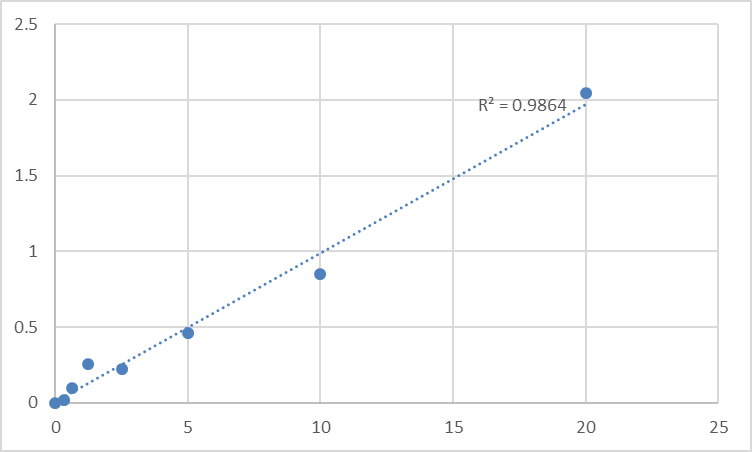
- Interpolate PCYOX1 concentration from the standard curve.
Consolidated performance envelope from distributor/technical listings aligned with this kit:
Parameter Typical KTE61281-class Specification
Target Human PCYOX1 / PCL1 / KIAA0908 (UniProt Q9UHG3, Gene ID 51449)
Format 96-well sandwich ELISA, pre-coated capture
Detection Biotin-Ab → SA-HRP → TMB, read 450 nm
Dynamic Range 0.313 – 20 ng/mL (equivalently 31.25 – 2000 pg/mL)
Sensitivity / LOD 0.118 – 0.16 ng/mL (118–160 pg/mL)
Intra-Assay CV < 8–10%
Inter-Assay CV < 10–15%
Specificity No significant cross-reactivity with other lysosomal proteins/similar structures
Samples Serum, plasma, tissue homogenates, cell lysates, culture supernatants
Assay time ~3–5 hours
(Always confirm exact range, dilution scheme, and lot-specific recovery on the Abbkine datasheet/CoA.)
Where Quantifying PCYOX1 Actually Advances the Story
- Mevalonate pathway & statin/isoprenoid rescue experiments
If your experiment involves lovastatin/simvastatin + GGPP/FPP rescue, or NLrx-1/mevalonate kinase perturbations, PCYOX1 in liver or macrophage lysates (normalized to mg total protein, BCA) gives you a catabolic-capacity readout: is the cell simply making fewer prenyl-proteins, or is it also changing how fast it clears the prenylcysteine waste?
- Atherosclerosis & platelet-reactive metabolite studies
Following up on the Pcyox1/thrombosis axis: quantify PCYOX1 in arterial plaque homogenates, macrophage lysates, or (exploratorily) platelet-poor plasma/serum to ask whether its oxidative disposal of prenylcysteines modulates the lipid-mediator environment that primes platelets.
- Ras-driven cancer models & prenylation-targeted therapy
FTI (farnesyltransferase inhibitor) resistance often reroutes Ras through geranylgeranylation (GGTase I). Tracking PCYOX1 protein alongside FTase/GGTase activity proxies or ICMT/Rep1 gives you the disposal side of the ledger — and a rationale for why certain cells accumulate bioactive prenyl-lipids even when new prenylation is partially blocked.
- Lysosomal storage & lipid catabolism crosstalk
Because PCYOX1 is lysosomal and FAD-linked, its levels can shift in models of lysosomal stress, TFEB/TCF1 nuclear translocation, cholesterol loading, and NPC1/2 disease — contexts where "isoprenoid waste" handling is rarely measured but mechanistically relevant.
- CRISPR / siRNA validation
Knockdown or edit PCYOX1? Report % PCYOX1 protein remaining ± SEM from a calibrated curve, normalized to mg total protein (BCA) and, if possible, a lysosomal marker (LAMP1/LAMP2). Don't let the "obscure enzyme" status tempt you into a single "band vs. housekeeping" photo.
A Minimal Prep Note (PCYOX1 Is Particulate — Treat It Like Lysosomal Membrane-Adjacent Protein)
• For tissues (liver/kidney/artery/fat): homogenize cold in 250 mM sucrose / 10 mM Tris pH 7.4 + protease inhibitors → differential spin → your post-nuclear 12,000–16,000 ×g pellet is already a good starting point for a PCYOX1-enriched read; lyse/solubilize gently in 0.5–1% Triton X-100 / 150 mM NaCl, clarify, keep cold.
• For cultured cells: lyse in RIPA or 0.5% NP-40 Tris-saline + inhibitors, spin 14,000 ×g 15 min, use supernatant.
• BCA → express as ng PCYOX1 / mg total protein.
• Warm kit reagents to RT ≥ 30 min, protect TMB from light, stop uniformly, read 450 nm promptly, and run the full standard curve on every plate — lysosomal-enzyme recovery varies with prep, and the curve is your insurance.
The Bottom Line
PCYOX1 is the FAD-dependent lysosomal scavenger that finishes the job Ras starts: it chops up free farnesyl/geranylgeranyl-cysteine so those sticky isoprenoid tails can't linger and confuse the membrane system. That makes it a quiet but essential node in mevalonate pathway homeostasis, atherothrombotic lipid oxidation, and the "waste-stream" side of prenylation biology that most Ras/prenylation papers pretend doesn't exist. The Human Prenylcysteine Oxidase 1 (PCYOX1) ELISA Kit — KTE61281 from Abbkine gives you a way to measure it properly: pre-coated capture → biotin detection → HRP–TMB → 450 nm → ng/mL, in a 0.313–20 ng/mL working range, with LOD in the ~0.12–0.16 ng/mL bracket — so the least famous step of your isoprenoid pathway finally has a number you can defend.
Product Reference: KTE61281 – Human Prenylcysteine Oxidase 1 (PCYOX1) ELISA Kit
Learn more and order: https://www.abbkine.com/product/human-prenylcysteine-oxidase-1-pcyox1-elisa-kit-kte61281/
(For Research Use Only; not for diagnostic procedures in humans.)





