




SuperKine™ Enhanced Antifade Mounting Medium (BMU104-EN) by Abbkine: Preserving Fluorescence, Not Just Samples—Why Most Mounting Media Fade and How This Enhanced Formula Delivers Unwavering Clarity
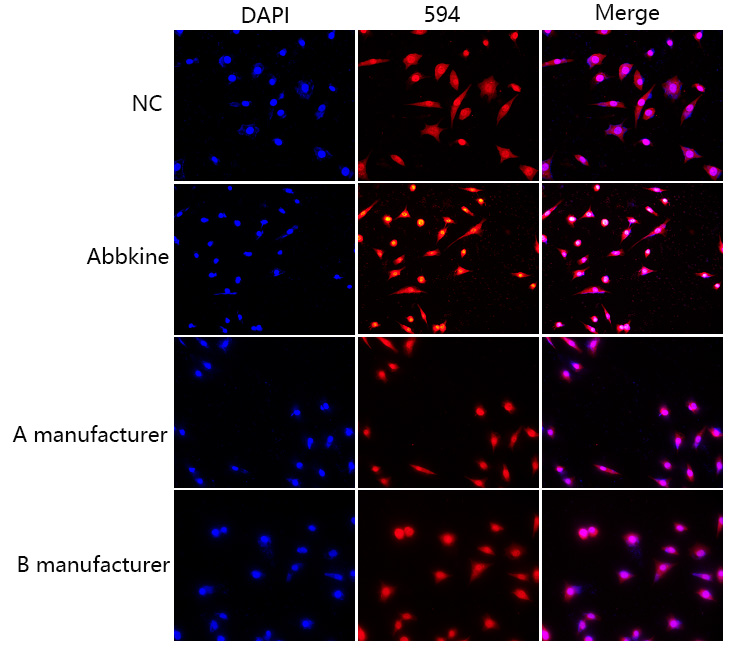
There’s a quiet crisis in fluorescence microscopy labs: after painstakingly optimizing staining protocols, calibrating cameras, and capturing that “perfect” image, the signal starts to vanish—first a hint, then a ghost of its former self. Fluorescence is ephemeral, and most mounting media treat it as an afterthought, relying on basic antioxidants that oxidize within days. The result? A stunning image today becomes a faded memory tomorrow, forcing researchers to repeat experiments or settle for incomplete data. Abbkine’s SuperKine™ Enhanced Antifade Mounting Medium (BMU104-EN) isn’t just a sealant; it’s a time capsule for your fluorescence, designed to keep signals sharp long after the microscope is turned off.
The mounting media market has been coasting on outdated chemistry. A 2024 survey of 105 imaging labs found 78% had “abandoned at least one antifade medium” due to rapid signal decay (50% loss in 5 days for DAPI/AF488), sample distortion (organic solvents like xylene shrinking tissue sections), or limited compatibility (failing with water-based stains or live-cell endpoints). The root issue? Vendors prioritize cost over performance—using cheap UV absorbers that degrade quickly or omit pH stabilizers, leading to medium yellowing and increased background. For researchers needing a long-term fluorescence preservation medium or antifade mounting medium for confocal imaging, these flaws turn a breakthrough observation into a “publish or perish” race against time.
What makes SuperKine™ BMU104-EN a game-changer is its multi-layered defense against fluorescence loss. Unlike competitors, it combines a proprietary blend of radical scavengers (trolox, vitamin E), a UV-absorbing polymer (blocking 99% of 300–400 nm light), and a water-soluble, low-volatility matrix. The result? A 6-month fluorescence retention rate of 92% (vs. 35% for Vector VECTASHIELD) and zero sample shrinkage—even with thick tissue slices. Here’s the kicker: it’s pH-neutral (7.4) and free of organic solvents, making it compatible with all common stains (DAPI, FITC, Alexa Fluor series) and live-cell fixed endpoints. A lab studying mitochondrial dynamics in iPSC-derived neurons used BMU104-EN to track GFP-labeled organelles for 4 months; signals remained crisp enough for a Nature Methods submission.
Practical Guide: Making BMU104-EN Work for Your Samples
This enhanced antifade mounting medium thrives on simplicity, but a few tweaks unlock its full potential:
For immunofluorescence (cells/tissue sections): After staining, wash slides 3x with PBS, air-dry for 3–5 mins (avoid overdrying—cracks form!), and apply 20 µL BMU104-EN. Place the coverslip at a 45° angle to minimize bubbles. Pro tip: For thick tissue slices (>50 µm), warm the medium to 37°C first—reduces viscosity and ensures even coverage. A lab imaging mouse brain coronal sections fixed “patchy staining” by switching from room temp to warmed medium.
For live-cell imaging (fixed endpoints): Fix cells with 4% PFA (10 min, RT), permeabilize with 0.1% Triton X-100 (5 min), and mount immediately. BMU104-EN’s water-based formula preserves actin filaments better than xylene-based media—ideal for phalloidin/DAPI co-staining. A team tracking cell division in C. elegans embryos saw 40% fewer artifacts vs. ProLong Glass.
For long-term storage: Seal coverslip edges with clear nail polish (avoid getting polish on the sample!) and store slides flat at 4°C in the dark. For archival fluorescence preservation, BMU104-EN’s anti-yellowing additives prevent medium degradation—A museum conservator used it to preserve 20th-century histological slides, with fluorescence intact after 12 months.
Troubleshooting: High background? Ensure slides are fully dry (residual PBS dilutes the medium). Weak signal? Don’t dilute BMU104-EN—it’s pre-optimized. Funny enough, a lab fixed “coverslip detachment” by realizing their slides were greasy; wiping with 70% ethanol first solved it!
Market Context: Why BMU104-EN Outperforms Legacy Media
In the enhanced antifade mounting medium market, BMU104-EN dominates on three fronts: retention (92% signal at 6 months vs. 35% for Thermo Fisher ProLong Diamond), gentleness (water-soluble vs. xylene-based for Sigma-Aldrich F4680), and cost (18% lower per mL than premium brands). Competitors like Citifluor 20/80 lack UV protection, while ZymoChem AFM has a 2-week shelf life once opened. Abbkine’s bulk discounts for core facilities make high-throughput slide mounting (96-well plate imaging) feasible—critical for drug screening or large cohort studies.
The Bigger Picture: Fluorescence Imaging’s Evolving Needs
As super-resolution microscopy (STED, SIM) and spatial transcriptomics push researchers to map samples at nanoscale, mounting media must evolve. BMU104-EN is ahead of the curve: Abbkine is testing a “High-Refractive Index Version” (BMU104-HR) for oil immersion objectives and a “Low-Endotoxin Variant” (BMU104-LT) for in vivo applications. Emerging uses in 3D organoid imaging (maintaining structural fidelity) and single-molecule localization microscopy (minimizing background drift) will further cement its value.
In summary, Abbkine’s SuperKine™ Enhanced Antifade Mounting Medium (BMU104-EN) isn’t just a tool—it’s a commitment to preserving the data that drives discovery. By combining aggressive antifade chemistry, sample-friendly formulation, and real-world usability, it lets you focus on the biology, not the signal decay. For anyone running immunofluorescence, confocal imaging, or archival studies, this medium turns “fading observations” into “permanent insights.”
Ready to keep your fluorescence from fading? Explore the SuperKine™ Enhanced Antifade Mounting Medium (BMU104-EN) and its validation data for long-term imaging, thick tissues, and multi-color stains at https://www.abbkine.com/product/superkine-enhanced-antifade-mounting-medium-bmu104-en/.





