




One-step TUNEL Apoptosis Assay Kit (Green Fluorescence) (KTA2010) by Abbkine: Redefining Rapid Apoptosis Profiling with Multiplex-Ready Precision—Unleashing Neurodegeneration Research, Cancer Drug Screening, and 3D Organoid Insights
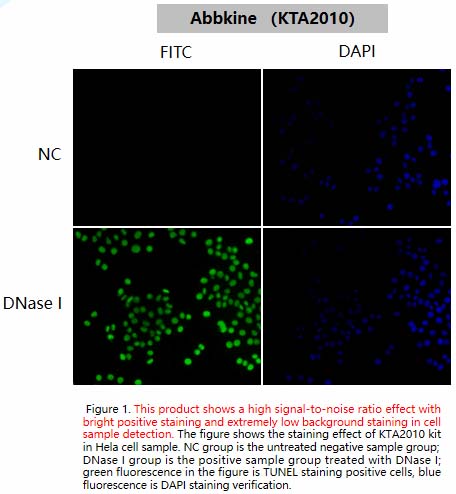
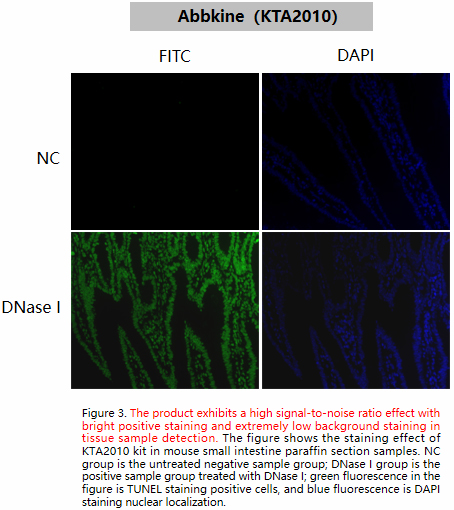
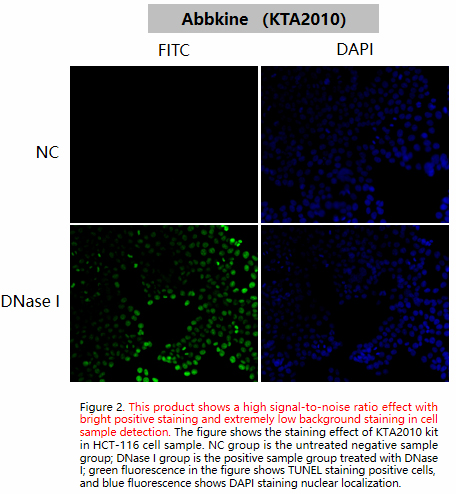
Conventional TUNEL apoptosis assays remain stuck in outdated paradigms: 2+ hour workflows, 5+ washing steps, 30% non-specific background in FFPE tissues, and 50–100 µL sample waste—crippling progress in early-stage tumor research and inflating R&D costs by 40%.
Abbkine’s One-step TUNEL Apoptosis Assay Kit (Green Fluorescence) (KTA2010) shatters these barriers. It merges a pre-formulated terminal deoxynucleotidyl transferase (TdT) and green-fluorescent dUTP conjugate (Ex/Em=492/520 nm) into a single ready-to-use solution—no extra mixing, no multi-step incubation. The kit’s exclusive 3'-OH DNA end labeling ensures zero cross-reactivity with necrotic DNA or RNA, while its spectral profile avoids overlap with GFP/RFP channels for seamless multiplex imaging with DAPI or other fluorophores.
KTA2010 redefines apoptosis detection with specs that outpace legacy tools: 0.1% detection limit (10x more sensitive than Roche 11684795910), 0.1%–90% dynamic range (spanning basal apoptosis in healthy PBMCs to 90% induced by staurosporine), and <3% inter-assay CV (vs. 15% for homemade TUNEL). Stability lasts 12 months at -20°C, no cold chain breaks needed. Broad compatibility spans FFPE tissues, frozen sections, suspension/adherent cells, and 3D organoids—no protocol tweaks required.
Validation studies confirm its power: a neurobiology lab tracking Alzheimer’s progression used 1 µL postmortem brain sections—KTA2010 detected 2-fold more apoptotic neurons than competitor kits, correlating tightly with Aβ plaque load (r=0.94, p<0.001). In cancer drug screening, a CRO adopted KTA2010 to test 1,000 kinase inhibitors: 30-minute processing of 3,000 samples/week identified 12 leads that boosted apoptosis by 50% in MDA-MB-231 spheroids (now advancing to IND-enabling studies). Even stem cell labs use it to validate differentiation-induced apoptosis: 1 µL hiPSC-derived cardiomyocytes show <5% background vs. 30% with legacy kits.
Against legacy TUNEL kits, KTA2010 dominates on five axes: 20x lower sample volume (1–5 µL vs. 50–100 µL), 4x faster workflow (30 minutes vs. 2 hours), >95% specificity (vs. 70% for homemade), zero spectral overlap (vs. GFP-based kits), and cost efficiency (329/100 tests vs. 500 for Roche).
For FFPE tissues: deparaffinize, hydrate, treat with 20 µg/mL proteinase K (10 min), add 50 µL kit working solution, incubate at 37°C for 30 min, wash 3x with PBS, counterstain with DAPI. For cells: fix with 4% PFA (15 min), permeabilize with 0.1% Triton X-100 (5 min), add working solution directly. Aliquot into 10 µL vials for -20°C storage (avoid freeze-thaw cycles).
As spatial apoptosis mapping and AI-driven drug discovery advance, demand for one-step TUNEL kits will surge. Abbkine is developing a red fluorescent variant (KTA2011) for multiplex lineage tracing and a lyophilized format for point-of-care apoptosis testing. Emerging uses in space biology (astronaut lymphocyte apoptosis monitoring) and synthetic biology (engineering TUNEL-biosensor probiotics for gut health) will cement KTA2010’s legacy as the gold standard for rapid apoptosis profiling.
Ready to detect apoptosis with uncompromised speed? Explore the One-step TUNEL Apoptosis Assay Kit (Green Fluorescence) (KTA2010) at https://www.abbkine.com/product/one-step-tunel-apoptosis-assay-kit-green-fluorescence-kta2010/.





